
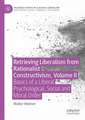
Retrieving Liberalism from Rationalist Constructivism, Volume I: Palgrave Studies in Classical Liberalism
Autor Walter B. Weimeren Limba Engleză Hardback – 8 mai 2022
This book draws out the differences between the classical liberalism dependent upon spontaneous and tacit ordering as a result of evolution, and the explicit or conscious or directed version of progressivism. It shows that the most important recent developments in the philosophy of rationality and the methodology of scientific research, as well as in evolutionary epistemology and the philosophy of biology, actually stem from the theories of complex social organization of the moralists such as Hume, Ferguson, and Smith. The book shows clearly that classical liberalism was never refuted—indeed, no attempt to do so has been offered—it has simply been ignored in favour of programs which sound beneficial and soothing but which cannot be instituted without returning to tribalism.
Din seria Palgrave Studies in Classical Liberalism
- 18%
 Preț: 928.66 lei
 - 18%
 Preț: 761.34 lei
 - 15%
 Preț: 722.14 lei
 - 15%
 Preț: 728.32 lei
 - 15%
 Preț: 618.37 lei
 -
 Preț: 372.55 lei
 - 15%
 Preț: 676.88 lei
 - 15%
 Preț: 407.81 lei
 -
 Preț: 406.95 lei
 - 15%
 Preț: 610.02 lei
 - 15%
 Preț: 672.99 lei
 - 18%
 Preț: 754.93 lei
 - 15%
 Preț: 692.98 lei
 - 15%
 Preț: 562.35 lei
 -
 Preț: 504.10 lei
 - 15%
 Preț: 672.12 lei
 - 15%
 Preț: 545.20 lei
 - 15%
 Preț: 722.51 lei
 - 15%
 Preț: 668.81 lei
 - 18%
 Preț: 697.89 lei
 - 15%
 Preț: 483.62 lei
 - 15%
 Preț: 616.45 lei
 - 15%
 Preț: 619.05 lei
 - 15%
 Preț: 666.78 lei
 - 18%
 Preț: 1036.81 lei
 - 15%
 Preț: 662.29 lei
 - 18%
 Preț: 752.41 lei
 - 15%
 Preț: 670.90 lei
 - 15%
 Preț: 723.82 lei
 - 15%
 Preț: 672.76 lei
 - 18%
 Preț: 928.89 lei
 -
 Preț: 465.05 lei
 - 15%
 Preț: 721.58 lei
 -
 Preț: 245.50 lei
Preț: 926.75 lei
Preț vechi: 1130.18 lei
-18%
Puncte Express: 1390
Carte tipărită la comandă
Livrare economică 08-22 decembrie
Livrare prin curier în România Termenul estimat este afișat lângă disponibilitate.
Transport gratuit pentru acest produs Plată online sau ramburs, în funcție de opțiunile comenzii.
Retur gratuit în 14 zile Comandă securizată și suport în română.
Specificații
ISBN-13: 9783030948573
ISBN-10: 3030948579
Pagini: 340
Ilustrații: XXI, 316 p. 1 illus.
Dimensiuni: 153 x 216 x 23 mm
Greutate: 0.51 kg
Ediția:1st ed. 2022
Editura: Palgrave MacMillan
Colecția Palgrave Studies in Classical Liberalism
Seria Palgrave Studies in Classical Liberalism
Locul publicării:Cham, Switzerland
ISBN-10: 3030948579
Pagini: 340
Ilustrații: XXI, 316 p. 1 illus.
Dimensiuni: 153 x 216 x 23 mm
Greutate: 0.51 kg
Ediția:1st ed. 2022
Editura: Palgrave MacMillan
Colecția Palgrave Studies in Classical Liberalism
Seria Palgrave Studies in Classical Liberalism
Locul publicării:Cham, Switzerland
Cuprins
Chapter 1: Introduction.- Chapter 2: The history of the conflict: from the Greeks to the Middle Ages.- Chapter 3: The history of the conflict: Descartes, the Enlightenment, and positivism.- Chapter 4: History rewritten: the 20th century constructivist interpretation of classic liberalism.- Chapter 5: The new enlightenment: Russell on organization and socialism.- Chapter 6: The new enlightenment: Chomsky on Cartesian linguistics and anarchist socialism.- Chapter 7: The new enlightenment: Skinner and the search for system.- Chapter 8: The new enlightenment: The abandoned road.- Chapter 9: Rationalist constructivism in protest song rhetoric.- Chapter 10: Retrieving history: liberalism and the study of spontaneous social orders.- Chapter 11: Retrieving history: the legacy of David Hume.- Chapter 12: Toward a rational theory of tradition: order, knowledge, tradition.- Chapter 13: Toward a rational theory oftradition: methodological and conceptual issues.
Textul de pe ultima copertă
This first volume, History and its Betrayal, traces the development of major themes of liberalism from the increase in human population beyond the limits of the face-to-face society of tribalism and small groups up until the present day. It shows that the principles underlying liberalism are the evolutionary development of social organizations that have resulted from the complexity of human action rather than any conscious design or purpose.
This book draws out the differences between the classical liberalism dependent upon spontaneous and tacit ordering as a result of evolution, and the explicit or conscious or directed version of progressivism. It shows that the most important recent developments in the philosophy of rationality and the methodology of scientific research, as well as in evolutionary epistemology and the philosophy of biology, actually stem from the theories of complex social organization of the moralists such as Hume, Ferguson, and Smith. The book shows clearly that classical liberalism was never refuted—indeed, no attempt to do so has been offered—it has simply been ignored in favour of programs which sound beneficial and soothing but which cannot be instituted without returning to tribalism. Walter B. Weimer is Emeritus Professor of Psychology at the Pennsylvania State University. He was instrumental in bringing Hayek’s philosophical psychology both to a psychology audience and to an economics audience.
This book draws out the differences between the classical liberalism dependent upon spontaneous and tacit ordering as a result of evolution, and the explicit or conscious or directed version of progressivism. It shows that the most important recent developments in the philosophy of rationality and the methodology of scientific research, as well as in evolutionary epistemology and the philosophy of biology, actually stem from the theories of complex social organization of the moralists such as Hume, Ferguson, and Smith. The book shows clearly that classical liberalism was never refuted—indeed, no attempt to do so has been offered—it has simply been ignored in favour of programs which sound beneficial and soothing but which cannot be instituted without returning to tribalism. Walter B. Weimer is Emeritus Professor of Psychology at the Pennsylvania State University. He was instrumental in bringing Hayek’s philosophical psychology both to a psychology audience and to an economics audience.