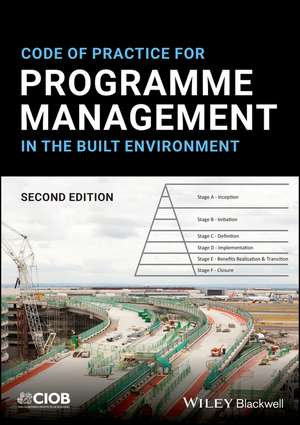
Code of Practice for Programme Management in the Built Environment
Autor Ciob (the Chartered Institute of Building)en Limba Engleză Paperback – 25 mar 2024
Provenind direct din vasta expertiză a Ciob (the Chartered Institute of Building), această a doua ediție a codului de bune practici reprezintă un standard riguros pentru mediul construit. Ne-a atras atenția modul în care volumul reușește să transcendă limitele șantierului tradițional, ancorându-se într-o viziune strategică asupra programelor complexe. Găsim în această carte o metodologie clară, menită să coordoneze proiecte interdependente în sectoare critice precum energia nucleară sau infrastructura de transport, unde miza depășește simpla execuție tehnică.
Ca și Project Management for the Built Environment, lucrarea pune în valoare aplicarea practică a conceptelor de management, dar cu un accent pe viziunea de ansamblu a programului, nu doar pe unitatea individuală a proiectului. Structura este organizată logic, începând cu integrarea temelor de bază — digitalizare, sustenabilitate și etică — și continuând cu definirea rolurilor cheie, precum cel de sponsor de program sau manager de program. Subliniem calitatea sintezei oferite de editura Wiley, care transformă un text tehnic într-un ghid fluid, esențial pentru navigarea în complexitatea modernă a metodelor de construcție bazate pe platforme și date. Ritmul expunerii este unul analitic, oferind cititorului nu doar proceduri, ci și o înțelegere profundă a contextului cultural și tehnologic actual.
Preț: 508.52 lei
Preț vechi: 627.80 lei
-19%
Carte disponibilă
Livrare economică 28 noiembrie-12 decembrie
Livrare express 17-21 noiembrie pentru 37.06 lei
Specificații
ISBN-10: 1394192436
Pagini: 192
Dimensiuni: 206 x 292 x 10 mm
Greutate: 0.56 kg
Ediția:2nd edition
Editura: Wiley
Locul publicării:Chichester, United Kingdom
V-ar putea interesa
-
 The New Penguin Dictionary of Civil EngineeringDavid Blockley-17%Preț: 96.27 lei116.08 lei
-
 Architect's Legal Handbook: The Law for ArchitectsAnthony Speaight KCPreț: 466.12 leiRecomandat
-
 Ciob Facilities Management ContractCiob (the Chartered Institute of Building)Preț: 246.96 lei
-
 Construction Planning, Programming and ControlBrian CookePreț: 401.02 lei
-
 -19%Preț: 459.54 lei567.33 lei
-
 Managing Construction TechnologyKurt Maldovan-19%Preț: 458.22 lei565.70 lei
-
 Preț: 363.33 lei
-
 Construction Project Scheduling and ControlSaleh A. Mubarak-9%Preț: 975.31 lei1071.77 lei
-
 Project Management in the Construction IndustrySaleh A. Mubarak-23%Preț: 703.02 lei913.01 lei
-
 BIM HandbookRafael Sacks-23%Preț: 653.79 lei849.08 lei
-
 The Standard for Program Management - Fifth EditionProject Management Institute-8%Preț: 455.14 lei494.73 lei
-
 -8%Preț: 624.11 lei678.38 lei
-
 Preț: 112.21 lei
-
 Handbook of Practice ManagementMatt Thompson-8%Preț: 530.90 lei577.07 lei
-
 Preț: 440.20 lei
-
 -31%Preț: 402.10 lei583.22 lei
De ce să citești această carte
Această resursă este vitală pentru profesioniștii care doresc să evolueze de la managementul de proiect la cel de program. Cititorul câștigă acces la un cadru de lucru recunoscut internațional, adaptat provocărilor de digitalizare și sustenabilitate. Este o recomandare fermă pentru managerii din infrastructură, aviație sau energie care au nevoie de o structură solidă pentru a livra valoare în proiecte complexe din mediul construit.
Despre autor
Ciob (the Chartered Institute of Building) este cea mai importantă organizație profesională din lume dedicată managementului construcțiilor și mediului construit. Cu o istorie bogată și o prezență globală, institutul stabilește standardele de excelență și etică în industrie. Prin publicațiile sale academice și profesionale, CIOB contribuie direct la formarea specialiștilor, oferind resurse care integrează inovația tehnologică cu responsabilitatea socială. Această ediție reflectă misiunea lor de a promova profesionalismul într-un sector în continuă transformare.
Notă biografică
Cuprins
Acknowledgements xv
List of Figures xvii
Working Group (WG) of the Code of Practice for Programme Management xix
Glossary xxi
CHAPTER 1 Programme Management in Context 1
1.1 Introduction 1
1.1.1 Need for programme management in the built environment 2
1.1.2 Future programme management in the built environment 3
1.1.3 Core themes that must be integrated 5
1.1.4 Developing capability 6
1.1.5 Procuring value 6
1.1.6 Digitalisation, visualisation and data 7
1.1.7 Cultural identity and ethics 8
1.1.8 Sustainability and its governance 8
1.1.9 Platform thinking and modern methods of construction 9
1.2 Applying programme management in practice 10
1.2.1 Introduction to programme management 10
1.2.2 Types of programmes 10
1.2.3 Programme management process and stages 12
1.3 Programme organisation 12
1.3.1 Types of clients who may initiate programmes 13
1.3.2 Key programme management roles 14
1.3.3 Programme sponsor 14
1.3.4 Programme sponsor's board 15
1.3.5 Programme manager 15
1.3.6 Programme management board 15
1.3.7 Programme management office 15
1.3.8 Wider programme management team 16
1.3.9 Stakeholders 16
1.3.10 Portfolio management 17
CHAPTER 2 Stage A: Inception 19
2.1 Purpose of this stage 19
2.2 Key activities of this stage 19
2.2.1 Vision statement 19
2.2.2 Programme mandate 20
2.2.3 Managing strategic change 20
2.3 Key roles and responsibilities of this stage 25
2.3.1 Client organisation 25
2.3.2 Business partners and funders 26
2.3.3 Programme sponsor 26
2.3.4 Programme sponsor's board 26
CHAPTER 3 Stage B: Initiation 29
3.1 Purpose of this stage 29
3.2 Key activities of this stage 29
3.2.1 Programme brief 29
3.2.2 Programme business case 30
3.2.3 Benefits management 31
3.2.4 Feasibility study 32
3.2.5 Funding arrangements 33
3.3 Key roles and responsibilities of this stage 34
3.3.1 Programme sponsor's board 34
3.3.2 Programme business change manager 35
3.3.3 Programme manager 35
CHAPTER 4 Stage C: Definition 37
4.1 Purpose of this stage 37
4.2 Key activities at this stage 37
4.2.1 Benefits profiles 37
4.2.2 Scope definition 37
4.2.3 Scope of undertaking 38
4.2.4 Stakeholder analysis 39
4.2.5 Risk, opportunities, issues, assumptions and constraints 39
4.2.6 Programme timescale plan 40
4.2.7 Programme controls 40
4.2.8 Programme financial plan 40
4.2.9 Transition plan 42
4.2.10 Programme delivery plan 43
4.2.11 Establishing the programme organisation 43
4.2.12 Benefits management 44
4.2.13 Change management 44
4.2.14 Assurance and audits 44
4.2.15 Transition 44
4.2.16 Stakeholder analysis 44
4.2.17 External environment and relationships 45
4.2.18 Scope management 45
4.2.19 Risk management 47
4.2.20 Reference class forecasting 49
4.2.21 Programme schedule and risks 50
4.2.22 Programme governance 50
4.2.23 Issues management 53
4.2.24 Time scheduling 53
4.2.25 Financial management 54
4.2.26 Cost management 55
4.2.27 Change control 60
4.2.28 Information management 60
4.2.29 Integration 61
4.2.30 Communication management 62
4.2.31 Quality management 63
4.2.32 Procurement and commercial management 63
4.2.33 Resources management 65
4.2.34 Health and safety management 66
4.2.35 Sustainability/environmental management 66
4.3 Key roles and responsibilities of this stage 67
4.3.1 Programme sponsor's board 67
4.3.2 Programme sponsor 67
4.3.3 Business change manager 67
4.3.4 Benefits realisation manager 68
4.3.5 Programme manager 68
4.3.6 Programme financial manager 69
4.3.7 Programme management board 69
4.3.8 Stakeholder/communications manager 69
4.3.9 Programme management office 70
CHAPTER 5 Stage D: Implementation 73
5.1 Purpose of this stage 73
5.2 Key activities of this stage 73
5.2.1 Initiate projects 74
5.2.2 Performance monitoring and control 74
5.2.3 Reporting 75
5.2.4 Project closure 75
5.2.5 Construction procurement methods 75
5.2.6 Measuring progress 75
5.2.7 Data collection and analysis 75
5.2.8 Data management 76
5.2.9 Monitoring progress 76
5.2.10 Managing multiple projects 79
5.2.11 Reporting and forecasting 79
5.2.12 Programme delivery plan 79
5.2.13 Benefits management 81
5.2.14 Business case management 81
5.2.15 Performance monitoring, control and reporting 81
5.2.16 Correct use of graphics 82
5.2.17 Risk and issue management 84
5.2.18 Financial management 86
5.2.19 Change management 86
5.2.20 Time management 87
5.2.21 Information management 87
5.2.22 Stakeholder/communications management 87
5.2.23 Quality management 88
5.2.24 Procurement and commercial management 88
5.2.25 Health and safety management 89
5.2.26 Sustainability/environmental management 89
5.2.27 Transition management - projects closure 89
5.3 Key roles and responsibilities of this stage 90
5.3.1 Programme sponsor's board 90
5.3.2 Programme sponsor 90
5.3.3 Programme business change manager 90
5.3.4 Programme benefits realisation manager 91
5.3.5 Programme manager 91
5.3.6 Programme financial manager 91
5.3.7 Programme management board 92
5.3.8 Stakeholder/communications manager 92
5.3.9 Programme management office 92
5.3.10 Project management structures 93
5.3.11 Key points of contact 94
CHAPTER 6 Stage E: Benefits Realisation and Transition 95
6.1 Purpose of this stage 95
6.2 Key activities of this stage 95
6.2.1 Benefits review 95
6.2.2 Benefits realisation 96
6.2.3 Transition 96
6.2.4 Training and induction 97
6.2.5 Benefits management 97
6.2.6 Managing and realising benefits 97
6.2.7 Benefits and disbenefits 98
6.2.8 Benefits identification and mapping 99
6.2.9 Profiling benefits 102
6.2.10 Realising benefits 104
6.2.11 Reviewing and embedding 105
6.2.12 Communications 106
6.2.13 Sign-off 106
6.2.14 Transition strategy and management 107
6.3 Key roles and responsibilities of this stage 108
6.3.1 Programme sponsor 108
6.3.2 Programme business change manager 108
6.3.3 Programme business realisation manager 109
6.3.4 Programme manager 109
6.3.5 Programme financial manager 109
6.3.6 Programme management office 109
6.3.7 Programme sponsor's board 109
CHAPTER 7 Stage F: Closure 111
7.1 Purpose of this stage 111
7.2 Key activities of this stage 111
7.2.1 Shutting down the programme 111
7.2.2 Disbanding the programme team 112
7.2.3 Programme closure 112
7.2.4 Preparing for closure 113
7.2.5 Programme review 113
7.2.6 Programme closure 114
7.2.7 Communications 114
7.2.8 Disband programme organisation and supporting functions 114
7.2.9 Sign-off 114
7.3 Key roles and responsibilities of this stage 114
7.3.1 Programme sponsor's board 114
7.3.2 Programme sponsor 115
7.3.3 Programme business change manager 115
7.3.4 Programme manager 115
7.3.5 Programme financial manager 116
7.3.6 Stakeholder/communications manager 116
7.3.7 Programme management office 116
7.3.8 Health and safety manager 116
7.3.9 Sustainability manager 116
APPENDIX AProgramme Delivery Matrix 117
A.1 Background 117
A.2 Use of the Programme Delivery Matrix 117
APPENDIX B Tools and Techniques 119
B.1 Background 119
B.1.1 Stage review process 119
B.1.2 Planning poker 120
B.1.3 Managing work products using agile methods 122
B.1.4 Managing the time schedule 122
B.1.5 Burndown charts 124
B.1.6 Media wall 124
B.1.7 Managing the programme scope 125
B.1.8 Three-point estimating 126
B.1.9 Reference class forecasting - example 127
APPENDIX CTemplates 131
C.1 Vision statement 131
C.1.1 Overview 132
C.1.2 Business context 132
C.1.3 Strategic need 132
C.1.4 Programme vision 132
C.1.5 Constraints and limitations 132
C.2 High-level programme scope 132
C.3 Programme mandate 132
C.3.1 Business need/vision statement 133
C.3.2 Outcomes 133
C.3.3 Next steps 133
C.3.4 Sign-off 133
C.4 Programme brief 133
C.4.1 Programme vision 134
C.4.2 Financial benefits 134
C.4.3 Non-financial benefits 134
C.4.4 Disbenefits 134
C.4.5 Programme activity and projects 134
C.4.6 Quick wins 134
C.4.7 Key risks and issues 134
C.4.8 Financial information 135
C.4.9 Financial costs 135
C.4.10 Constraints 135
C.4.11 Assumptions 135
C.4.12 Programme capability 135
C.4.13 Sign-off 135
C.5 Business case 136
C.5.1 Contents 136
C.5.2 Appendices 136
C.5.3 Executive summary 137
C.5.4 Strategic case 137
C.5.5 Economic case 137
C.5.6 Commercial case 138
C.5.7 Financial case 138
C.5.8 Management case 138
C.6 Monthly programme report 139
C.7 Programme highlight report 139
C.7.1 Programme Detail 141
C.8 Benefits profile 142
C.8.1 Sign-off 142
C.9 Tracking benefits: benefits-monitoring 143
C.10 Programme closure report 143
C.10.1 Context 143
C.10.2 Delivery 143
C.10.3 Benefits 144
C.10.4 Handover 144
C.10.5 Risks 144
C.10.6 Issues 144
C.10.7 Projects (optional section for premature closure only) 144
C.10.8 Lessons learned 144
C.10.9 Sign-off 145
APPENDIX D Key Roles: Skills and Competencies 147
D.1 Programme manager 147
D.1.1 Main duties 147
D.1.2 Key competencies 148
D.1.3 Key criteria 148
D.2 Programme business change manager 149
D.2.1 Main duties 149
D.2.2 Key competencies 150
D.3 Programme benefits realisation manager 150
D.3.1 Main duties 150
D.3.2 Key competencies 152
D.4 Programme financial manager 152
D.4.1 Main duties 152
D.4.2 Key competencies 153
D.4.3 Key criteria 153
D.5 Head of programme management office 154
D.5.1 Main duties 154
D.5.2 Key competencies 154
D.5.3 Key criteria 155
D.6 Programme risk manager 155
D.6.1 Main duties 155
D.6.2 Key competencies 155
D.6.3 Key criteria 156
D.7 Programme scheduling manager 156
D.7.1 Main duties 156
D.7.2 Key criteria 157
D.8 Programme cost manager 157
D.8.1 Main duties 157
D.8.2 Key competencies 158
D.8.3 Key criteria 158
Bibliography 159
Past Working Group of the Code of Practice for Programme Management 161
Index 163