
Closer Reading: Garrett Stewart's Essays in Refraction
Autor Professor or Dr. Garrett Stewart Editat de Dr. David LaRoccaen Limba Engleză Paperback – 13 noi 2025
Ne-a atras atenția modul în care Closer Reading reușește să sintetizeze o carieră de peste cincizeci de ani dedicată analizei textuale, propunând o perspectivă profund interdisciplinară. Observăm cum Professor or Dr. Garrett Stewart navighează cu o rigoare academică remarcabilă între domenii aparent disparate: teoria literară, studiile cinematografice, arta conceptuală și noile medii digitale. Această ediție publicată de Bloomsbury Academic nu este doar o antologie de texte, ci o demonstrație a „lecturii prismatice”, o metodă prin care interacțiunea dintre cuvânt și imagine este refractată prin lentila criticii contemporane.
Subliniem importanța acestui volum în contextul operei autorului, servind drept punct de ancorare pentru temele explorate în lucrări anterioare precum The Metanarrative Hall of Mirrors sau Novel Violence. Dacă în studiile sale precedente Stewart se concentra pe infrastructura verbală și vizuală a narațiunii, Closer Reading extinde acest focus către o dispoziție cognitivă generală. Această lucrare acoperă aceeași arie tematică precum Close Reading and Its Alternatives de Mun-Hou Lo, dar cu o abordare mult mai personală și experimentală, punând accent pe micro-analiza frazei și pe mecanismele de percepție ale mediului, în detrimentul unei istorii consolidate a tehnicii de lectură.
Structura volumului este riguros organizată pentru a ghida cititorul printr-o progresie logică: secțiunea „Revisitations” reevaluează figuri precum Coppola sau Dickens, în timp ce „Renewed Ventures” explorează stilul cinematografic al lui John le Carré și punctuația la Dickens. Finalul cărții, marcat de dialogul cu Dr. David LaRocca, oferă o incursiune rară în laboratorul mental al unui critic care a redefinit standardele lecturii atente în mediul academic anglo-saxon.
Preț: 134.44 lei
Preț vechi: 158.46 lei
-15%
Carte disponibilă
Livrare economică 28 octombrie-11 noiembrie
Livrare express 13-17 octombrie pentru 57.06 lei
Specificații
Pagini: 304
Dimensiuni: 152 x 230 x 22 mm
Greutate: 0.5 kg
Editura: Bloomsbury Publishing
Colecția Bloomsbury Academic
Locul publicării:New York, United States
V-ar putea interesa
-
 The Art of FictionDavid Lodge-20%Preț: 62.22 lei77.63 lei
 -
 Changing My MindZadie Smith-25%Preț: 64.55 lei86.27 lei
 -
 Against Interpretation and Other EssaysSusan Sontag-25%Preț: 70.05 lei93.32 lei
 -
 Aspects of the NovelE. M. Forster-27%Preț: 56.53 lei77.15 lei
 -
 On Close ReadingProfessor John GuilloryPreț: 133.40 lei
 -
 Image-Music-TextRoland BarthesPreț: 103.79 lei
 -
 The Cambridge Companion to Tom StoppardKatherine E. KellyPreț: 199.27 lei
 -
 Mystery and MannersFlannery O'ConnorPreț: 92.71 lei
 -
 Feeding the MonsterAnna BogutskayaPreț: 92.81 lei
 -
 Preț: 202.14 lei
 -
 Preț: 379.65 leiRecomandat
 -
 -26%Preț: 58.43 lei78.89 lei
 -
 Selected Writings on Visual Arts and CultureStuart HallPreț: 201.78 lei
 -
 -22%Preț: 241.79 lei308.65 lei
 -
 The Difficult GhostLeila GuerrieroPreț: 76.82 lei
 -
 The Correction of TasteDenis DonoghuePreț: 129.78 lei
 -
 The Work of Reading: Literary Criticism in the 21st CenturyAnirudh Sridhar-18%Preț: 877.50 lei1070.12 lei
 -
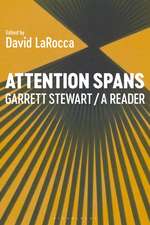 Attention Spans: Garrett Stewart, a ReaderProfessor or Dr. Garrett Stewart-16%Preț: 163.88 lei194.13 lei
 -
 Bandwidths: Reading Across Media with Garrett StewartDr. David LaRocca-32%Preț: 583.98 lei864.43 lei
De ce să citești această carte
Această carte se adresează cercetătorilor și studenților din domeniul filologiei și studiilor media care doresc să stăpânească tehnica analizei de text la cel mai înalt nivel. Cititorul câștigă acces la o metodologie critică rafinată, capabilă să descifreze nu doar literatura clasică, ci și arta digitală sau cinematografia, transformând actul lecturii într-o experiență intelectuală vibrantă și riguroasă.
Descriere
Among the most prolific and exacting readers of his generation, Stewart is renowned for his virtuosic interventions across a number of humanistic fields, including prose narrative, screen studies, and literary theory. Elected to the American Academy of Arts and Sciences in 2010 and winner of the International Society for the Study of Narrative's prize for Novel Violence (2009), Stewart draws on these varied realms in his intensive readings of enduring works across media - ones worthy of a re-view and a closer look.
Closer Reading, like Stewart's writing more broadly, offers up-close analyses of novels, poetry, cinema, and conceptual art, including chapters on Gerard Manley Hopkins, Charles Dickens, Francis Ford Coppola, Stanley Cavell, and John le Carré. A collection a half-century in the making - yet brimming with critical notes from the vanguard - Closer Reading finds Stewart demonstrating, from sentence to sentence, a sustained rethinking of the value of close reading not just as a methodology but also as a cognitive disposition.
Leaving paranoid, symptomatic, and surface reading to the side, Stewart revels in the workings of sentences and the many senses of media. Such a "prismatic reading" affords insight into the spectrum of interpretation and the bent light of interaction, refraction, and diffraction. To dwell in the astute and generous line of Stewart's inquiry is to experience an exhilaration rare in critical commentary. Featuring full-length essays, including still-potent early publications and accompanied by an entirely new and wide-ranging interview with David LaRocca, Closer Reading provides a deep and satisfying critical survey of and immersion in Garrett Stewart's inimitable oeuvre.
Cuprins
David LaRocca
I. Revisitations
1. Coppola's Conrad: The Repetitions of Complicity
2. The Foreign Offices of British Fiction
3. The Avoidance of Stanley Cavell
II. Renewed Ventures
4. Gerard Manley Hopkins' Phonetic Script
5. Charles Dickens and the Plotting of Punctuation
6. John le Carré's Cinematographic Style
7. Negative Imprints in Conceptual Art
III. Revenant Revisions: "Ghost Reading"
8. Narrative Afterwording: Too Close for Closure
A Dialogue in Diffraction
Garrett Stewart & David LaRocca
Notes on Contributors
Index
Recenzii
It is never enough for Garrett Stewart merely to write, down or out, the results of his reading, whether of literature, film, or art. His impulse is rather to strain ever closer to the objects of his close readings, to attain a propinquity intimate enough to enter into composition with them. The results, in what Stewart calls the 'textual prismatics' arrayed here, are uniquely collusive alloys of reading and writing, which magically protract, dilate, and reinflame the works that they treat.
To read Garrett Stewart's expansive readings is to enter an expanding world: texts, images, and forms come more alive than they were before we read his account of them. His attention to novels, films, art objects, and criticism enlarges our very senses and makes us see how active reading can be.
This book offers a welcome opportunity to retrace and to connect some of Garrett Stewart's brilliantly eccentric footsteps. These essays - on Dickens, Hopkins, and Conrad, on Le Carré, Cavell, and conceptual art - are technically eccentric because, as they maintain an elliptic or parabolic orbit around criticism's shifting centers of gravity (New Historicism, postcolonial theory, surface reading, etc.), they use the official history of literary scholarship as a spur to Stewart's unofficial, beautifully errant, and always exciting thought.