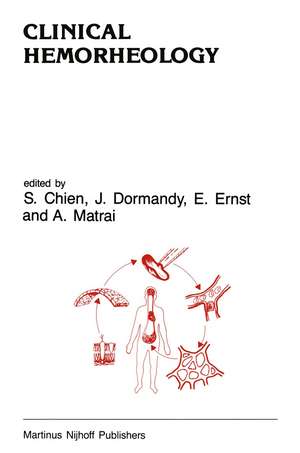
Clinical Hemorheology: Applications in Cardiovascular and Hematological Disease, Diabetes, Surgery and Gynecology: Developments in Cardiovascular Medicine, cartea 74
Editat de S. Chien, John A. Dormandy, E. Ernst, A. Matraien Limba Engleză Paperback – 13 oct 2011
Din seria Developments in Cardiovascular Medicine
- 5%
 Preț: 375.20 lei
 - 5%
 Preț: 405.64 lei
 - 5%
 Preț: 382.86 lei
 - 5%
 Preț: 1356.08 lei
 - 5%
 Preț: 365.42 lei
 - 5%
 Preț: 1048.97 lei
 - 5%
 Preț: 1382.39 lei
 - 5%
 Preț: 365.84 lei
 - 5%
 Preț: 357.02 lei
 - 5%
 Preț: 365.81 lei
 - 5%
 Preț: 2034.92 lei
 - 5%
 Preț: 355.87 lei
 - 5%
 Preț: 356.02 lei
 - 5%
 Preț: 357.02 lei
 - 5%
 Preț: 359.75 lei
 - 5%
 Preț: 685.66 lei
 - 5%
 Preț: 1048.97 lei
 - 5%
 Preț: 364.50 lei
 - 5%
 Preț: 362.47 lei
 - 5%
 Preț: 695.99 lei
 - 5%
 Preț: 2034.57 lei
 - 5%
 Preț: 360.88 lei
 - 5%
 Preț: 694.44 lei
 - 5%
 Preț: 364.30 lei
 - 5%
 Preț: 1367.84 lei
 - 5%
 Preț: 691.45 lei
 - 5%
 Preț: 692.85 lei
 - 5%
 Preț: 3060.90 lei
 - 5%
 Preț: 1363.09 lei
 - 5%
 Preț: 687.05 lei
 - 5%
 Preț: 366.54 lei
 - 5%
 Preț: 357.02 lei
 - 5%
 Preț: 404.28 lei
 - 5%
 Preț: 366.69 lei
 - 5%
 Preț: 368.64 lei
 - 5%
 Preț: 2044.40 lei
 - 5%
 Preț: 366.00 lei
 - 5%
 Preț: 1371.17 lei
 - 5%
 Preț: 1359.76 lei
 - 5%
 Preț: 373.89 lei
 - 5%
 Preț: 2783.34 lei
 - 5%
 Preț: 360.33 lei
Preț: 693.91 lei
Preț vechi: 730.42 lei
-5%
Puncte Express: 1041
Carte tipărită la comandă
Livrare economică 08-22 iunie
Specificații
ISBN-13: 9789401084048
ISBN-10: 9401084041
Pagini: 404
Ilustrații: XI, 387 p.
Dimensiuni: 155 x 235 x 21 mm
Greutate: 0.57 kg
Ediția:1987
Editura: SPRINGER NETHERLANDS
Colecția Springer
Seria Developments in Cardiovascular Medicine
Locul publicării:Dordrecht, Netherlands
ISBN-10: 9401084041
Pagini: 404
Ilustrații: XI, 387 p.
Dimensiuni: 155 x 235 x 21 mm
Greutate: 0.57 kg
Ediția:1987
Editura: SPRINGER NETHERLANDS
Colecția Springer
Seria Developments in Cardiovascular Medicine
Locul publicării:Dordrecht, Netherlands
V-ar putea interesa
-
 The BMT Data Book: Including Cellular TherapyReinhold Munker-5%Preț: 801.74 lei843.94 lei
 -
 Haematology in Critical CareJecko Thachil-5%Preț: 548.36 lei577.22 lei
 -
 Practical Flow Cytometry in HaMike Leach-5%Preț: 890.10 lei936.94 lei
 -
 Haematology at a GlanceA. Victor Hoffbrand-5%Preț: 284.06 lei299.01 lei
 -
 The Coagulation ConsultAlan Lichtin-5%Preț: 1129.69 lei1189.15 lei
 -
 HämatologieRolf Mahlberg-5%Preț: 299.40 lei315.16 lei
Public țintă
ResearchCuprins
1. Introduction: On the way to modern clinical hemorheology.- 2. Biophysics.- 2.1. Basic concepts.- 2.2. Viscometry.- 2.3. Other techniques quantifying blood rheology.- 2.4. Rheology of normal blood.- 2.5. Blood sampling and handling in hemorheological tests.- 2.6. Clinical interpretation of hemorheological data.- 2.7. References.- 3. Rheology of blood cells.- 3.1. Introduction.- 3.2. Dynamic deformability of blood cells.- 3.3. Rheological implications of blood cell deformabilities.- 3.4. Blood cell aggregation - disaggregation and interaction with vascular endothelium.- 3.5. Acknowledgements.- 3.6. References.- 4. Structural, hemodynamic and rheological characteristics of blood flow in the circulation.- 4.1. Introduction.- 4.2. Structural and hemodynamic characteristics of the vascular system.- 4.3. Functional compartments within the vascular system.- 4.4. Blood cell rheology in the circulation.- 4.5. Summary and conclusions.- 4.6. References.- 5. Physiological and pathophysiological significance of hemorheology.- 5.1. The role of hemorheology in circulatory physiology.- 5.2. Circulatory consequences of pathological alterations in blood rheology.- 5.3. Summary and conclusions.- References.- 6. Cardiovascular diseases.- 6.1. Introduction.- 6.2. Myocardial ischemia.- 6.3. Hypertension.- 6.4. Cerebral ischemia.- 6.5. Ischemia of the leg.- 6.6. Raynaud’s phenomenon.- 6.7. Conclusions.- 6.8. References.- 7. Thrombosis and hemorheology.- 7.1. Introduction.- 7.2. Rheology and platelets.- 7.3. Rheology, coagulation and fibrinolysis.- 7.4. Venous thromboembolism.- 7.5. Arterial thromboembolism.- 7.6. Thrombosis of arterial shunts and grafts.- 7.7. Microvascular thrombosis.- 7.8. References.- 8. Hemorheology and blood diseases.- 8.1. Introduction.- 8.2. The pathophysiology ofblood hyperviscosity.- 8.3. The syndrome of polycythemic hyperviscosity.- 8.4. The syndrome of sclerocythemic hyperviscosity.- 8.5. The syndrome of plasmatic hyperviscosity.- 8.6. Summary and conclusions 249 References.- 9. Obstetrics, neonatology and gynaecology.- 9.1. Why rheology in obstetrics, gynaecology and neonatology?.- 9.2. Maternal rheology in normal pregnancy.- 9.3. Normal fetal hemorheology.- 9.4. Pathological pregnancy.- 9.5. Rheology in the neonate.- 9.6. Treatment of neonatal hyperviscosity.- 9.7. Rheological sequelae of oral contraception.- 9.8. References.- 10. Diabetes.- 10.1. Introduction.- 10.2. Diabetes and its complications.- 10.3. Relevance of blood rheology in diabetes.- 10.4. Macrorheology of blood in diabetes.- 10.5. Microrheology of blood in diabetes.- 10.6. Implications.- 10.7. References.- 11. Other syndromes associated with impaired blood flow and rheology.- 11.1. Introduction.- 11.2. Shock.- 11.3. Surgery and anesthesia.- 11.4. Rheumatic disease.- 11.5. Renal disease.- 11.6. Neoplastic disease.- 11.7. Miscellaneous.- 11.8. Summary and conclusion.- 11.9. References.- 12. Hemorheological treatment.- 12.1. Introduction.- 12.2. Hemodilution 330 12.2.1. Forms of hemodilution.- 12.3. Apheresis.- 12.4. Plasma substitutes.- 12.5. Defibrinogenation.- 12.6. Oral drugs.- 12.7. Non-pharmacological approach.- 12.8. Conclusions.- 12.9. References.- 13. Summary, Conclusions and Perspectives.- 13.1. Brief summary.- 13.2. Conclusions.- 13.3. Perspectives.
Recenzii
`The book completely fulfills its initial objective of bridging `... the gap between scientific investigation and clinical practice ...'. It has no relevant negative aspects and thus constitutes a very good and very useful book, at an attractive price. I recommend it to all interested in hemorheology, and particularly to scientists and clinicians who wish to acquire specific knowledge on the scientific basis of hemorheology and its present state-of-the-art, or who want an extensive references book.'
J. Martins e Silva, Clinical Hemorheology, Vol. 8, 1988.
J. Martins e Silva, Clinical Hemorheology, Vol. 8, 1988.