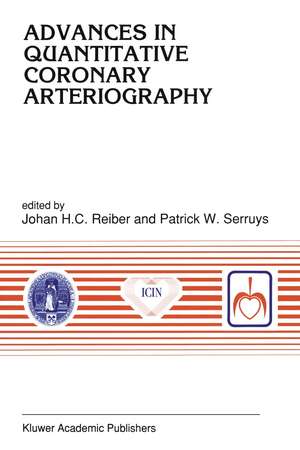
Advances in Quantitative Coronary Arteriography: Developments in Cardiovascular Medicine, cartea 137
Editat de Johan H. C. Reiber, P.W. Serruysen Limba Engleză Paperback – 28 oct 2012
Din seria Developments in Cardiovascular Medicine
- 5%
 Preț: 375.20 lei
 - 5%
 Preț: 405.64 lei
 - 5%
 Preț: 382.86 lei
 - 5%
 Preț: 1356.08 lei
 - 5%
 Preț: 365.42 lei
 - 5%
 Preț: 1048.97 lei
 - 5%
 Preț: 1382.39 lei
 - 5%
 Preț: 365.84 lei
 - 5%
 Preț: 357.02 lei
 - 5%
 Preț: 365.81 lei
 - 5%
 Preț: 2034.92 lei
 - 5%
 Preț: 355.87 lei
 - 5%
 Preț: 356.02 lei
 - 5%
 Preț: 357.02 lei
 - 5%
 Preț: 359.75 lei
 - 5%
 Preț: 685.66 lei
 - 5%
 Preț: 1048.97 lei
 - 5%
 Preț: 364.50 lei
 - 5%
 Preț: 362.47 lei
 - 5%
 Preț: 695.99 lei
 - 5%
 Preț: 2034.57 lei
 - 5%
 Preț: 360.88 lei
 - 5%
 Preț: 694.44 lei
 - 5%
 Preț: 364.30 lei
 - 5%
 Preț: 1367.84 lei
 - 5%
 Preț: 691.45 lei
 - 5%
 Preț: 692.85 lei
 - 5%
 Preț: 3060.90 lei
 - 5%
 Preț: 1363.09 lei
 - 5%
 Preț: 687.05 lei
 - 5%
 Preț: 366.54 lei
 - 5%
 Preț: 357.02 lei
 - 5%
 Preț: 404.28 lei
 - 5%
 Preț: 366.69 lei
 - 5%
 Preț: 368.64 lei
 - 5%
 Preț: 2044.40 lei
 - 5%
 Preț: 366.00 lei
 - 5%
 Preț: 1371.17 lei
 - 5%
 Preț: 1359.76 lei
 - 5%
 Preț: 2783.34 lei
 - 5%
 Preț: 360.33 lei
Preț: 373.89 lei
Preț vechi: 393.57 lei
-5%
Puncte Express: 561
Carte tipărită la comandă
Livrare economică 06-20 iunie
Specificații
ISBN-13: 9789401048194
ISBN-10: 9401048193
Pagini: 660
Ilustrații: XVI, 640 p.
Dimensiuni: 160 x 240 x 35 mm
Greutate: 0.91 kg
Ediția:Softcover reprint of the original 1st ed. 1993
Editura: SPRINGER NETHERLANDS
Colecția Springer
Seria Developments in Cardiovascular Medicine
Locul publicării:Dordrecht, Netherlands
ISBN-10: 9401048193
Pagini: 660
Ilustrații: XVI, 640 p.
Dimensiuni: 160 x 240 x 35 mm
Greutate: 0.91 kg
Ediția:Softcover reprint of the original 1st ed. 1993
Editura: SPRINGER NETHERLANDS
Colecția Springer
Seria Developments in Cardiovascular Medicine
Locul publicării:Dordrecht, Netherlands
V-ar putea interesa
-
 Interventional RadiologyRaman Uberoi-31%Preț: 416.34 lei601.71 lei
 -
 Problem Solving in Abdominal Imaging with CD-ROMNeal C. Dalrymple-28%Preț: 756.41 lei1052.81 lei
 -
 The Teaching Files: Head and Neck Imaging: Expert Consult - Online and PrintGirish M. Fatterpekar-25%Preț: 650.53 lei869.25 lei
 -
 Nuclear Medicine Technology Study GuideAndrzej Moniuszko-5%Preț: 510.05 lei536.88 lei
 -
 Chest ImagingLes R. Folio-5%Preț: 351.38 lei369.87 lei
 -
 Atlas of Real Time 3D Transesophageal EchocardiographyFrancesco F. Faletra-5%Preț: 1524.94 lei1605.20 lei
 -
 Learning Pediatric Imaging: 100 Essential CasesMaría I. Martínez-León-5%Preț: 370.17 lei389.65 lei
 -
 Clinical Cardiac MRIJan Bogaert-5%Preț: 1599.60 lei1683.79 lei
Public țintă
ResearchCuprins
One: Quantitative coronary arteriography (QCA) versus other modalities.- 1. A pathologist’s view of quantitative coronary arteriography.- 2. Angioscopy versus angiography for the detection of coronary artery disease surface morphology.- 3. Development and application of coronary intravascular ultrasound: comparison to quantitative angiography.- Two: QCA: cinefilm versus digital arteriography.- 4. Quantitative analysis of the cineangiogram: Why bother?.- 5. Quantitative coronary arteriography: equipment and technical requirements.- 6. The filmless catheterization laboratory: when will it be reality?.- Three: Quality control in QCA.- 7. Optimal frame selection for QCA.- 8. Variability of QCA-core laboratory assessment of coronary anatomy.- 9. Automated physical assessment of image quality in digital cardiac imaging.- 10. Experiences of a quantitative coronary angiographic core laboratory in restenosis prevention trials.- Four: Coronary blood flow and flow reserve.- 11. Flow and flow reserve by parametric imaging.- 12. Maximal myocardial perfusion as a measure of the functional significance of coronary artery disease.- 13. Angiographic measurement of coronary blood flow.- Five: QCA in regression/progression of atherosclerotic disease.- 14. Value and limitations of quantitative coronary angiography to assess progression or regression of coronary atherosclerosis.- 15. The impact of the calcium antagonist nifedipine on the angiographic progression of coronary artery disease — results of INTACT (International Nifedipine Trial on Anti-atherosclerotic Therapy).- 16. Progression and regression of coronary atherosclerosis: data from a controlled clinical trial with Nicardipine.- 17. Computer quantitative measurements of CLAS coronary angiograms compared to evaluation by panelsof human angiographers.- 18. A maximum confidence strategy for measuring progression and regression of coronary artery disease in clinical trials.- Six: QCA in restenosis studies.- 19. Pharmacological prevention of restenosis after percutaneous transluminal coronary angioplasty (PTCA); overview and methodological considerations.- 20. CARPORT — Coronary Artery Restenosis Prevention On Repeated Thromboxane Antagonism. A multicenter randomized clinical trial.- 21. Angiotensin converting enzyme inhibition in the prevention of restenosis: the MERCATOR and MARCATOR trials.- 22. Historic. A multicenter randomized clinical trial to evaluate feasibility and tolerability of recombinant congener of hirudin as an alternative to heparin during PTCA.- 23. Angiopeptin in experimental models of restenosis.- 24. Cyclic flow alterations and neointimal proliferation following experimental coronary stenosis and endothelial injury.- Seven: QCA after recanalization techniques in coronary arteries.- 25. The use of quantitative coronary angiography (QCA) in interventional cardiology.- 26. Quantitative coronary arteriography in laser balloon angioplasty.- 27. Quantitative coronary angiography after directional coronary atherectomy.- 28. Directional coronary atherectomy evaluation by quantitative angiography.- 29. Quantitative results and lesion morphology in coronary excimer laser angioplasty.- 30. Percutaneous transluminal coronary rotational ablation: early follow-up at 24 hours by quantitative angiography.- 31. Quantitative assessment of the residual stenosis after percutaneous transluminal coronary rotary ablation: European experience.- 32. Quantitative coronary angiography after revascularization with the Transluminal Extraction — Endarterectomy Catheter (TECTM).- Eight: QCA andintracoronary prostheses.- 33. An experimental cardiologist’s view on coronary stents.- 34. The Palmaz-SchatzTM stent.- 35. The Wallstent experience: 1986-1990.- 36 Immediate and long-term clinical and angiographic results following WiktorTM stent implantation in patients with documented restenosis of a native coronary artery lesion following prior balloon angioplasty.- 37. Coronary Gianturco-Roubin Stents.