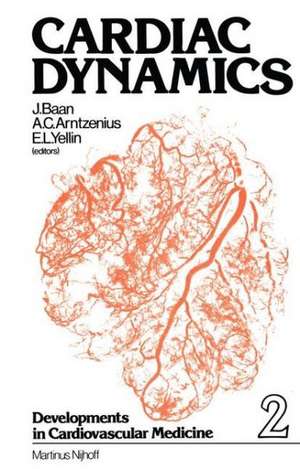
Cardiac Dynamics: Developments in Cardiovascular Medicine, cartea 2
Editat de J. Baan, A.C. Arntzenius, E.L. Yellinen Limba Engleză Paperback – 6 noi 2011
Din seria Developments in Cardiovascular Medicine
- 5%
 Preț: 405.64 lei
 - 5%
 Preț: 382.86 lei
 - 5%
 Preț: 1356.08 lei
 - 5%
 Preț: 365.42 lei
 - 5%
 Preț: 1048.97 lei
 - 5%
 Preț: 1489.13 lei
 - 5%
 Preț: 380.15 lei
 - 5%
 Preț: 357.02 lei
 - 5%
 Preț: 365.81 lei
 - 5%
 Preț: 2184.32 lei
 - 5%
 Preț: 355.87 lei
 - 5%
 Preț: 356.02 lei
 - 5%
 Preț: 357.02 lei
 - 5%
 Preț: 373.81 lei
 - 5%
 Preț: 685.66 lei
 - 5%
 Preț: 1048.97 lei
 - 5%
 Preț: 364.50 lei
 - 5%
 Preț: 376.65 lei
 - 5%
 Preț: 695.99 lei
 - 5%
 Preț: 374.98 lei
 - 5%
 Preț: 694.44 lei
 - 5%
 Preț: 364.30 lei
 - 5%
 Preț: 1467.76 lei
 - 5%
 Preț: 691.45 lei
 - 5%
 Preț: 692.85 lei
 - 5%
 Preț: 1058.46 lei
 - 5%
 Preț: 1358.01 lei
 - 5%
 Preț: 687.05 lei
 - 5%
 Preț: 366.54 lei
 - 5%
 Preț: 357.02 lei
 - 5%
 Preț: 404.28 lei
 - 5%
 Preț: 366.69 lei
 - 5%
 Preț: 368.64 lei
 - 5%
 Preț: 366.00 lei
 - 5%
 Preț: 1479.69 lei
 - 5%
 Preț: 1393.43 lei
 - 5%
 Preț: 373.89 lei
 - 5%
 Preț: 2975.28 lei
 - 5%
 Preț: 360.33 lei
 - 5%
 Preț: 412.01 lei
 - 5%
 Preț: 1054.94 lei
 - 5%
 Preț: 1128.58 lei
 - 5%
 Preț: 369.20 lei
 - 5%
 Preț: 1046.14 lei
 - 5%
 Preț: 355.79 lei
Preț: 375.20 lei
Preț vechi: 394.95 lei
-5%
Puncte Express: 563
Carte disponibilă
Livrare economică 12-26 noiembrie
Livrare express 29 octombrie-04 noiembrie pentru 57.51 lei
Livrare prin curier în România Termenul estimat este afișat lângă disponibilitate.
Transport gratuit de la 400.00 lei Plată online sau ramburs, în funcție de opțiunile comenzii.
Retur gratuit în 14 zile Comandă securizată și suport în română.
Specificații
ISBN-13: 9789400987982
ISBN-10: 9400987986
Pagini: 576
Ilustrații: 555 p.
Dimensiuni: 156 x 244 x 30 mm
Greutate: 0.94 kg
Ediția:Softcover reprint of the original 1st ed. 1980
Editura: SPRINGER NETHERLANDS
Colecția Springer
Seria Developments in Cardiovascular Medicine
Locul publicării:Dordrecht, Netherlands
ISBN-10: 9400987986
Pagini: 576
Ilustrații: 555 p.
Dimensiuni: 156 x 244 x 30 mm
Greutate: 0.94 kg
Ediția:Softcover reprint of the original 1st ed. 1980
Editura: SPRINGER NETHERLANDS
Colecția Springer
Seria Developments in Cardiovascular Medicine
Locul publicării:Dordrecht, Netherlands
V-ar putea interesa
-
 Mayo Clinic Electrophysiology ManualSamuel J. Asirvatham-24%Preț: 2236.79 lei2957.27 lei
 -
 Atherothrombosis in Clinical PracticeDeepak L. Bhatt-19%Preț: 279.19 lei343.22 lei
 -
 -24%Preț: 611.61 lei801.75 lei
 -
 Introduction to Translational Cardiovascular ResearchDennis V. Cokkinos-5%Preț: 1172.12 lei1233.81 lei
 -
 Clinico-Pathological Atlas of Cardiovascular DiseasesJoaquín S. Lucena-5%Preț: 1269.24 lei1336.04 lei
 -
 Pathophysiology and Pharmacotherapy of Cardiovascular DiseaseGowraganahalli Jagadeesh-5%Preț: 1432.48 lei1507.87 lei
 -
 Thrombolysis in Pulmonary EmbolismCarlos Jerjes-Sánchez-5%Preț: 747.60 lei786.95 lei
 -
 Practical Textbook of Cardiac CT and MRITae-Hwan Lim-5%Preț: 1094.80 lei1152.42 lei
 -
 Text Atlas of Practical ElectrocardiographyMassimo Romanò-5%Preț: 633.37 lei666.70 lei
 -
 Sudden DeathH.E. Kulbertus-5%Preț: 364.56 lei383.75 lei
Public țintă
ResearchCuprins
Section 1: Cardiac Muscle Mechanics: From the Fiber Down to the Sarcomere.- 1.1 The coming of age of cardiac muscle mechanics.- 1.2 The importance of passive elements in the contraction of the heart.- 1.3 Tension development and sarcomere length in rat cardiac trabe-culae: evidence of length-dependent activation.- 1.4 Inseparability between preload and contractility effects on pressure development in the isovolumically contracting isolated rabbit heart.- 1.5 Force-velocity-length relations in cardiac muscle segments.- 1.6 Theoretical and experimental force-velocity relations of the ventricular myocardium.- 1.7 Time course of changes in action potential duration and ejection shortening during regional transient ischaemia of pig ventricle in situ.- 1.8 A quantitative analysis of the force transients of skeletal muscle in response to quick changes in length.- Section 2: Cardiac Chamber Dynamics: From the Fiber up to the Myocardium.- 2.1 A fundamental similarity between isolated muscle mechanics and cardiac chamber dynamics.- 2.2 The chamber dynamics of the intact left ventricle.- 2.3 LV wall fibre pathways for impulse propagation.- 2.4 Transmural course of stress and sarcomere length in the left ventricle under normal hemodynamic circumstances.- 2.5 The role of wall thickness in the relation between sarcomere dynamics and ventricular dynamics.- 2.6 A model for left ventricular contractions based on the sliding filament theory.- Section 3: Pump Function and Filling: Interaction with the Low Pressure System.- 3.1 Dynamic determinants of left ventricular filling: an overview.- 3.2 Effects of the pericardium on left ventricular performance.- 3.3 Blood flow dynamics during the human left ventricular filling phase.- 3.4 Relaxation of the left ventricle.- 3.5 Intramural stress and strain analysis in the intact heart.- 3.6 Effects of intravenous isosorbide dinitrate on filling pressures and pump function in patients with refractory pump failure.- 3.7 Transfer function model of the heart.- 3.8 Dynamics of sequential large pulmonary emboli.- Section 4: Pump Function and Ejection: Interaction with Systemic Load and Coronary Perfusion.- 4.1 Pump function and its interaction with the systemic load.- 4.2 Quantification of extravascular coronary resistance.- 4.3 Studies on the optimal matching between heart and arterial system.- 4.4 End-systolic pressure as direct determinant of stroke volume from fixed end-diastolic volume in isolated canine left ventricle.- 4.5 Pump function of the left ventricle evaluated from pressure-volume loops.- 4.6 Simulation study of flow distribution across myocardium.- 4.7 Experimental studies: the appearance of large coronary arteries during arteriography.- 4.8 Hemodynamic effects of reductions in coronary blood flow caused by mechanical stenosis and platelet aggregates forming in dog coronary arteries.- Section 5: Measuring Cardiac Performance: Aims and Validity of Invasive and Noninvasive Measurement.- 5.1 Isaac Starr Lecture: Invasive and noninvasive monitoring of cardiovascular dynamics in clinical practice.- 5.2 Measuring cardiac performance: aims and validity of invasive and noninvasive assessment.- 5.3 The clinical usefulness of noninvasive and invasive tools in the assessment of left ventricular function in myocardial infarction.- 5.4 Model-based hemodynamic indicators of left ventricular performance.- 5.5 Comparative evaluation of myocardial performance factors.- 5.6 Circulatory changes during isometric exercise measured by transcutaneous aortovelography.- 5.7 Validity of parameters of ventricular performance determined by radiocardiography in patients with coronary artery disease.- 5.8 Assessment of the dynamics of cardiac responses to positive inotropic agents.- 5.9 Assessment of cardiac function in the dog by cross-sectional echocardiography.- 5.10 Dynamics of the left ventricular centre of mass in intact unanaesthetized man in the presence and absence of wall motion abnormalities.- 5.11 Cardiac pump function by ballistocardiogram: normal standards and comparison with coronary arteriograms.- Section 6: Energy Losses: Hemodynamics of Valves.- 6.1 Konrad Witzig Memorial Lecture: Some fluid mechanic theories and their application to the design of heart valves and membrane lungs.- 6.2 Fluid dynamics in the aorta.- 6.3 The closing behaviour of the natural aortic valve.- 6.4 Fluid mechanics of the aortic valve.- 6.5 Mechanical energy losses resulting from stenosis of semilunar valves.- 6.6 Pressure-flow relations and energy losses across prosthetic mitral valves: in vivo and in vitro studies.- 6.7 Blood flow velocity in subclavian artery and through mitral valve measured with transcutaneous Doppler ultrasound. The effects of exercise and mitral valve disease.- Closing Lecture: Approaching the heart of the matter.