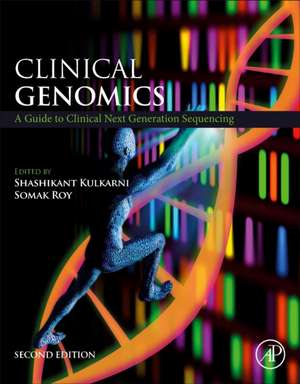
Clinical Genomics: A Guide to Clinical Next Generation Sequencing
Editat de Shashikant Kulkarni, Somak Royen Limba Engleză Paperback – oct 2026
Notăm cu interes apariția celei de-a doua ediții a volumului Clinical Genomics, o resursă fundamentală pentru profesioniștii care vizează certificarea și practica avansată în medicina de precizie. Într-un domeniu în care standardele tehnice și reglementările se transformă rapid, lucrarea oferă rigoarea necesară pentru implementarea secvențierii de generație următoare (NGS) în conformitate cu cerințele actuale ale laboratoarelor de diagnostic molecular. Suntem de părere că această ediție este esențială pentru directorii de laborator care trebuie să navigheze nu doar complexitatea tehnică, ci și cadrele etice și strategiile de rambursare specifice sistemelor de sănătate moderne.
Comparabil cu Genomic Applications in Pathology în ceea ce privește rigoarea științifică, volumul de față se distinge prin actualizarea fluxurilor de lucru bioinformatice și prin includerea tehnologiilor emergente, cum este secvențierea long-read. Structura cărții este organizată pragmatic pentru a facilita progresia de la metodele de bază la aplicații clinice complexe. Prima secțiune detaliază aspectele tehnice și chimia NGS, trecând de la metode non-selective la cele bazate pe captură și amplificare. Urmează o analiză aprofundată a bioinformaticii, de la alinierea secvențelor la detecția variantelor structurale mari, oferind soluții concrete pentru provocările identificate în practica clinică.
Putem afirma că Clinical Genomics reușește să creeze o punte necesară între tehnologia de vârf și managementul operațional. Spre deosebire de Clinical Applications for Next-Generation Sequencing, care se concentrează pe utilizarea translațională, volumul editat de Shashikant Kulkarni și Somak Roy acordă o atenție sporită infrastructurii IT și soluțiilor bazate pe cloud, elemente vitale pentru gestionarea volumului masiv de date genomice în era medicinei personalizate.
Preț: 1069.46 lei
Preț vechi: 1471.28 lei
-27% Nou
Carte disponibilă
Livrare economică 02-16 noiembrie
Specificații
ISBN-10: 0323900240
Pagini: 562
Ilustrații: 120 illustrations (120 in full color)
Dimensiuni: 216 x 276 mm
Ediția:2
Editura: ELSEVIER SCIENCE
V-ar putea interesa
-
 Principles and Practice of Clinical ResearchJohn I. Gallin-9%Preț: 644.54 lei708.29 lei
 -
 Medical Genetics and GenomicsEmanuela Volpi-10%Preț: 398.87 lei442.78 lei
 -
 -27%Preț: 373.48 lei512.19 lei
 -
 Henry's Clinical Diagnosis and Management by Laboratory MethodsRichard A. McPherson-26%Preț: 1181.68 lei1600.30 lei
 -
 Clinical Pathology Board ReviewSuzanne Arinsburg-28%Preț: 1159.43 lei1607.58 lei
 -
 Tietz Textbook of Laboratory MedicineNader Rifai-29%Preț: 1795.39 lei2539.74 lei
 -
 Diagnostic Pathology: Molecular OncologyMohammad A. Vasef-28%Preț: 1920.31 lei2652.30 lei
 -
 Kumar and Clark's Clinical MedicineDavid Randall-26%Preț: 487.97 lei658.70 leiRecomandat
 -
 -31%Preț: 840.65 lei1218.05 lei
 -
 Clinical ChemistryWilliam J. Marshall-5%Preț: 357.78 lei376.60 leiRecomandat
 -
 Emery's Elements of Medical Genetics and GenomicsPeter D. Turnpenny-27%Preț: 316.54 lei433.31 lei
 -
 Human Molecular GeneticsTom Strachan-5%Preț: 739.98 lei778.93 lei
 -
 Bioinformatics and Functional GenomicsJonathan Pevsner-23%Preț: 833.61 lei1082.62 lei
 -
 -5%Preț: 1511.51 lei1591.06 leiRecomandat
 -
 Essential Medical Genetics, Includes Desktop EditionEdward S. Tobias-5%Preț: 402.99 lei424.20 lei
 -
 Next-Generation DNA Sequencing Informatics, Second EditionStuart M BrownPreț: 524.38 lei
 -
 -27%Preț: 999.26 lei1362.25 lei
 -
 Genomics and Clinical DiagnosticsDavid Whitehouse-14%Preț: 725.40 lei843.49 lei
 -
 New Clinical Genetics, fourth editionAndrew Read-5%Preț: 408.27 lei429.76 lei
 -
 Clinical Molecular DiagnosticsShiyang Pan-5%Preț: 1311.76 lei1380.81 lei
De ce să citești această carte
Această lucrare este recomandată specialiștilor care doresc să integreze genomica în practica clinică curentă. Cititorul câștigă o înțelegere clară a întregului proces: de la alegerea platformei de secvențiere și validarea bioinformatică, până la aspectele juridice și financiare ale diagnosticării. Este un instrument indispensabil pentru patologi și medici care utilizează datele NGS pentru diagnosticul, prognosticul și managementul tulburărilor ereditare și somatice.
Descriere scurtă
Structured for ease of reference, this book covers targeted gene sequencing methods, whole exome/genome approaches, emerging technologies such as long-read sequencing, and critical considerations for assay validation. Detailed sections address bioinformatics workflows, variant detection and interpretation methodologies, integration with clinical informatics systems, and essential IT infrastructure, including cloud-based solutions.
This book also thoroughly addresses practical topics essential to laboratory management, such as regulatory compliance, ethical frameworks, billing strategies, and reimbursement paradigms, helping directors navigate the evolving landscape of genomic diagnostics.
- Technical guidance: In-depth overview of sequencing platforms, chemistries, targeted capture methods, RNA sequencing, and methylome analysis for informed assay design and validation
- Bioinformatics workflows: Practical approaches for implementing pipelines to accurately detect and interpret genomic variants, structural changes, and complex genomic alterations
- Clinical implementation: Real-world applications for both constitutional and somatic disorders, including cancer diagnostics and precision medicine strategies
- Regulatory and ethical insights: Current regulatory requirements, ethical considerations, legal implications, and genomic reference standards pertinent to clinical practice
- Operational and financial considerations: Guidance on billing, reimbursement, and operational integration of genomic medicine into clinical practice and electronic health records
Cuprins
1. Overview of Technical Aspects and Chemistries of Next-Generation Sequencing
2. Targeted Hybrid Capture Methods
3. Amplification-Based Methods
4. Emerging DNA Sequencing Technologies
5. Transcriptomics, RNA-Sequencing and Methylome Analysis
Section II: Bioinformatics
6. Base Calling, Read Mapping, and Coverage Analysis
7. Single Nucleotide Variant Detection Using Next Generation Sequencing
8. Insertions and Deletions (Indels)
9. Translocation Detection Using Next-Generation Sequencing
10. Copy Number Variant Detection Using Next-Generation Sequencing
11. Reference Databases for Disease Associations
12. Reporting of Clinical Genomics Test Results
13. Reporting Software
14. Constitutional Diseases: Target enrichment strategies for Targeted gene sequencing panels
15. Targeted Hybrid Capture for Inherited Disease Panels
16. Constitutional Disorders: Whole Exome and Whole Genome Sequencing
17. Somatic Diseases (Cancer): Amplification-Based Next-Generation Sequencing
18. Targeted Hybrid-Capture for Somatic Mutation Detection in the Clinic
19. Somatic Diseases (Cancer): Whole Exome and Whole Genome Sequencing
20. Assay Validation
21. Regulatory Considerations Related to Clinical Next Generation Sequencing
22. Genomic Reference Materials for Clinical Applications
23. Ethical Challenges in Clinical Genomics
24. Legal Issues
25. Billing and Reimbursement
Section III: Clinical Informatics and IT Infrastructure
26. Cloud Computing for Clinical NGS Testing
Section III: Interpretation
27. Bioinformatics of Long Read Sequencing
Section IV: Regulation, Reimbursement, and Legal Issues
28. Business aspect of Precision Genomic Medicine
29. Driving precision medicine through genomics-EHR integration