Cantitate/Preț
Produs
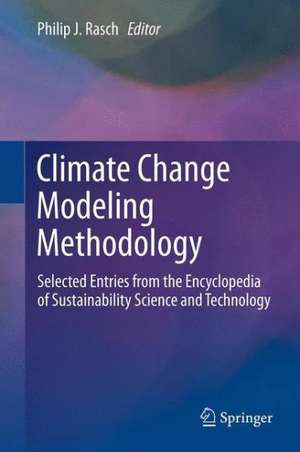
Climate Change Modeling Methodology de Philip J. Rasch

Climate Change Modeling Methodology

Editat de Philip J. Rasch
98739 lei 120414 lei -18%
  • Economic11-25 ianuarie 27 98739 lei
Adaugă în listă1481 Puncte Express
  • Transport gratuit pentru acest produs
  • Plată online sau ramburs
  • Retur gratuit în 14 zile

Despre carte

The Earth's average temperature has risen by 1.4°F over the past century, and computer models project that it will rise much more over the next hundred years, with significant impacts on weather, climate, and human society. Many climate scientists attribute these increases to the build up of greenhouse gases produced by the burning of fossil fuels and to the anthropogenic production of short-lived climate pollutants. Climate Change Modeling Methodologies: Selected Entries from the Encyclopaedia of Sustainability Science and Technology provides readers with an introduction to the tools and analysis techniques used by climate change scientists to interpret the role of these forcing agents on climate. Readers will also gain a deeper understanding of the strengths and weaknesses of these models and how to test and assess them. The contributions include a glossary of key terms and a concise definition of the subject for each topic, as well as recommendations for sources of more detailed information.

Detalii

ISBN-13
9781461457664
ISBN-10
1461457661
Editura
Springer
Ediția
2012
Pagini
344
Ilustrații
VI, 338 p.
Dimensiuni
160 x 241 x 22 mm
Greutate
0.63 kg
Locul publicării
New York, NY, United States

Cuprins

1. Climate Change Modeling Methodology, Introduction
2. Coupled Climate and Earth System Models
3. Cryosphere, Modeling of
4. Oceanic General Circulation Models
5. Weather Prediction Models
6. Atmospheric General Circulation Modeling
7. Earth System Model, Modeling the Land Component of
8. Integrated Assessment Modeling
9. Regional Climate Models
10. Climate Change Projections: Characterizing Uncertainty Using Climate Models
11. Climate Predictions, Seasonal-to-Decadal
12. Monsoon Systems, Modeling of

Index

Textul de pe ultima copertă

The Earth's average temperature has risen by 1.4°F over the past century, and computer models project that it will rise much more over the next hundred years, with significant impacts on weather, climate, and human society. Many climate scientists attribute these increases to the buildup of greenhouse gases produced by the burning of fossil fuels and to the anthropogenic production of short-lived climate pollutants. Climate Change Modeling Methodologies: Selected Entries from the Encyclopedia of Sustainability Science and Technology provides readers with an introduction to the tools and analysis techniques used by climate change scientists to interpret the role of these forcing agents on climate.  Readers will also gain a deeper understanding of the strengths and weaknesses of these models and how to test and assess them.  The contributions include a glossary of key terms and a concise definition of the subject for each topic, as well as recommendations for sources of more detailed information.

Features authoritative, peer-reviewed contributions on the development and use of contemporary methods in climate change science

Provides insight into the construction, assessment, and testing of climate models

Covers individual component models for the atmosphere, ocean, land, and ice, and discusses their contribution to an example of climate change in monsoon systems

Discusses how climate change models can shed light on the changing climate of the past and on possible shifts in the future

Public țintă

Upper undergraduate