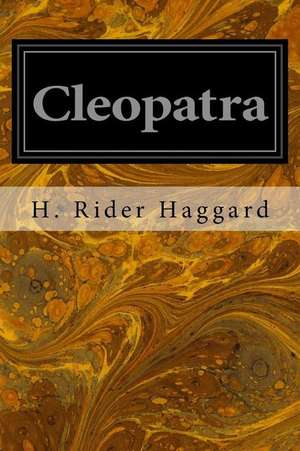
Cleopatra
Autor H. Rider Haggarden Limba Engleză Paperback
Preț: 66.43 lei
Puncte Express: 100
Carte disponibilă
Livrare economică 06-20 noiembrie
Livrare prin curier în România Termenul estimat este afișat lângă disponibilitate.
Transport gratuit de la 400.00 lei Plată online sau ramburs, în funcție de opțiunile comenzii.
Retur gratuit în 14 zile Comandă securizată și suport în română.
Specificații
ISBN-13: 9781533031211
ISBN-10: 1533031215
Pagini: 156
Dimensiuni: 152 x 229 x 8 mm
Greutate: 0.22 kg
ISBN-10: 1533031215
Pagini: 156
Dimensiuni: 152 x 229 x 8 mm
Greutate: 0.22 kg
V-ar putea interesa
-
 King Solomon's MinesHenry Rider HaggardPreț: 28.01 leiNou
 -
 Mr. Poirot: Mischief on the NileAdam HargreavesPreț: 55.56 lei
 -
 Desert GodWilbur SmithPreț: 67.90 lei
 -
 I Am CleopatraNatasha SolomonsPreț: 105.16 lei
 -
 SheH. Rider Haggard-17%Preț: 48.27 lei58.40 lei
 -
 Forged in RomeConn IgguldenPreț: 150.75 lei
 -
 The Memoirs of CleopatraMargaret George-26%Preț: 87.10 lei117.37 lei
 -
 King Solomon's MinesH. Rider HaggardPreț: 56.27 lei
 -
 Abduction of a SlaveDana Stabenow-27%Preț: 51.94 lei70.74 lei
 -
 Cleo: Chosen: Book 2Lucy Coats-24%Preț: 43.05 lei56.91 lei
 -
 The Blue CurtainsHenry Rider HaggardPreț: 60.91 lei
 -
 When the World ShookH. Rider HaggardPreț: 82.66 lei
 -
 Morning StarH. Rider HaggardPreț: 50.79 lei
 -
 Moon of IsraelH. Rider HaggardPreț: 51.02 lei
 -
 Pearl-MaidenH. Rider HaggardPreț: 55.72 lei
 -
 Preț: 100.87 lei
 -
 -15%Preț: 42.30 lei49.84 lei
 -
 House of Two PharaohsWilbur SmithPreț: 157.95 lei
 -
 AyeshaH. Rider HaggardPreț: 63.31 lei
 -
 The Alan Quatermain Omnibus: King Solomon'S Mines & Allan QuatermainH. Rider Haggard-24%Preț: 76.00 lei100.39 lei
Notă biografică
H. Rider Haggard was an English novelist, colonial administrator, agricultural reformer, and one of the central figures in the development of modern adventure fiction. He was born Henry Rider Haggard in Norfolk, England, in 1856, and spent part of his young adulthood in southern Africa, where he worked in the colonial service. That experience gave him material, settings, and political assumptions that shaped much of his fiction, especially his stories of exploration, empire, ancient kingdoms, hidden peoples, and dangerous quests.Haggard became famous with King Solomon's Mines, first published in 1885, a novel that introduced Allan Quatermain and helped establish the lost-world adventure as a powerful popular form. Its success was followed by Allan Quatermain, She, Ayesha, Nada the Lily, Montezuma's Daughter, The People of the Mist, and many other novels. His books combined fast-moving action, exotic landscapes, mysterious civilizations, supernatural suggestion, romance, and imperial-era adventure in a style that influenced later pulp fiction, lost-race stories, jungle adventure, fantasy, and cinematic adventure heroes.Allan Quatermain remains Haggard's most enduring male hero: a hunter, guide, observer, and reluctant adventurer whose toughness is often tempered by humility, fatalism, and melancholy. Haggard's work is also historically complicated. His fiction reflects the racial, imperial, and colonial attitudes of its age, yet it often shows more interest in African cultures, oral tradition, leadership, and moral courage than many adventure novels of the same period. That tension is part of why his books remain important artifacts of Victorian popular literature.Beyond fiction, Haggard wrote on agriculture, rural life, and land policy, subjects he took seriously throughout his later career. He was knighted in 1912 and died in 1925. His influence continued long after his death, especially through adventure fiction, fantasy, lost-world stories, and the broad tradition of expeditionary romance. Writers and filmmakers who built stories around ancient secrets, hidden kingdoms, perilous journeys, and larger-than-life explorers worked in territory Haggard helped define.