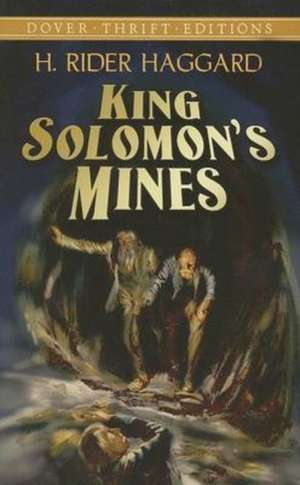
King Solomon's Mines
Autor H. Rider Haggarden Limba Engleză Paperback – 10 feb 2006
"It goes and it grips and it moves with all the freshness of youth." Rudyard Kipling
When Robert Louis Stevenson's "Treasure Island" was first published, H. Rider Haggard made a five-shilling bet that he could write a better adventure tale. In 1885, he created" King Solomon's Mines, "a story in which Allan Quatermain, a gentleman adventurer, is hired to locate a man who had disappeared into the heart of Africa while hunting for the legendary lost diamond mines of King Solomon. The book became an instant sensation and has remained popular ever since.
Tales of adventure in exotic settings were the hallmark of Haggard's art; and "King Solomon s Mines "was no exception. Here were all the elements for which his novels were famous: a gripping tale in a foreign setting, supernatural adventures, terror, passion, and discovery. Praised as the most amazing story ever written, the book went on to become one of the best-selling novels of the nineteenth century."
Preț: 56.27 lei
Puncte Express: 84
Carte disponibilă
Livrare economică 05-19 noiembrie
Livrare prin curier în România Termenul estimat este afișat lângă disponibilitate.
Transport gratuit de la 400.00 lei Plată online sau ramburs, în funcție de opțiunile comenzii.
Retur gratuit în 14 zile Comandă securizată și suport în română.
Specificații
ISBN-13: 9780486447827
ISBN-10: 0486447820
Pagini: 192
Dimensiuni: 135 x 209 x 13 mm
Greutate: 0.15 kg
Editura: Dover Publications
ISBN-10: 0486447820
Pagini: 192
Dimensiuni: 135 x 209 x 13 mm
Greutate: 0.15 kg
Editura: Dover Publications
V-ar putea interesa
-
 Robinson CrusoeDaniel DefoePreț: 28.01 lei
 -
 King Solomon's MinesHenry Rider HaggardPreț: 28.01 leiNou
 -
 King Solomon's MinesRider Haggard-26%Preț: 52.95 lei71.61 lei
 -
 SheH. Rider Haggard-17%Preț: 48.27 lei58.40 lei
 -
 The Virginian: A Horseman of the PlainsOwen Wister-17%Preț: 54.69 lei65.92 lei
 -
 Heart of DarknessJoseph Conrad-19%Preț: 23.12 lei28.58 lei
 -
 Riders of the Purple SageZane GreyPreț: 78.50 lei
 -
 Tangled (Disney Tangled)Ben SmileyPreț: 39.72 lei
 -
 BraveTennant RedbankPreț: 34.80 lei
 -
 Walt Disney's Mary Poppins (Disney Classics)Annie North BedfordPreț: 39.72 lei
 -
 Red HarvestDashiell Hammett-27%Preț: 51.91 lei70.95 lei
 -
 The Blue CurtainsHenry Rider HaggardPreț: 60.91 lei
 -
 When the World ShookH. Rider HaggardPreț: 82.66 lei
 -
 CleopatraH. Rider HaggardPreț: 52.19 lei
 -
 Moon of IsraelH. Rider HaggardPreț: 51.02 lei
 -
 If There's No TomorrowJennifer L. ArmentroutPreț: 69.99 lei
 -
 Maiwa's RevengeH. Rider HaggardPreț: 40.19 lei
 -
 AyeshaH. Rider HaggardPreț: 63.31 lei
 -
 The Alan Quatermain Omnibus: King Solomon'S Mines & Allan QuatermainH. Rider Haggard-24%Preț: 76.00 lei100.39 lei
Descriere
Praised as "the most amazing story ever written," this 1885 story tells the tale in which Allan Quatermain, a gentleman adventurer, is hired to locate a man who has disappeared into the heart of Africa while hunting for the legendary lost diamond mines of King Solomon.
Notă biografică
Sir Henry Rider Haggard (1856-1925) was a prolific British writer of adventure novels set in exotic locations, predominantly Africa. Born in Norfolk, England, Haggard was the eighth of ten children. He attended Ipswich Grammar School before leaving for London, where he worked as an unpaid secretary for a while. In 1875, Haggard travelled to South Africa to serve as the secretary to Sir Henry Bulwer, the governor of Natal. He spent six years in South Africa, during which he gained a deep appreciation for the African landscape, culture and people. These experiences would later provide a rich backdrop for his novels. Haggard returned to England in 1881 and began to focus on his writing career. He wrote his first novel, Dawn, in 1884, but it was his next work, King Solomon's Mines, published in 1885, that brought him widespread acclaim and commercial success. The novel introduced the character Allan Quatermain, a skilled hunter and adventurer who would become the protagonist of many of Haggard's subsequent novels. Haggard continued to write throughout his life, producing over 40 novels, numerous short stories, and non-fiction works. His other notable works include She (1887), Allan Quatermain (1887) and Cleopatra (1889). Haggard's writing was characterized by vivid descriptions of the African landscape and culture, thrilling adventures and a deep sense of spirituality and mysticism.
Recenzii
When first published, King Solomon’s Mines (1885) was an enormous popular success. The narrative follows the explorations of Allan Quatermain, a fortune hunter who travels to Africa in search of ancient treasures and a lost fellow explorer. Written as an adventure story, the novel is also a late-Victorian imperial romance that illuminates the politics of British imperialist capitalism in 1870s and 1880s South Africa.
This edition includes contemporary reviews, other writings by Haggard on Africa and romance, and documents focusing on imperialism and diamond mining in late nineteenth-century South Africa.
“Scholars, students and general readers will welcome Gerald Monsman’s new edition, which comes lavishly supplied with illuminating contextual documents. In a provocative introductory essay, Professor Monsman describes the mythopoeic ambition of King Solomon’s Mines by recovering its intellectual context in Victorian anthropology. Haggard sought to create an Africa of the imagination, more precious for the access it gave modern readers to their alienated psychic origins than for its material resources. Readers of this excellent new edition will find that the fictions of imperialism were richer and stranger than they had thought.” — Ian Duncan, University of California, Berkeley
This edition includes contemporary reviews, other writings by Haggard on Africa and romance, and documents focusing on imperialism and diamond mining in late nineteenth-century South Africa.
“Scholars, students and general readers will welcome Gerald Monsman’s new edition, which comes lavishly supplied with illuminating contextual documents. In a provocative introductory essay, Professor Monsman describes the mythopoeic ambition of King Solomon’s Mines by recovering its intellectual context in Victorian anthropology. Haggard sought to create an Africa of the imagination, more precious for the access it gave modern readers to their alienated psychic origins than for its material resources. Readers of this excellent new edition will find that the fictions of imperialism were richer and stranger than they had thought.” — Ian Duncan, University of California, Berkeley
Cuprins
Preface
Introduction
H. Rider Haggard: A Brief Chronology
A Note on the Text
King Solomon’s Mines
Appendix A: Victorian Critical Reaction
Introduction
H. Rider Haggard: A Brief Chronology
A Note on the Text
King Solomon’s Mines
Appendix A: Victorian Critical Reaction
- The Saturday Review, 10 October 1885
- Robert Louis Stevenson, 1885
- The Spectator, 7 November 1885
- The Literary World, 23 January 1886
- Gerard Manley Hopkins, 28 October 1886
- The Dial, May 1887
- The Book Buyer, August 1887
- The Church Quarterly Review, January 1888
- Fortnightly Review, 1 September 1888
- Forum, May 1889
- “Notes on King Solomon’s Mines” (1906)
- “Anecdote” (c. 1876)
- “A Zulu War-Dance” (1877)
- “About Fiction” (1877)
- Fred Fynney, Zululand and the Zulus (1880)
- John Ruskin, Lectures on Art (1873)
- Cecil Rhodes,“Confession of Faith” (1877)
- Cecil Rhodes, Speeches (1881-1900)
- Olive Schreiner, Trooper Peter Halket of Mashonaland (1897)
- Olive Schreiner, Thoughts on South Africa (1890-92)
- The Bible, I Kings 10: 1-13
- Kebra Negast (c. 14th Century)
- “The Ophir of Scripture,” The Illustrated London News, 11 January 1873
- Hugh Mulleneux Walmsley, The Ruined Cities of Zulu Land (1869)
- Olive Schreiner, “Diamond Fields” (c. 1880)
- Frederick Courteney Selous, A Hunter’s Wanderings in Africa (1890)