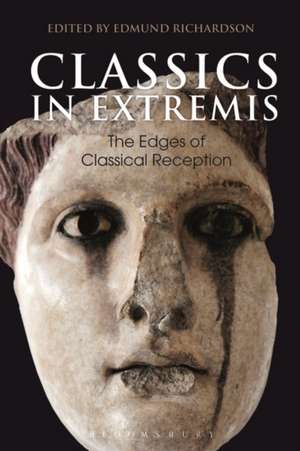
Classics in Extremis: The Edges of Classical Reception: Bloomsbury Studies in Classical Reception
Editat de Dr Edmund Richardsonen Limba Engleză Paperback – 28 mai 2020
Its protagonists are 'marginal' figures who resisted that definition in the strongest terms. Contributors argue for a decentered model of classical reception: where the 'marginal' shapes the 'central' as much as vice versa - and where the most unlikely appropriations of antiquity often have the greatest impact. What kind of distortions does the model of 'centre' and 'margins' produce? How can 'marginal' receptions be recovered most effectively?
Bringing together some of the leading scholars in the field, Classics in Extremis moves beyond individual case studies to develop fresh methodologies and perspectives on the study of classical reception.
Din seria Bloomsbury Studies in Classical Reception
- 32%
 Preț: 553.18 lei
 - 31%
 Preț: 569.81 lei
 - nou
 Preț: 596.11 lei
 - 32%
 Preț: 667.93 lei
 - 24%
 Preț: 264.65 lei
 - 26%
 Preț: 200.07 lei
 - 23%
 Preț: 236.74 lei
 - 25%
 Preț: 252.61 lei
 - 22%
 Preț: 245.45 lei
 - 30%
 Preț: 218.44 lei
 - 23%
 Preț: 252.43 lei
 - 24%
 Preț: 249.47 lei
 - 22%
 Preț: 244.53 lei
 -
 Preț: 242.41 lei
 - 24%
 Preț: 199.72 lei
 - 33%
 Preț: 615.41 lei
 - 23%
 Preț: 243.47 lei
 - 35%
 Preț: 600.89 lei
 - 24%
 Preț: 184.06 lei
 - 24%
 Preț: 283.37 lei
 - 24%
 Preț: 838.74 lei
 - 31%
 Preț: 669.96 lei
 - 24%
 Preț: 286.66 lei
 -
 Preț: 249.26 lei
 - 27%
 Preț: 239.73 lei
 - 38%
 Preț: 668.32 lei
 - 18%
 Preț: 236.49 lei
 - 31%
 Preț: 636.73 lei
 - 20%
 Preț: 253.17 lei
 - 22%
 Preț: 244.44 lei
 - 36%
 Preț: 623.81 lei
 - 24%
 Preț: 849.51 lei
Preț: 251.46 lei
Preț vechi: 328.10 lei
-23%
Puncte Express: 377
Carte tipărită la comandă
Livrare economică 07-21 decembrie
Livrare prin curier în România Termenul estimat este afișat lângă disponibilitate.
Transport gratuit de la 400.00 lei Plată online sau ramburs, în funcție de opțiunile comenzii.
Retur gratuit în 14 zile Comandă securizată și suport în română.
Specificații
ISBN-13: 9781350166264
ISBN-10: 135016626X
Pagini: 272
Ilustrații: 31 bw illus
Dimensiuni: 152 x 232 x 12 mm
Greutate: 0.38 kg
Editura: Bloomsbury Publishing
Colecția Bloomsbury Academic
Seria Bloomsbury Studies in Classical Reception
Locul publicării:London, United Kingdom
ISBN-10: 135016626X
Pagini: 272
Ilustrații: 31 bw illus
Dimensiuni: 152 x 232 x 12 mm
Greutate: 0.38 kg
Editura: Bloomsbury Publishing
Colecția Bloomsbury Academic
Seria Bloomsbury Studies in Classical Reception
Locul publicării:London, United Kingdom
Cuprins
1. Introduction - Edmund Richardson - Durham University, UK
2. Thinking with classical reception: critical distance, critical licence, critical amnesia? - Lorna Hardwick - Open University, UK
3. Daphnis transformed: Aphra Behn's politics of translation. - Amanda Klause - Academy of Notre Dame de Namur, USA
4. Local engagements with Ancient Greek vases in Ottoman and Revolutionary Greece, c.1800-1833. - Alexia Petsalis-Diomidis - University of St Andrews, UK
5. The hand that shook the world: Daniel Dunglas Home's disembodied classics. - Edmund Richardson - Durham University, UK
6. Picturing Antiquity: photography, performance and Julia Margaret Cameron. - Jennifer Wallace - Cambridge University, UK
7. High culture in low company? The reception of ancient 'homosexuality' in the pornographic The Sins of the Cities of the Plain: The Recollections of a Mary-Ann. - Jennifer Ingleheart - Durham University, UK
8. The Caribbean Socrates: Pedro Henríquez Ureña and the Mexican Ateneo de la Juventud. - Rosa Andújar - King's College, London, UK
9. Beyond the limits of art and war trauma: David Jones 'In Parenthesis'. - Edith Hall - King's College, London, UK
10. Classics down the mineshaft: a buried history. - Henry Stead - Open University, UK
11. Extreme Classicisms: Jorge Luis Borges. - Laura Jansen - University of Bristol, UK
12. The costly fabric of conservatism: Classical references in contemporary public culture. - Maarten De Pourcq - Radboud University Nijmegen, Netherlands
Bibliography
Index
2. Thinking with classical reception: critical distance, critical licence, critical amnesia? - Lorna Hardwick - Open University, UK
3. Daphnis transformed: Aphra Behn's politics of translation. - Amanda Klause - Academy of Notre Dame de Namur, USA
4. Local engagements with Ancient Greek vases in Ottoman and Revolutionary Greece, c.1800-1833. - Alexia Petsalis-Diomidis - University of St Andrews, UK
5. The hand that shook the world: Daniel Dunglas Home's disembodied classics. - Edmund Richardson - Durham University, UK
6. Picturing Antiquity: photography, performance and Julia Margaret Cameron. - Jennifer Wallace - Cambridge University, UK
7. High culture in low company? The reception of ancient 'homosexuality' in the pornographic The Sins of the Cities of the Plain: The Recollections of a Mary-Ann. - Jennifer Ingleheart - Durham University, UK
8. The Caribbean Socrates: Pedro Henríquez Ureña and the Mexican Ateneo de la Juventud. - Rosa Andújar - King's College, London, UK
9. Beyond the limits of art and war trauma: David Jones 'In Parenthesis'. - Edith Hall - King's College, London, UK
10. Classics down the mineshaft: a buried history. - Henry Stead - Open University, UK
11. Extreme Classicisms: Jorge Luis Borges. - Laura Jansen - University of Bristol, UK
12. The costly fabric of conservatism: Classical references in contemporary public culture. - Maarten De Pourcq - Radboud University Nijmegen, Netherlands
Bibliography
Index
Recenzii
This is a thought-provoking, engaging volume. Its scope ensures that it will appeal to a wide range of audiences, while pushing us to think further not only about the reception of classics in contexts that have often been seen as 'marginal', 'peripheral', or in extremis, but also to see how these 'edges' have been altered and re-shaped by those engaging with Graeco-Roman antiquity.
[The contributors] have enlivened "marginal" voices upon whose winged-words were the Greeks and Romans. The range of these voices is proof that "Classics" has never truly been the exclusive realm of the elite male, despite attempts by the latter to make it so . Classics in Extremis is an excellent and timely addition to the contemporary scholarly zeitgeist.
[The contributors] have enlivened "marginal" voices upon whose winged-words were the Greeks and Romans. The range of these voices is proof that "Classics" has never truly been the exclusive realm of the elite male, despite attempts by the latter to make it so . Classics in Extremis is an excellent and timely addition to the contemporary scholarly zeitgeist.