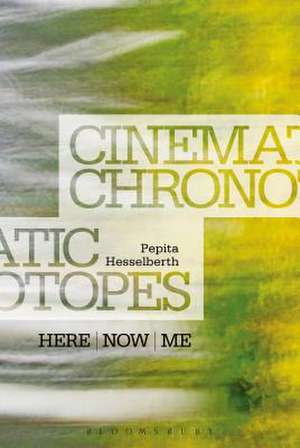
Cinematic Chronotopes: Here, Now, Me
Autor Pepita Hesselberthen Limba Engleză Paperback – 17 dec 2015
Preț: 276.29 lei
Preț vechi: 328.63 lei
-16%
Puncte Express: 414
Carte tipărită la comandă
Livrare economică 07-21 decembrie
Livrare prin curier în România Termenul estimat este afișat lângă disponibilitate.
Transport gratuit de la 400.00 lei Plată online sau ramburs, în funcție de opțiunile comenzii.
Retur gratuit în 14 zile Comandă securizată și suport în română.
Specificații
ISBN-13: 9781501316104
ISBN-10: 1501316109
Pagini: 202
Ilustrații: 85 bw illus
Dimensiuni: 152 x 229 x 11 mm
Greutate: 0.28 kg
Editura: Bloomsbury Publishing
Colecția Bloomsbury Academic
Locul publicării:New York, United States
ISBN-10: 1501316109
Pagini: 202
Ilustrații: 85 bw illus
Dimensiuni: 152 x 229 x 11 mm
Greutate: 0.28 kg
Editura: Bloomsbury Publishing
Colecția Bloomsbury Academic
Locul publicării:New York, United States
V-ar putea interesa
-
 Psycho in the Shower: The History of Cinema's Most Famous ScenePhilip J. Skerry-41%Preț: 132.03 lei223.35 lei
 -
 An Auteurist History of FilmCharles Silver-15%Preț: 142.27 lei168.10 lei
 -
 Amateur Filmmaking: The Home Movie, the Archive, the WebLaura RascaroliPreț: 262.29 lei
 -
 Cinema II: The Time-ImageGilles Deleuze-19%Preț: 171.54 lei211.01 lei
 -
 The Universal ExceptionSlavoj Zizek-24%Preț: 184.32 lei242.25 lei
 -
 Art of HorrorStephen JonesPreț: 323.09 lei
 -
 Acting: Behind the Silver Screen: A Modern History of FilmmakingClaudia Springer-25%Preț: 190.01 lei252.61 lei
 -
 The 50 Greatest WesternsBarry StonePreț: 65.59 lei
 -
 -13%Preț: 99.52 lei114.26 lei
 -
 Preț: 401.52 lei
 -
 ExhibitionistRichard Dorment-27%Preț: 173.78 lei237.18 lei
Cuprins
Acknowledgements
List of Illustrations
Introduction
The Site of Cinema
Cinematic Time
Deixis
Flashing Forward
HERE - Locating the Cinematic
Expanded Cinema: Proliferating Screens
It's About Time (Or Is It?): Situating
Other Rooms: Re-scaling
Outer and Inner Space: Expanding
Locating the Cinematic: Here
NOW - Navigating Cinematic Time
Handheld Histories: Authenticity, Reflexivity, Corporeality
Authentic Encounters: Zusje (Little Sister)
Affective Encounters: Rosetta
Traumatic Encounters: Idioterne (The Idiots)
Navigating Cinematic Time: Now
Me - Situating Cinematic Presence
3D and the Demise of the Euclidian Subject
Projection: From Subject-Effect to Presence-Effect
Presence and the Temporality of the Event
The Experience of Agency
Situating Cinematic Presence: Me
Coda - Flash Forward
Notes
Filmography
Bibliography
Index
List of Illustrations
Introduction
The Site of Cinema
Cinematic Time
Deixis
Flashing Forward
HERE - Locating the Cinematic
Expanded Cinema: Proliferating Screens
It's About Time (Or Is It?): Situating
Other Rooms: Re-scaling
Outer and Inner Space: Expanding
Locating the Cinematic: Here
NOW - Navigating Cinematic Time
Handheld Histories: Authenticity, Reflexivity, Corporeality
Authentic Encounters: Zusje (Little Sister)
Affective Encounters: Rosetta
Traumatic Encounters: Idioterne (The Idiots)
Navigating Cinematic Time: Now
Me - Situating Cinematic Presence
3D and the Demise of the Euclidian Subject
Projection: From Subject-Effect to Presence-Effect
Presence and the Temporality of the Event
The Experience of Agency
Situating Cinematic Presence: Me
Coda - Flash Forward
Notes
Filmography
Bibliography
Index
Recenzii
Pepita Hesselberth's Cinematic Chronotopes contributes to the contemporary debate about the survival and role of cinema in the era of digital media.
The question of cinematic time has become one of the key issues in contemporary film studies, and Cinematic Chronotopes tackles this issue in an original way, navigating between the idea that time has been eviscerated and the Deleuzean position that cinema immerses us in the time-image. This is a work full of great insights and edifying film analyses.
Cinema and video art experiments with space, time and agency, warping and multiplying them outside of their linguistic indices by embodying them as affective encounters. Cinematic Chronotopes analyses these encounters across a range of sites, from Andy Warhol to Rafael Lozano-Hemmer, from Lars Von Trier's The Idiots to Duncan Jones' Source Code: in every case it offers us fundamental insights into the power of the moving image to relocate the viewer and itself within a living, mutating space-time.
Cinematic Chronotopes is an ambitious work that connects our contemporary multimediated lives with the potential of the 'cinematic'. At once sensitive to the accomplishment of film theory and the need for more nuanced discussions of new image experiences, Hesselberth offers a valuable model for re-engaging the cinematic self in the post-cinematic age
Pepita Hesselberth's Cinematic Chronotopes disassembles two decades of film culture: in the gallery, in the European art cinema, in projections into public space and in recent Hollywood. Taking on and rewriting influential accounts of the time-image, phenomenological, historical and formal film criticism, she gives a new account of the moving image as art of time, and of subjectivity as process engendered in the cinematic encounter that is as profound as it is innovative.
The question of cinematic time has become one of the key issues in contemporary film studies, and Cinematic Chronotopes tackles this issue in an original way, navigating between the idea that time has been eviscerated and the Deleuzean position that cinema immerses us in the time-image. This is a work full of great insights and edifying film analyses.
Cinema and video art experiments with space, time and agency, warping and multiplying them outside of their linguistic indices by embodying them as affective encounters. Cinematic Chronotopes analyses these encounters across a range of sites, from Andy Warhol to Rafael Lozano-Hemmer, from Lars Von Trier's The Idiots to Duncan Jones' Source Code: in every case it offers us fundamental insights into the power of the moving image to relocate the viewer and itself within a living, mutating space-time.
Cinematic Chronotopes is an ambitious work that connects our contemporary multimediated lives with the potential of the 'cinematic'. At once sensitive to the accomplishment of film theory and the need for more nuanced discussions of new image experiences, Hesselberth offers a valuable model for re-engaging the cinematic self in the post-cinematic age
Pepita Hesselberth's Cinematic Chronotopes disassembles two decades of film culture: in the gallery, in the European art cinema, in projections into public space and in recent Hollywood. Taking on and rewriting influential accounts of the time-image, phenomenological, historical and formal film criticism, she gives a new account of the moving image as art of time, and of subjectivity as process engendered in the cinematic encounter that is as profound as it is innovative.