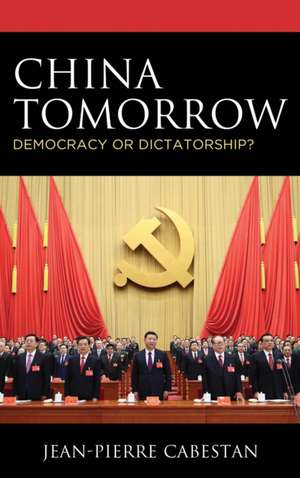
China Tomorrow: Democracy or Dictatorship?
Autor Jean-Pierre Cabestanen Limba Engleză Paperback – 21 iun 2019
Relevanța acestui volum pentru cercetătorii în științe politice și analiștii de relații internaționale rezidă în capacitatea sa de a demonta mitul tranziției democratice inevitabile, oferind un suport teoretic esențial pentru înțelegerea regimurilor autoritare moderne. Într-un peisaj academic marcat de speranța că expansiunea clasei de mijloc va eroda totalitarismul, Jean-Pierre Cabestan propune o perspectivă sobră și ancorată în realitatea instituțională chineză. Subliniem faptul că autorul nu se limitează la o observație superficială, ci analizează modul în care ideologia sovietică și tradiția birocratică au creat un „echilibru autoritar sustenabil”.
Structura lucrării urmărește o progresie logică, de la analiza sistemului actual la explorarea culturii democratice reprimate și a rolului elitelor în modelarea viitorului imperial al Chinei. Cititorii familiarizați cu China’s Long Quest for Democracy de Lin Gang vor aprecia modul în care Cabestan aprofundează reziliența sistemului de partid unic, oferind o replică argumentată teoriilor despre schimbarea dihotomică a sistemelor politice. În timp ce alte lucrări se concentrează pe tranziție, China Tomorrow evidențiază adaptabilitatea Partidului Comunist.
Această lucrare se înscrie natural în bibliografia autorului, completând analizele sale anterioare din Facing China sau China and the Global Financial Crisis. Dacă în lucrările precedente Cabestan explora poziționarea globală a Chinei, aici el sondează mecanismele interne de control. Remarcăm tonul precis și argumentația densă, care transformă acest volum într-o resursă fundamentală pentru înțelegerea direcției spre care se îndreaptă cel mai populat stat al lumii sub o dictatură digitală și birocratică.
Preț: 220.56 lei
Preț vechi: 292.94 lei
-25%
Carte tipărită la comandă
Livrare economică 08-22 decembrie
Specificații
ISBN-10: 1538129582
Pagini: 192
Dimensiuni: 151 x 230 x 17 mm
Greutate: 0.33 kg
Editura: Bloomsbury Publishing
Colecția Rowman & Littlefield
Locul publicării:New York, United States
V-ar putea interesa
-
 The Ascension FactorFrank HerbertPreț: 120.59 lei
 -
 Die Neuerfindung der DiktaturKai StrittmatterPreț: 106.19 lei
De ce să citești această carte
Această carte este indispensabilă pentru profesioniștii din diplomație și studenții la științe politice care doresc să înțeleagă de ce modelul democratic occidental nu se aplică în China. Jean-Pierre Cabestan oferă o analiză lucidă a modului în care securitatea și prosperitatea economică sunt folosite pentru a legitima un regim autoritar, oferind cititorului instrumentele necesare pentru a evalua corect riscurile geopolitice viitoare.
Descriere
Cuprins
1 China's Current Political System: A Strong, Sustainable, Authoritarian Equilibrium
2 Bureaucratic Tradition and the Soviet Model: Patterns of State Hegemony
3 Democratic Culture: Repressed, Fragile, and Distorted
4 Civil Society: Leashed by the Party-State
5 The Role of Elites: Shaping Political Evolution
6 China's Future: Toward an Authoritarian and Imperial Political System
A Regime on Extended Reprieve
About the Author
Recenzii
The book is a careful and structured look at an emerging super power, and especially the carefully constructed party-state as it emerges under Xi. . . . The book makes an important and unapologetic contribution to a more realistic appreciation of modern China.
Cabestan has used his long scholarly engagement with China and wide reading to describe the remarkable hybridity of the Communist Party and the ways that this operates as a source of strength and flexibility. This is a nuanced and focused corrective to the more apocalyptic work on China's future-one that shows that while beset by challenges, the party's keen sense of survival and its use of opacity and control means it is likely to be the only viable game in town for some time yet.
In this impressively well-informed book, Cabestan presents a comprehensive analysis of China's political system, its history and culture, and its policies and achievements. He argues convincingly that even though the Chinese system is beset with difficulties, it is too strong to collapse for a long time to come. And even when the current system does finally weaken, it is likely to remain authoritarian and resistant to Western influence, only less orderly and more dangerous than it is today. This is a valuable contribution to our understanding of China today and our ability to understand its probable future.
Don't be misled by the question mark: China tomorrow-and for the next decade at least-will remain dictatorial. Most Chinese are grateful to the regime that relieved them from poverty. Far beyond this commonsense remark, Cabestan's comprehensive analysis of factors such as democratic values, civil society, and the role of elites takes care to give full weight to every conceivable objection before concluding in favor of the party-state's resilience. For such an audacious synthesis dealing with the future to be convincing is both wonderful and unfortunate: Cabestan himself would prefer to be proven wrong.