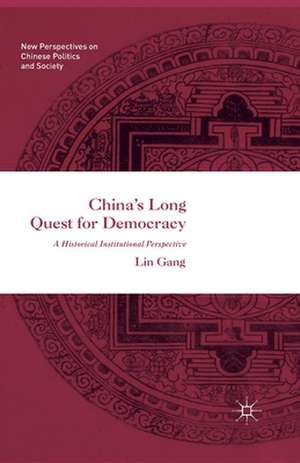
China's Long Quest for Democracy
Autor Lin Gangen Limba Engleză Paperback – 11 feb 2020
Preț: 638.76 lei
Preț vechi: 751.48 lei
-15%
Puncte Express: 958
Carte tipărită la comandă
Livrare economică 18 noiembrie-02 decembrie
Livrare prin curier în România Termenul estimat este afișat lângă disponibilitate.
Transport gratuit pentru acest produs Plată online sau ramburs, în funcție de opțiunile comenzii.
Retur gratuit în 14 zile Comandă securizată și suport în română.
Specificații
ISBN-13: 9781349959853
ISBN-10: 1349959855
Pagini: 248
Ilustrații: VII, 239 p.
Dimensiuni: 140 x 216 x 14 mm
Greutate: 0.32 kg
Ediția:1st ed. 2016
Editura: Palgrave MacMillan
Locul publicării:New York, United States
ISBN-10: 1349959855
Pagini: 248
Ilustrații: VII, 239 p.
Dimensiuni: 140 x 216 x 14 mm
Greutate: 0.32 kg
Ediția:1st ed. 2016
Editura: Palgrave MacMillan
Locul publicării:New York, United States
V-ar putea interesa
-
 On RevolutionHannah ArendtPreț: 99.15 lei
 -
 Human Rights in Criminal ProceedingsStefan Trechsel-17%Preț: 736.90 lei883.19 lei
 -
 Marx TodayJ. SittonPreț: 421.47 lei
 -
 Preț: 341.13 lei
 -
 Deliberative Democracy: A Critical IntroductionZsuzsanna ChappellPreț: 283.29 lei
 -
 Pragmatism and DiversityJ. GreenPreț: 389.67 lei
 -
 -15%Preț: 661.22 lei777.90 lei
 -
 The Politics of Harry PotterB. Barratt-15%Preț: 524.73 lei617.33 lei
 -
 Security Studies: A ReaderChristopher W. Hughes-8%Preț: 425.02 lei461.98 lei
 -
 The Quest for Cosmic JusticeThomas SowellPreț: 100.44 lei
 -
 Idiot America: How Stupidity Became a Virtue in the Land of the FreeCharles P. PiercePreț: 65.57 lei
 -
 The Civic Culture RevisitedGabriel Abraham Almond-18%Preț: 822.45 lei1003.00 lei
 -
 On Power: The Natural History of Its GrowthBertrand Jouvenel-11%Preț: 85.21 lei96.10 lei
 -
 Sovereignty: An Enquiry into the Political GoodBertrand de JouvenelPreț: 95.87 lei
Cuprins
1. Introduction.- 2. Liberal Democratic Principles and China's Authoritarian Tradition.- 3. Ideological Transportation in Pre-Reform China.- 4. Evolution of Democratic Ideas in Post-Mao China.- 5. From a 'Party State' toward the a 'State-Party'.- 6. Institutional Innovations toward Democracy.- 7. Conclusions.
Notă biografică
Lin Gang is Distinguished Professor of Political Science, Academic Committee Chair of the School of International and Public Affairs, and Director of the Center for Taiwan Studies at Shanghai Jiao Tong University, China. He has served as Program Associate at the Woodrow Wilson Center and President of the Association of Chinese Political Studies. He is the author of several books, including China after Jiang.
Textul de pe ultima copertă
Conceptualizing China as a country with rapid economic transformation and little political progress has led to a normative misjudgment that economic reform should occur before significant democratization.
This book compares several historical junctures during China's long journey towards democracy to observe the constraints of pre-chosen ideological and institutional patterns on political elites in advancing legal and electoral reforms.
Confucian legacies of moralism, elitism, and state centralism, in addition to revolutionary guardianship and populism remain embedded in Chinese practice in rule by law, grassroots autonomy, and intra-party democracy.
However, China's hope for democratic development is encouraged by urban and educational development, generational change and growing individualism. This book explores the feasible paths toward democracy in China, challenging methodological wisdom in employing quantitative changes in socioeconomic structure to predict change in the political system.
This book compares several historical junctures during China's long journey towards democracy to observe the constraints of pre-chosen ideological and institutional patterns on political elites in advancing legal and electoral reforms.
Confucian legacies of moralism, elitism, and state centralism, in addition to revolutionary guardianship and populism remain embedded in Chinese practice in rule by law, grassroots autonomy, and intra-party democracy.
However, China's hope for democratic development is encouraged by urban and educational development, generational change and growing individualism. This book explores the feasible paths toward democracy in China, challenging methodological wisdom in employing quantitative changes in socioeconomic structure to predict change in the political system.