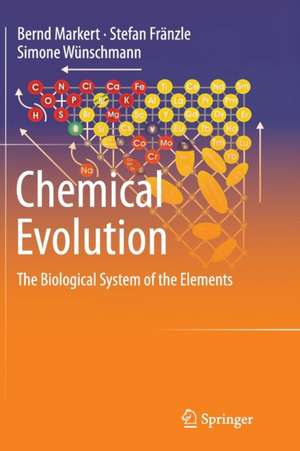
Chemical Evolution
Autor Bernd Markert, Stefan Fränzle, Simone Wünschmannen Limba Engleză Paperback – 5 oct 2016
Această monografie de cercetare publicată de Springer propune o schimbare de paradigmă în înțelegerea rolului elementelor chimice în sistemele biologice și de mediu. Notăm cu interes teza centrală a autorilor: Sistemul Periodic al Elementelor (PSE), deși fundamental pentru chimie, oferă o descriere insuficientă pentru complexitatea vieții și a proceselor ecotoxicologice. În acest context, Bernd Markert, Stefan Fränzle și Simone Wünschmann fundamentează conceptul de Sistem Biologic al Elementelor (BSE), bazat pe date multi-element precise și pe relații inter-elementare evolutive. Structura volumului urmărește o progresie logică, pornind de la definiția istorică a disciplinei și avansând spre metodologii avansate, precum Analiza Rețelelor Stoichiometrice (SNA). Reținem importanța acordată coordonării reacțiilor chimice în materialul biologic și influenței majore a apei, solului și atmosferei asupra evoluției chimice. Lucrarea merge dincolo de granițele chimiei bioanorganice clasice, introducând „cărțile de identitate ecotoxicologice”, instrumente menite să ofere o descriere aplicată a speciilor chimice relevante pentru mediu. Această lucrare reprezintă o alternativă conceptuală la The Biological Chemistry of the Elements de J. J. R. Fraústo da Silva pentru cursurile de biogeochimie și ecotoxicologie, cu avantajul că integrează perspectiva evoluției chimice și a cercetării spațiale în contextul funcționalității elementelor. Față de lucrările anterioare ale lui Stefan Fränzle, precum Chemical Elements in Plants and Soil: Parameters Controlling Essentiality, volumul de față extinde analiza de la mediul vegetal la o viziune sistemică globală, abordând inclusiv proiectele viitoare de cercetare spațială care vor defini înțelegerea evoluției chimice în deceniile următoare.
Preț: 643.87 lei
Preț vechi: 757.49 lei
-15%
Carte tipărită la comandă
Livrare economică 07-21 decembrie
Specificații
ISBN-10: 3319343467
Pagini: 300
Ilustrații: XVII, 282 p. 75 illus., 48 illus. in color.
Dimensiuni: 155 x 235 x 17 mm
Greutate: 0.46 kg
Ediția:Softcover reprint of the original 1st edition 2015
Editura: Springer
Locul publicării:Cham, Switzerland
V-ar putea interesa
-
 Handbook of Lithium and Natural Calcium ChlorideDonald E. Garrett-27%Preț: 1468.93 lei2016.44 lei
 -
 Metal Phosphonate ChemistryAbraham Clearfield-14%Preț: 1148.57 lei1335.55 lei
 -
 -11%Preț: 368.16 lei413.66 lei
 -
 -15%Preț: 614.90 lei723.41 lei
 -
 Mono to multinuclearMohan Bharara-8%Preț: 459.62 lei499.59 lei
 -
 -18%Preț: 945.75 lei1153.36 lei
 -
 Preț: 78.03 lei
 -
 Preț: 268.20 lei
 -
 -19%Preț: 511.41 lei631.37 lei
 -
 Problemes de Chimie Inorganique: Une Boite Noire?Mourad Cherif-23%Preț: 696.15 lei904.08 lei
 -
 Preț: 444.36 lei
 -
 Ceramiques Techniques: Elaboration de Thermistances CtnAlexis Ngueteu Kamlo-19%Preț: 406.84 lei502.26 lei
 -
 -24%Preț: 849.89 lei1118.28 lei
 -
 Current Trends in X-Ray CrystallographyAnnamalai Chandrasekaran-23%Preț: 951.57 lei1235.81 lei
 -
 SupercoolingPeter Wilson-23%Preț: 805.25 lei1045.78 lei
 -
 Advances in Crystallization ProcessesYitzhak Mastai-23%Preț: 1100.93 lei1429.78 lei
 -
 Recent Advances in CrystallographyJason B. Benedict-23%Preț: 941.38 lei1222.58 lei
 -
 CrystallizationMarcello Andreeta-23%Preț: 1093.54 lei1420.18 lei
 -
 Tungsten CarbideKui Liu-23%Preț: 805.55 lei1046.16 lei
De ce să citești această carte
Recomandăm această monografie cercetătorilor și studenților avansați care doresc să depășească viziunea statică a tabelului periodic. Cititorul câștigă un cadru teoretic nou pentru interpretarea ecotoxicologiei și a fiziologiei elementelor. Este un instrument esențial pentru înțelegerea modului în care speciile chimice nu doar există în mediu, ci interacționează dinamic în rețele stoichiometrice complexe, definind însăși evoluția vieții.
Despre autor
Bernd Markert, Stefan Fränzle și Simone Wünschmann sunt cercetători recunoscuți în domeniul chimiei mediului și al biogeochimiei. Stefan Fränzle a publicat anterior lucrări fundamentale despre esențialitatea elementelor chimice în plante și sol, explorând relațiile contra-intuitive din nutriția minerală. Bernd Markert este cunoscut pentru abordările sale interdisciplinare în monitorizarea mediului. Prezentul volum reflectă expertiza lor comună în dezvoltarea Sistemului Biologic al Elementelor, o direcție de cercetare care integrează datele analitice riguroase cu viziunea sistemică asupra evoluției biosferei.
Descriere scurtă
Cuprins
Recenzii
“The book explains the methodology of the field through stoichiometric network analysis and ends with recent work and future studies anticipated in space research. Figures throughout are well placed and enhance the overall quality of the text, but it is the inclusion of several informative and detailed tables that makes this book valuable to scientists studying the onset of systems (chemical or biological) driven by evolution and natural selection. … Summing Up: Recommended. Graduate students and researchers/faculty.” (C. Sokolik, Choice, Vol. 53 (2), October, 2015)
Notă biografică
Born 1958 in Meppen, Germany; Univ.-Prof. Dr. rer. nat., Dr. rer. nat. habil, natural scientist. Studies in Chemistry and Biology, Ludwig Maximilian University of Munich, Germany. Ph.D in 1986 and habilitation for ecology in 1993 at the University of Osnabrueck (Germany). Former Director of the International Graduate School Zittau and Univ.-Professor for Environmental High Technology. Currently structuring an “Environmental Institute of Scientific Networks” (EISN-Institute.de) in Haren, Germany. Publications: author/co-author / editor/co-editor of about 400 scientific papers and 21 scientific books. Research interests: Biochemistry of trace substances in the water/soil/plant/animal/human system; Instrumental analysis of chemical elements; Developing the “Biological System of the Elements”; Eco- and human-toxicological aspects of hazardous substances; Pollution control by use of bioindicators and biomonitors. Development of technologies for waste management, environmental restoration and remedial action on soils; Different interdisciplinary working fields of economic and social sciences.
Stefan Fränzle
Born 1961 in Bonn, Germany; Dr. rer. nat. habil., natural scientist. Studies in inorganic- and photochemistry and astronomy at the Christian - Albrechts - University of Kiel, Germany. Ph.D. in 1992 and habilitation for environmental sciences (chemical focus) in 2008 at the University of Vechta (Germany). Scientific assistant at the International Graduate School Zittau, Germany. Publications: author/co-author of about 75 scientific papers and eight scientific books. Research interests: Working about the “Biological System of Elements”, reconstruction of conditions of chemical and biological evolution, implication of interelement abundance correlations for biomonitoring, the theory of the dynamics of the cell cycle (cancer and chemotherapy), wastewater treatment with visible light.
Simone Wünschmann
Born 1967 in Heidelberg, Germany; Dr. rer. nat, natural scientist. Former scientific assistant at the International Graduate School Zittau, Germany, Department of Environmental High Technology; Working group for Human- and Ecotoxicology. Degree of a Diploma Engineer for Ecology and Environmental Protection at the University of Applied Sciences Zittau/Görlitz, Germany; Ph.D in Environmental Sciences at the University of Vechta, Germany. Currently team member of the Environmental Institute of Scientific Networks (EISN-Institute.de). Publications: author/co-author of about 40 scientific papers and 4 scientific books. Participant of more than 50 international conferences. Research interests: Pollution control; human- and ecotoxicology; ecology and environmental protection; environmental engineering with emphasis on renewable energy.