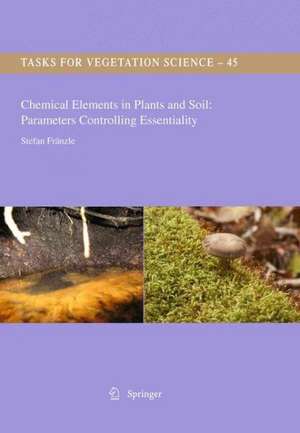
Chemical Elements in Plants and Soil: Parameters Controlling Essentiality: Tasks for Vegetation Science, cartea 45
Autor Stefan Fränzleen Limba Engleză Paperback – 2 noi 2014
In an attempt to provide a more coherent theory behind plant mineral nutrition, this groundbreaking book adopts a very different approach from the existing literature, presenting an explanation of the essentiality of chemical elements in biological systems and the application of stoichiometric network analysis (SNA) to the biological system of elements. Starting with data from biochemical environmental analysis, and a discussion of the phenomena involved in metal ion partition and autocatalytic behaviour, conditions and criteria controlling the partition of metals into biomass are investigated. Several rules are derived and investigated in terms of their interaction both in comparisons among contemporary organisms and in terms of evolution. This allows the construction, for example of a map which directly traces the biological feature of essentiality to parameters of coordination chemistry.
The book will have worldwide appeal for researchers interested in fields such as soil/plant interactions, bioinorganic chemistry, plant nutrition, phytomining, bioremediation, biogeochemistry, nutrient cycling, soil chemistry, and cellular physiology.
Din seria Tasks for Vegetation Science
-
 Preț: 33.22 lei
- 18%
 Preț: 1171.70 lei
- 20%
 Preț: 599.79 lei
-
 Preț: 382.49 lei
-
 Preț: 380.99 lei
-
 Preț: 387.47 lei
- 24%
 Preț: 854.48 lei
- 18%
 Preț: 1754.49 lei
- 18%
 Preț: 1171.27 lei
- 18%
 Preț: 1263.54 lei
-
 Preț: 71.00 lei
- 18%
 Preț: 1174.45 lei
- 18%
 Preț: 1171.27 lei
-
 Preț: 424.29 lei
-
 Preț: 381.92 lei
- 18%
 Preț: 1172.94 lei
- 18%
 Preț: 905.27 lei
- 18%
 Preț: 907.10 lei
- 24%
 Preț: 1707.09 lei
- 18%
 Preț: 1183.12 lei
- 24%
 Preț: 916.13 lei
- 24%
 Preț: 1136.03 lei
-
 Preț: 401.02 lei
- 18%
 Preț: 1268.20 lei
- 24%
 Preț: 847.22 lei
- 18%
 Preț: 904.83 lei
- 18%
 Preț: 947.94 lei
- 24%
 Preț: 1148.45 lei
- 18%
 Preț: 1183.12 lei
- 18%
 Preț: 1228.89 lei
- 24%
 Preț: 856.71 lei
- 24%
 Preț: 1210.38 lei
- 18%
 Preț: 914.66 lei
- 18%
 Preț: 985.87 lei
- 24%
 Preț: 849.83 lei
- 18%
 Preț: 913.62 lei
- 24%
 Preț: 873.74 lei
- 15%
 Preț: 679.53 lei
- 18%
 Preț: 1000.20 lei
- 18%
 Preț: 920.28 lei
- 24%
 Preț: 948.53 lei
-
 Preț: 389.65 lei
- 18%
 Preț: 1170.96 lei
Preț: 849.89 lei
Preț vechi: 1118.28 lei
-24%
Puncte Express: 1275
Carte tipărită la comandă
Livrare economică 03-09 decembrie
Livrare prin curier în România Termenul estimat este afișat lângă disponibilitate.
Transport gratuit pentru acest produs Plată online sau ramburs, în funcție de opțiunile comenzii.
Retur gratuit în 14 zile Comandă securizată și suport în română.
Specificații
ISBN-13: 9789400791848
ISBN-10: 9400791844
Pagini: 204
Ilustrații: VIII, 196 p.
Dimensiuni: 193 x 260 x 11 mm
Greutate: 0.44 kg
Ediția:2010
Editura: SPRINGER NETHERLANDS
Colecția Springer
Seria Tasks for Vegetation Science
Locul publicării:Dordrecht, Netherlands
ISBN-10: 9400791844
Pagini: 204
Ilustrații: VIII, 196 p.
Dimensiuni: 193 x 260 x 11 mm
Greutate: 0.44 kg
Ediția:2010
Editura: SPRINGER NETHERLANDS
Colecția Springer
Seria Tasks for Vegetation Science
Locul publicării:Dordrecht, Netherlands
V-ar putea interesa
-
 Astrobiology: A Very Short IntroductionDavid C. Catling-20%Preț: 57.15 lei71.12 lei
-
 The Biology of Peatlands, 2eHÃ¥kan Rydin-21%Preț: 544.87 lei689.64 lei
-
 Structural Equation Modeling and Natural SystemsJames Grace-11%Preț: 487.67 lei547.94 lei
-
 Experiments in EcologyA. J. Underwood-8%Preț: 597.69 lei649.66 lei
-
 Wildlife Ecology, Conservation, and Management 3eAnthony R. E. SinclairPreț: 468.80 lei
-
 Ecological Challenges and Conservation ConundrumsJohn A. Wiens-8%Preț: 569.17 lei618.67 lei
-
 -8%Preț: 523.37 lei568.88 lei
-
 Ecological Processes HandbookLuca Palmeri-18%Preț: 1265.62 lei1543.44 lei
-
 Tools for Oceanography and Ecosystemic ModelingAndré Monaco-9%Preț: 1025.51 lei1126.93 lei
-
 The Ecology of Browsing and GrazingIain J. Gordon-18%Preț: 922.01 lei1124.41 lei
-
 How Likely is Extraterrestrial Life?J. Woods HalleyPreț: 382.81 lei
-
 Evolution of Sexual Reproduction in Marine InvertebratesAndrew (Andrey N. Ostrovsky-24%Preț: 1224.79 lei1611.55 lei
Public țintă
ResearchCuprins
From the contents
Introduction.- 1. The biological System of Elements. 1.1. Principles of Element Distribution in Plants. 1.2. Methodology of Inquiries into the Biological System of Elements.- 2. Autocatalytic Processes and the Role of Essential Elements in Plant Growth. 2.1. Biomass Stability in the Light of Gibbs's Phase Rule. 2.2. Coordination-Chemical Control of Element Uptake. 2.3. Some Remarks on Chemical Ecology.- 3. A Causal Model of Biochemical Essentiality. 3.1. Influence of Intrinsic Bonding Stability and Ligand Sensitivity on the Biocatalytic Properties of Metal Ions. 3.2. Complex Stability in Relation to other Bioorganic Parameters. 3.3. Scope of the Essentiality Model.- 4. The Evolution of Essentiality. 4.1. Evolution and Biochemical Catalysis. 4.2. The Three-Function-Rule as a Controlling Factor in the Origins of Essentiality. 4.3. Biogeochemical Fractionation Processes and essentiality Patterns in Different Taxa under Changing Biogeochemical Boundary Conditions.- References.
Introduction.- 1. The biological System of Elements. 1.1. Principles of Element Distribution in Plants. 1.2. Methodology of Inquiries into the Biological System of Elements.- 2. Autocatalytic Processes and the Role of Essential Elements in Plant Growth. 2.1. Biomass Stability in the Light of Gibbs's Phase Rule. 2.2. Coordination-Chemical Control of Element Uptake. 2.3. Some Remarks on Chemical Ecology.- 3. A Causal Model of Biochemical Essentiality. 3.1. Influence of Intrinsic Bonding Stability and Ligand Sensitivity on the Biocatalytic Properties of Metal Ions. 3.2. Complex Stability in Relation to other Bioorganic Parameters. 3.3. Scope of the Essentiality Model.- 4. The Evolution of Essentiality. 4.1. Evolution and Biochemical Catalysis. 4.2. The Three-Function-Rule as a Controlling Factor in the Origins of Essentiality. 4.3. Biogeochemical Fractionation Processes and essentiality Patterns in Different Taxa under Changing Biogeochemical Boundary Conditions.- References.
Textul de pe ultima copertă
Earlier works on plant essential elements have revealed a series of complicated, counter-intuitive relationships among various chemical elements in different plant species, due to both unlike usage of certain elements in plants and to different carriers effecting resorption and transport.
In an attempt to provide a more coherent theory behind plant mineral nutrition, this groundbreaking book adopts a very different approach from the existing literature, presenting an explanation of the essentiality of chemical elements in biological systems and the application of stoichiometric network analysis (SNA) to the biological system of elements. Starting with data from biochemical environmental analysis, and a discussion of the phenomena involved in metal ion partition and autocatalytic behaviour, conditions and criteria controlling the partition of metals into biomass are investigated. Several rules are derived and investigated in terms of their interaction both in comparisons among contemporary organisms and in terms of evolution. This allows the construction, for example of a map which directly traces the biological feature of essentiality to parameters of coordination chemistry.
The book will have worldwide appeal for researchers interested in fields such as soil/plant interactions, bioinorganic chemistry, plant nutrition, phytomining, bioremediation, biogeochemistry, nutrient cycling, soil chemistry, and cellular physiology.
Caracteristici
Novel thinking on plant nutrition Good summary of extensive publication outputs over past 10 years A correlation between bioinorganic chemistry and systems biology A/n (evolutionary) model of biochemical essentiality of chemical elements
Notă biografică
Bernd Markert
Born 1958 in Meppen, Germany; Univ.-Prof. Dr. rer. nat., Dr. rer. nat. habil, natural scientist. Studies in Chemistry and Biology, Ludwig Maximilian University of Munich, Germany. Ph.D in 1986 and habilitation for ecology in 1993 at the University of Osnabrueck (Germany). Former Director of the International Graduate School Zittau and Univ.-Professor for Environmental High Technology. Currently structuring an "Environmental Institute of Scientific Networks" (EISN-Institute.de) in Haren, Germany. Publications: author/co-author / editor/co-editor of about 400 scientific papers and 21 scientific books. Research interests: Biochemistry of trace substances in the water/soil/plant/animal/human system; Instrumental analysis of chemical elements; Developing the "Biological System of the Elements"; Eco- and human-toxicological aspects of hazardous substances; Pollution control by use of bioindicators and biomonitors. Development of technologies for waste management, environmental restoration and remedial action on soils; Different interdisciplinary working fields of economic and social sciences.
Stefan Fränzle
Born 1961 in Bonn, Germany; Dr. rer. nat. habil., natural scientist. Studies in inorganic- and photochemistry and astronomy at the Christian - Albrechts - University of Kiel, Germany. Ph.D. in 1992 and habilitation for environmental sciences (chemical focus) in 2008 at the University of Vechta (Germany). Scientific assistant at the International Graduate School Zittau, Germany. Publications: author/co-author of about 75 scientific papers and eight scientific books. Research interests: Working about the "Biological System of Elements", reconstruction of conditions of chemical and biological evolution, implication of interelement abundance correlations for biomonitoring, the theory of the dynamics of the cell cycle (cancer and chemotherapy), wastewater treatment with visible light.
Simone Wünschmann
Born 1967 in Heidelberg, Germany; Dr. rer. nat, natural scientist. Former scientific assistant at the International Graduate School Zittau, Germany, Department of Environmental High Technology; Working group for Human- and Ecotoxicology. Degree of a Diploma Engineer for Ecology and Environmental Protection at the University of Applied Sciences Zittau/Görlitz, Germany; Ph.D in Environmental Sciences at the University of Vechta, Germany. Currently team member of the Environmental Institute of Scientific Networks (EISN-Institute.de). Publications: author/co-author of about 40 scientific papers and 4 scientific books. Participant of more than 50 international conferences. Research interests: Pollution control; human- and ecotoxicology; ecology and environmental protection; environmental engineering with emphasis on renewable energy.