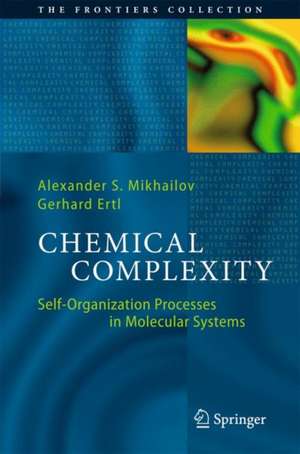
Chemical Complexity
Autor Alexander S. Mikhailov, Gerhard Ertlen Limba Engleză Hardback – 23 aug 2017
Traditionally, physical chemistry has been concerned with interactions between atoms and molecules that produce a variety of equilibrium structures - or the 'dead' order - in a stationary state. But biological cells exhibit a different 'living' kind of order, prompting E. Schrödinger to pose his famous question “What is life?” in 1943. Through an unprecedented theoretical and experimental development, it was later revealed that biological self-organization phenomena are in complete agreement with the laws of physics, once they are applied to a special class of thermodynamically open systems and non-equilibrium states. This knowledge has in turn led tothe design and synthesis of simple inorganic systems capable of self-organization effects. These artificial 'living organisms' are able to operate on macroscopic to microscopic scales, even down to single-molecule machines. In the future, such research could provide a basis for a technological breakthrough, comparable in its impact with the invention of lasers and semiconductors. Its results can be used to control natural chemical processes, and to design artificial complex chemical processes with various functionalities. The book offers an extensive discussion of the history of research on complex chemical systems and its future prospects.
Preț: 754.69 lei
Preț vechi: 920.36 lei
-18%
Puncte Express: 1132
Carte tipărită la comandă
Livrare economică 05-19 decembrie
Livrare prin curier în România Termenul estimat este afișat lângă disponibilitate.
Transport gratuit pentru acest produs Plată online sau ramburs, în funcție de opțiunile comenzii.
Retur gratuit în 14 zile Comandă securizată și suport în română.
Specificații
ISBN-13: 9783319573755
ISBN-10: 3319573756
Pagini: 216
Ilustrații: VII, 208 p. 137 illus., 57 illus. in color.
Dimensiuni: 160 x 241 x 18 mm
Greutate: 0.44 kg
Ediția:1st edition 2017
Editura: Springer
Locul publicării:Cham, Switzerland
ISBN-10: 3319573756
Pagini: 216
Ilustrații: VII, 208 p. 137 illus., 57 illus. in color.
Dimensiuni: 160 x 241 x 18 mm
Greutate: 0.44 kg
Ediția:1st edition 2017
Editura: Springer
Locul publicării:Cham, Switzerland
V-ar putea interesa
-
 Capillarity and Wetting PhenomenaPierre Gilles de Gennes-15%Preț: 613.01 lei721.19 lei
 -
 -9%Preț: 927.72 lei1019.47 lei
 -
 Models for Bonding in ChemistryValerio MagnascoPreț: 375.58 lei
 -
 The Computation of Chemical EquilibriaVan Zeggeren FPreț: 379.31 lei
 -
 -18%Preț: 1185.08 lei1445.22 lei
 -
 -18%Preț: 728.04 lei887.84 lei
 -
 Current Trends of Surface Science and CatalysisJeong Young Park-15%Preț: 668.50 lei786.47 lei
 -
 Chemical Thermodynamics: An IntroductionErnö KeszeiPreț: 446.10 lei
 -
 Frustrated Lewis Pairs IGerhard Erker-18%Preț: 1270.64 lei1549.56 lei
 -
 Plasma Chemistry IIIS. Veprek-15%Preț: 636.56 lei748.89 lei
 -
 INTRO TO INTERFACES & COLLOIDS,ANBerg John CPreț: 516.23 lei
Cuprins
Self-organization vs. self-assembly.- Thermodynamics of open systems.- The Turing instability.- Waves in the heart.- The Belousov-Zhabotinsky reaction.- Surface catalysis.- Corrosion of steels.- Nonequilibrium soft matter.- Phase transitions in reactive systems.- Self-organization in biological cells.- Protein machines and molecular motors.- Active propulsion on microscales.- Oscillators and synchronization phenomena.- Chemical chaos.- Network problems.- Design and control of self-organizing systems.- Open problems and application perspectives.
Textul de pe ultima copertă
This book provides an outline of theoretical concepts and their experimental verification in studies of self-organization phenomena in chemical systems, as they emerged in the mid-20th century and have evolved since. Presenting essays on selected topics, it was prepared by authors who have made profound contributions to the field.
Traditionally, physical chemistry has been concerned with interactions between atoms and molecules that produce a variety of equilibrium structures - or the 'dead' order - in a stationary state. But biological cells exhibit a different 'living' kind of order, prompting E. Schrödinger to pose his famous question “What is life?” in 1943. Through an unprecedented theoretical and experimental development, it was later revealed that biological self-organization phenomena are in complete agreement with the laws of physics, once they are applied to a special class of thermodynamically open systems and non-equilibrium states. This knowledgehas in turn led to the design and synthesis of simple inorganic systems capable of self-organization effects. These artificial 'living organisms' are able to operate on macroscopic to microscopic scales, even down to single-molecule machines. In the future, such research could provide a basis for a technological breakthrough, comparable in its impact with the invention of lasers and semiconductors. Its results can be used to control natural chemical processes, and to design artificial complex chemical processes with various functionalities. The book offers an extensive discussion of the history of research on complex chemical systems and its future prospects.
Gerhard Ertl received the Nobel Prize in Chemistry in 2007 for his studies on heterogeneous catalysis and self-organization processes in surface chemical reactions. He was the director of the Physical Chemistry department at the Fritz Haber Institute of the Max Planck Society in Berlin, where he is currently a Professor Emeritus. Prof. Alexander S. Mikhailov, of the same institute, is a theoretical physicist who has been working with G. Ertl for more than twenty years. He is the author of three monographs published by Springer and was awarded the International Solvay Chair in Chemistry in 2009. Together, the authors initiated and organized a series of international conferences on "Engineering of Chemical Complexity".
Traditionally, physical chemistry has been concerned with interactions between atoms and molecules that produce a variety of equilibrium structures - or the 'dead' order - in a stationary state. But biological cells exhibit a different 'living' kind of order, prompting E. Schrödinger to pose his famous question “What is life?” in 1943. Through an unprecedented theoretical and experimental development, it was later revealed that biological self-organization phenomena are in complete agreement with the laws of physics, once they are applied to a special class of thermodynamically open systems and non-equilibrium states. This knowledgehas in turn led to the design and synthesis of simple inorganic systems capable of self-organization effects. These artificial 'living organisms' are able to operate on macroscopic to microscopic scales, even down to single-molecule machines. In the future, such research could provide a basis for a technological breakthrough, comparable in its impact with the invention of lasers and semiconductors. Its results can be used to control natural chemical processes, and to design artificial complex chemical processes with various functionalities. The book offers an extensive discussion of the history of research on complex chemical systems and its future prospects.
Gerhard Ertl received the Nobel Prize in Chemistry in 2007 for his studies on heterogeneous catalysis and self-organization processes in surface chemical reactions. He was the director of the Physical Chemistry department at the Fritz Haber Institute of the Max Planck Society in Berlin, where he is currently a Professor Emeritus. Prof. Alexander S. Mikhailov, of the same institute, is a theoretical physicist who has been working with G. Ertl for more than twenty years. He is the author of three monographs published by Springer and was awarded the International Solvay Chair in Chemistry in 2009. Together, the authors initiated and organized a series of international conferences on "Engineering of Chemical Complexity".
Caracteristici
Authored by leading researchers in the field Provides a non-technical introduction and overview of the field Contains an extensive discussion of the historical developments Includes supplementary material: sn.pub/extras Includes supplementary material: sn.pub/extras