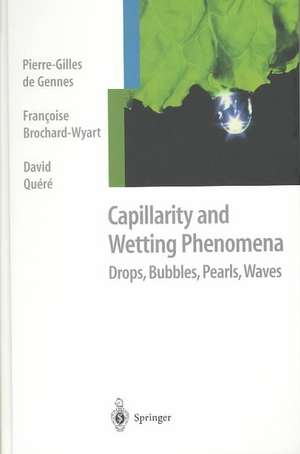
Capillarity and Wetting Phenomena
Autor Pierre Gilles de Gennes, Francoise Brochard-Wyart, David Quereen Limba Engleză Hardback – 12 sep 2003
Găsim în această carte o explorare fascinantă a micro-lumii fluidelor, care pornește de la probleme practice imediate: de ce rămân picăturile mici de ploaie fixate pe parbriz în timp ce altele alunecă, sau cum se explică formarea „mărgelelor” de rouă pe firele unei pânze de păianjen. Notăm cu interes modul în care autorii transformă aceste observații cotidiene în studii de caz fundamentale pentru înțelegerea tensiunii superficiale și a mecanicii interfețelor, oferind soluții aplicabile în domenii diverse, de la industria cosmetică la tratarea fibrelor textile. Capillarity and Wetting Phenomena este organizată metodic în zece capitole, debutând cu studiul interfețelor deformabile și continuând cu influența gravitației, isterezisul liniilor triple și dinamica demouillării (dewetting). Structura indică o progresie logică de la forțele de lungă distanță la hidrodinamica complexă a interfețelor. Putem afirma că lucrarea reprezintă o sinteză accesibilă a conceptelor de „materie moale”, o temă recurentă în opera lui Pierre Gilles de Gennes. Dacă în Fragile Objects sau Simple Views on Condensed Matter autorul explora proprietățile polimerilor și cristalelor lichide, volumul de față se concentrează strict pe fenomenele de suprafață, păstrând stilul clar și intuitiv. Comparabil cu Physics of Wetting de Edward Yu. Bormashenko în rigurozitate, volumul de față se distinge prin actualizarea conceptelor pentru o audiență universitară aflată la început de drum, punând un accent mai mare pe tranziția de la observația calitativă la modelarea matematică. Ediția din 2004, publicată de Springer, rămâne un text de referință prin capacitatea de a explica forțele moleculare care guvernează comportamentul lichidelor în contact cu solidul.
Preț: 570.40 lei
Preț vechi: 671.05 lei
-15%
Carte tipărită la comandă
Livrare economică 08-22 iunie
Specificații
ISBN-10: 0387005927
Pagini: 292
Ilustrații: XVI, 292 p.
Dimensiuni: 159 x 241 x 25 mm
Greutate: 0.61 kg
Ediția:2004 edition
Editura: Springer
Locul publicării:New York, NY, United States
V-ar putea interesa
-
 -18%Preț: 918.59 lei1120.23 lei
 -
 Liquid Surfaces and InterfacesPeter S. Pershan-9%Preț: 1067.38 lei1172.94 lei
 -
 Fundamental Concepts in Heterogeneous CatalysisJens K Nørskov-23%Preț: 588.12 lei763.79 lei
 -
 -19%Preț: 581.11 lei717.42 lei
 -
 Fundamentals of Nanoscale Film AnalysisTerry L. Alford-15%Preț: 564.10 lei663.65 lei
 -
 -18%Preț: 946.35 lei1154.09 lei
 -
 Fragile ObjectsPierre Gilles de Gennes-8%Preț: 400.63 lei435.46 lei
 -
 Current Trends of Surface Science and CatalysisJeong Young Park-15%Preț: 623.80 lei733.88 lei
 -
 Sulfur-Centered Reactive Intermediates in Chemistry and BiologyC. ChatgilialogluPreț: 389.30 lei
 -
 Physical Chemistry and Acid-Base Properties of SurfacesJean-Charles Joud-9%Preț: 943.08 lei1036.35 lei
 -
 Supramolecular Chemistry at SurfacesDavid B Amabilino-14%Preț: 1343.41 lei1562.10 lei
 -
 Semiconductor ElectrochemistryRüdiger Memming-14%Preț: 909.42 lei1057.46 lei
 -
 -14%Preț: 582.71 lei677.57 lei
 -
 Surface and Interface AnalysisRudolf Holze-24%Preț: 864.43 lei1137.42 lei
 -
 Molecules in Interaction with Surfaces and InterfacesReinhold Haberlandt-15%Preț: 633.26 lei745.01 lei
 -
 Plasma Chemistry IIIS. Veprek-15%Preț: 609.39 lei716.93 lei
 -
 Simple Views on Condensed Matter (Expanded Edition)Pierre-Gilles de GennesPreț: 389.45 lei
 -
 SIMPLE VIEWS ON CONDENSED MTTR, 3ED(V12)Gennes Pierre-Gilles dePreț: 355.22 lei
 -
 PETIT POINTGennes Pierre-Gilles dePreț: 183.99 lei
Public țintă
Lower undergraduateDe ce să citești această carte
Această carte este esențială pentru studenții și cercetătorii care doresc să înțeleagă fizica suprafețelor prin lentila unui laureat Nobel. Cititorul câștigă o înțelegere profundă a fenomenelor de capilaritate, de la fundamente teoretice la aplicații industriale concrete. Este o recomandare ideală pentru cei care caută un echilibru între rigoarea științifică și intuiția fizică aplicată în viața de zi cu zi.
Despre autor
Pierre-Gilles de Gennes (1932–2007) a fost un fizician francez de renume mondial, laureat al Premiului Nobel pentru Fizică în 1991. Supranumit de comitetul Nobel „Isaac Newton al timpului nostru”, de Gennes a revoluționat înțelegerea fenomenelor critice în sisteme complexe, în special în domeniul cristalelor lichide și al polimerilor. Alături de colegii săi, Francoise Brochard-Wyart și David Quere, acesta a contribuit fundamental la dezvoltarea fizicii materiei moi, reușind să descrie matematic ordinea în sisteme aparent dezordonate.
Descriere scurtă
Cuprins
Recenzii
Choice
Review by P. R. Douville, emeritus, Central Connecticut State University
"You are an intelligent spider sitting on your web. Early morning light forms tiny rainbows as it passes through the beads of dew strung along the filaments composing your hard-earned handiwork. Why beads? What happened to the water in between each drop? To answer this question, our eight-legged intellectual must first gain an understanding of how liquids such as water actually wet surfaces and why such liquids fail to wet other surfaces. The problem encompasses such subjects as liquids rising up capillary tubes, paint spreading on solid surfaces or liquids spreading on other liquids, the fascinating subject of bubble formation and stability, and why water streams down some surfaces and forms droplets on other surfaces. De Gennes (Collège ((College) de France; Institute Curie), Brochard-Wyart (Institut Curie), and Quéré (Quere) (Collège ((College) deFrance) have written an excellent treatise on these phenomena that opens with a very poetic introduction relating esoteric concepts to everyday observations, and includes chapter references, historical sketches, and a very good discussion of each problem at chapter beginnings. For readers with backgrounds in mathematics, physics, and chemistry, although it is not beyond advanced undergraduates in the sciences and technological fields. Summing Up: Highly recommended. Upper-division undergraduates through professionals; two-year technical program students."
"This book is designed as an elementary introduction to the conceptual framework used in research on wetting/dewetting processes and related capillary phenomena. … a simple and inspiring style of writing allows the authors to ‘convey the sense of curiosity and joy’ that unites researchers in this area … . The range of topics covered and a host of physical ideas and principles the authors describe as guidelines in the field are likely to make this book interesting to a wide audience … ." (Dr. Y. D. Shikhmurzaev, Contemporary Physics, Vol. 46 (1), 2005)
"Capillarity refers to the study of surface phenomena involving at least one liquid phase. … This book brings together (almost) everything which is known in a single volume. In view of the fact that the history of capillarity covers several centuries, this is a real ‘tour de force’. … It contains a wealth of practical information about a very large variety of surface phenomena. … This book should be of interest to a large variety of scientists (not only physicists)." (Marc Baus, Physicalia, Vol. 57 (3), 2005)
"Capillarity and Wetting Phenomena: Drops, Bubbles, Pearls, Waves is a translation of the earlier French Gouttes, Bulles, Perles et Ondes … . It has been wonderfully translated by Axel Reisinger. The English is fully fluent and idiomatic … . The book can be read with pleasure and profit by the uninitiated, but it is also a valuable - andeven an indispensable reference work for the expert. … contains a whole bookshelf of information – all of it useful and much of it fascinating." (Benjamin Widom, Physics Today, December, 2004)
"De Gennes (Collège ((College) de France; Institute Curie), Brochard-Wyart (Institut Curie), and Quéré (Quere) (Collège (College) de France) have written an excellent treatise … with a very poetic introduction relating esoteric concepts to everyday observations, and includes chapter references, historical sketches, and a very good discussion of each problem at chapter beginnings. … Summing Up: Highly recommended. Upper-division undergraduates through professionals: two-year technical program students." (P. R. Douville, CHOICE, May, 2004)
"The whole book is in the same spirit, which is very enjoyable … . Thus it contains many illuminating examples and sketches … . it will also act as a reference for those working in the field. In conclusion, the intended readers of this book, whether they be soft matter students or scientists or simply the curious, should find therein not just a very good source of information but also an impressive collection of exciting and simple explanations of very complex phenomena." (Dr. Roberto Cerbino, Europhysics News, Vol. 37 (1), 2006)