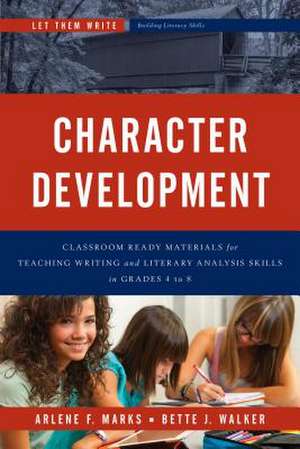
Character Development: Classroom Ready Materials for Teaching Writing and Literary Analysis Skills in Grades 4 to 8: Let Them Write: Building Literacy Skills
Autor Arlene F. Marks, Bette J. Walkeren Limba Engleză Paperback – sep 2015
Character Development focuses on the creation of fully-realized, multidimensional protagonists and antagonists. Students practice first-drafting, editing, polishing, and sharing original paragraphs, scenes, and stories featuring the characters they have brought to life.
The textcan be implemented in the classroom alone or in tandem with the two other titles in the Let Them Write Series -SETTING AND DESCRIPTION and PLOT BUILDING.
Also of interest for classroom teachers is the Literacy: Made for All Series
WORDSMITHING: Classroom Ready Materials for Teaching Nonfiction Writing and Analysis Skills in the High School Grades
ENJOYING LITERATURE: Classroom Ready Materials for Teaching Fiction and Poetry Analysis Skills in the High School Grades
STORY CRAFTING: Classroom Ready Materials for Teaching Fiction Writing in the High School Grades

Preț: 366.50 lei
Preț vechi: 507.34 lei
-28%
Puncte Express: 550
Carte tipărită la comandă
Livrare economică 30 noiembrie-14 decembrie
Livrare prin curier în România Termenul estimat este afișat lângă disponibilitate.
Transport gratuit de la 400.00 lei Plată online sau ramburs, în funcție de opțiunile comenzii.
Retur gratuit în 14 zile Comandă securizată și suport în română.
Specificații
ISBN-13: 9781475818406
ISBN-10: 1475818408
Pagini: 154
Dimensiuni: 217 x 279 x 11 mm
Greutate: 0.43 kg
Editura: Bloomsbury Publishing
Colecția Rowman & Littlefield
Seria Let Them Write: Building Literacy Skills
Locul publicării:New York, United States
ISBN-10: 1475818408
Pagini: 154
Dimensiuni: 217 x 279 x 11 mm
Greutate: 0.43 kg
Editura: Bloomsbury Publishing
Colecția Rowman & Littlefield
Seria Let Them Write: Building Literacy Skills
Locul publicării:New York, United States
V-ar putea interesa
-
 -23%Preț: 556.17 lei722.29 lei
 -
 101 Essential Lists for Primary TeachersFred Sedgwick-45%Preț: 69.55 lei127.24 lei
 -
 100 Ideas for AssembliesFred Sedgwick-42%Preț: 91.38 lei156.93 lei
 -
 -20%Preț: 122.36 lei153.89 lei
 -
 Preț: 385.49 lei
 -
 Writing Models Year 4Pie CorbettPreț: 294.99 lei
 -
 Writing Models Year 6Pie CorbettPreț: 320.48 lei
 -
 Preț: 285.41 lei
 -
 Becoming a Higher Level Teaching AssistantJean Edwards-23%Preț: 536.46 lei696.70 lei
 -
 Preț: 384.50 lei
 -
 How to Teach Fiction Writing at Key Stage 2Pie CorbettPreț: 293.57 lei
Cuprins
INTRODUCTION TO LET THEM WRITE
Messages from the authors
How to implement this program
The aims and objectives of this program
How to implement Let Them Read
Writing a literary essay
The aims and objectives of Let Them Read
Setting up a writer-friendly classroom
Authors need a writing plan
Publishing students' work
NCCS Anchors addressed
SECTION 1: CREATING CHARACTERS
SKILL 1: INTRODUCING A CHARACTER
As young authors practice describing characters to create a specific first impression for the reader, they will become more observant about the people around them.
SKILL 2: POSITIVE CHARACTER DESCRIPTIONS
Student authors will learn about and practice creating an appealing character through the purposeful selection of descriptive detail. In the process, they will gain a better understanding of their own reasons for reacting positively to other people.
SKILL 3: NEGATIVE CHARACTER DESCRIPTIONS
Student authors will learn about and practice selecting character details that will make an immediate negative impression on the reader. In the process, they may come to realize the importance of first impressions in real life.
SKILL 4: CREATING GOOD GUYS AND BAD GUYS Using Personality Traits
Student authors practice ways to make the hero(ine) a more sympathetic (likable) character than the villain(ess) of a story, in the process gaining a deeper understanding of human behavior.
SKILL 5: WRITING FROM A POINT OF VIEW
As students practice adopting a character's point of view, they will come to understand that there are different sides to every story, in real life as well as in fiction.
Reproducibles/Media: CCR 1--EVEN MICE HAVE DIFFERENT POINTS OF VIEW chartCCR 1A--TRY YOUR OWN FABLE chart
CCR 2-DIFFERENT POINTS OF VIEW chart
SKILL 6: WRITING FROM AN UNUSUAL POINT OF VIEW
Student authors practice personifying a variety of inanimate objects and writing from their point of view. In the process, both students and readers may gain a new perspective on a part of their life.
SECTION 2: DEEPENING CHARACTERIZATION
SKILL 1: CHARACTERS HAVE EMOTIONS
As students practice choosing verb synonyms, letting a character's actions reveal his or her emotional state, they will gain a deeper appreciation of word connotations and an awareness of the word choices they make in everyday life.
Reproducibles/Media: CCR 3--CHARACTERS HAVE EMOTIONS Chart
SKILL 2: AVOIDING STEREOTYPES
Student authors will learn and practice ways to avoid the use of story-weakening stereotypical characters. In the process they will become more aware of the damaging effects of stereotyping in real life.
Reproducibles/Media: CCR 4--STEREOTYPES WITH A TWIST
SKILL 3: BUILDING A CHARACTER'S PHYSICAL DIMENSION
Students will learn how to make a character more realistic for the reader by describing how the character takes up physical space and has an impact on his or her surroundings.
SKILL 4: SHOWING HOW CHARACTERS ARE AFFECTED BY THE SETTING
Student authors will learn and practice how to enhance the realism of a story by describing their characters' reactions to elements of the setting. In the process, students may become more aware of the reactions of others to real-life settings.
Reproducibles/Media: CCR 5-CHARACTER AFFECTED BY SETTING
SKILL 5: BUILDING A CHARACTER'S EMOTIONAL DIMENSION
As they practice showing the reader that a character has human feelings, students may increase their ability to 'read' the emotions being expressed by others in real life.
Reproducibles/Media: CCR 6--EMOTIONAL DIMENSION BUILDS A CHARACTER Chart
CCR 7-EMOTIONAL DIMENSION Chart
SKILL 6: REVEALING A CHARACTER'S PSYCHOLOGICAL DIMENSION
Students will practice writing a character's thought-revealing dialogue and internal monologue in order to enhance the realism of the character. In the process, students may become more skilled at expressing their own thoughts and feelings.
Reproducibles/Media: CCR 8--WHAT RUNS THROUGH YOUR MIND?
CCR 9-PSYCHOLOGICAL DIMENSION Chart
SECTION 3: CHARACTERS AND DIALOGUE
SKILL 1: USING DIALOGUE TO REVEAL CHARACTER INFORMATION
As student authors practice writing revealing dialogue for created characters, they may become more aware of the ways in which people reveal themselves to others in everyday life.
Reproducibles/Media: CCR 10--WHAT'S MY LINE?
SKILL 2: USING DIALOGUE TO REVEAL A CHARACTER'S REACTION TO A SETTING
Students will practice writing dialogue, in the process becoming aware of its usefulness as a tool to enhance the realism of a story setting.
SKILL 3: USING DIALOGUE TO REVEAL A CHARACTER'S BACKGROUND
Students will practice writing dialogue, in the process becoming aware of its usefulness as a tool to reveal such things as place of origin, level of education, and so on about the character speaking.
Reproducibles/Media: CCR 11--CHARACTERS BACKGROUND SHEET
SKILL 4: USING DIALOGUE TO REVEAL A CHARACTER'S STORY GOALS
As they practice writing dialogue, student authors will become adept at using it to reveal their characters' goals to the reader.
Reproducibles/Media: CCR 12--CHARACTERS AND PURPOSES
Messages from the authors
How to implement this program
The aims and objectives of this program
How to implement Let Them Read
Writing a literary essay
The aims and objectives of Let Them Read
Setting up a writer-friendly classroom
Authors need a writing plan
Publishing students' work
NCCS Anchors addressed
SECTION 1: CREATING CHARACTERS
SKILL 1: INTRODUCING A CHARACTER
As young authors practice describing characters to create a specific first impression for the reader, they will become more observant about the people around them.
SKILL 2: POSITIVE CHARACTER DESCRIPTIONS
Student authors will learn about and practice creating an appealing character through the purposeful selection of descriptive detail. In the process, they will gain a better understanding of their own reasons for reacting positively to other people.
SKILL 3: NEGATIVE CHARACTER DESCRIPTIONS
Student authors will learn about and practice selecting character details that will make an immediate negative impression on the reader. In the process, they may come to realize the importance of first impressions in real life.
SKILL 4: CREATING GOOD GUYS AND BAD GUYS Using Personality Traits
Student authors practice ways to make the hero(ine) a more sympathetic (likable) character than the villain(ess) of a story, in the process gaining a deeper understanding of human behavior.
SKILL 5: WRITING FROM A POINT OF VIEW
As students practice adopting a character's point of view, they will come to understand that there are different sides to every story, in real life as well as in fiction.
Reproducibles/Media: CCR 1--EVEN MICE HAVE DIFFERENT POINTS OF VIEW chartCCR 1A--TRY YOUR OWN FABLE chart
CCR 2-DIFFERENT POINTS OF VIEW chart
SKILL 6: WRITING FROM AN UNUSUAL POINT OF VIEW
Student authors practice personifying a variety of inanimate objects and writing from their point of view. In the process, both students and readers may gain a new perspective on a part of their life.
SECTION 2: DEEPENING CHARACTERIZATION
SKILL 1: CHARACTERS HAVE EMOTIONS
As students practice choosing verb synonyms, letting a character's actions reveal his or her emotional state, they will gain a deeper appreciation of word connotations and an awareness of the word choices they make in everyday life.
Reproducibles/Media: CCR 3--CHARACTERS HAVE EMOTIONS Chart
SKILL 2: AVOIDING STEREOTYPES
Student authors will learn and practice ways to avoid the use of story-weakening stereotypical characters. In the process they will become more aware of the damaging effects of stereotyping in real life.
Reproducibles/Media: CCR 4--STEREOTYPES WITH A TWIST
SKILL 3: BUILDING A CHARACTER'S PHYSICAL DIMENSION
Students will learn how to make a character more realistic for the reader by describing how the character takes up physical space and has an impact on his or her surroundings.
SKILL 4: SHOWING HOW CHARACTERS ARE AFFECTED BY THE SETTING
Student authors will learn and practice how to enhance the realism of a story by describing their characters' reactions to elements of the setting. In the process, students may become more aware of the reactions of others to real-life settings.
Reproducibles/Media: CCR 5-CHARACTER AFFECTED BY SETTING
SKILL 5: BUILDING A CHARACTER'S EMOTIONAL DIMENSION
As they practice showing the reader that a character has human feelings, students may increase their ability to 'read' the emotions being expressed by others in real life.
Reproducibles/Media: CCR 6--EMOTIONAL DIMENSION BUILDS A CHARACTER Chart
CCR 7-EMOTIONAL DIMENSION Chart
SKILL 6: REVEALING A CHARACTER'S PSYCHOLOGICAL DIMENSION
Students will practice writing a character's thought-revealing dialogue and internal monologue in order to enhance the realism of the character. In the process, students may become more skilled at expressing their own thoughts and feelings.
Reproducibles/Media: CCR 8--WHAT RUNS THROUGH YOUR MIND?
CCR 9-PSYCHOLOGICAL DIMENSION Chart
SECTION 3: CHARACTERS AND DIALOGUE
SKILL 1: USING DIALOGUE TO REVEAL CHARACTER INFORMATION
As student authors practice writing revealing dialogue for created characters, they may become more aware of the ways in which people reveal themselves to others in everyday life.
Reproducibles/Media: CCR 10--WHAT'S MY LINE?
SKILL 2: USING DIALOGUE TO REVEAL A CHARACTER'S REACTION TO A SETTING
Students will practice writing dialogue, in the process becoming aware of its usefulness as a tool to enhance the realism of a story setting.
SKILL 3: USING DIALOGUE TO REVEAL A CHARACTER'S BACKGROUND
Students will practice writing dialogue, in the process becoming aware of its usefulness as a tool to reveal such things as place of origin, level of education, and so on about the character speaking.
Reproducibles/Media: CCR 11--CHARACTERS BACKGROUND SHEET
SKILL 4: USING DIALOGUE TO REVEAL A CHARACTER'S STORY GOALS
As they practice writing dialogue, student authors will become adept at using it to reveal their characters' goals to the reader.
Reproducibles/Media: CCR 12--CHARACTERS AND PURPOSES
Recenzii
As a novice to teaching English, having taught only Science for twenty years, I found the Let Them Write/ Let Them Read program was easy to follow and easy to implement. This is a structured program for the teacher and built for the individual levels of ability of the students. My students' enthusiasm for writing and reading, and their blossoming literary skills, resulted in their achieving the highest English language standard for the school. Every student advanced significantly in grade level during the instructional time frame. Every student was successful every day in this program.
As a writer and teacher of creative writing at a university level, I know how challenging it is to break down the elements of good prose into language that is easily understood. The first step in 'teaching' creative writing is demystifying the process, dispelling fears that 'my writing sucks', while emphasizing the importance of narrative drive. Let Them Write provides building blocks that even the most creative- writing resistant teacher can deliver to students. To all those doubting their ability to inspire young people to write, grab hold of a copy of Let Them Write, follow the carefully orchestrated guidelines, sit back and let your students amaze you.
As a writer and teacher of creative writing at a university level, I know how challenging it is to break down the elements of good prose into language that is easily understood. The first step in 'teaching' creative writing is demystifying the process, dispelling fears that 'my writing sucks', while emphasizing the importance of narrative drive. Let Them Write provides building blocks that even the most creative- writing resistant teacher can deliver to students. To all those doubting their ability to inspire young people to write, grab hold of a copy of Let Them Write, follow the carefully orchestrated guidelines, sit back and let your students amaze you.