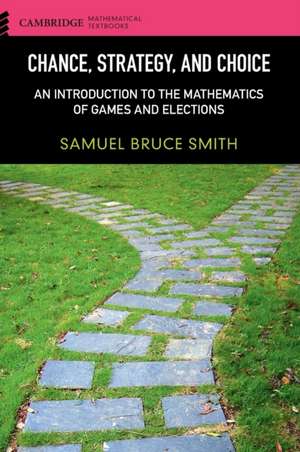
Chance, Strategy, and Choice
Autor Samuel Bruce Smithen Limba Engleză Hardback – 13 dec 2022
Preț: 409.23 lei
Puncte Express: 614
Carte tipărită la comandă
Livrare economică 19 septembrie-03 octombrie
Livrare prin curier în România Termenul estimat este afișat lângă disponibilitate.
Transport gratuit pentru acest produs Plată online sau ramburs, în funcție de opțiunile comenzii.
Retur gratuit în 14 zile Comandă securizată și suport în română.
Specificații
ISBN-13: 9781107084520
ISBN-10: 1107084520
Pagini: 392
Ilustrații: 60 b/w illus. 243 tables 300 exercises
Dimensiuni: 183 x 260 x 26 mm
Greutate: 0.93 kg
Editura: Cambridge University Press
Locul publicării:New York, United States
ISBN-10: 1107084520
Pagini: 392
Ilustrații: 60 b/w illus. 243 tables 300 exercises
Dimensiuni: 183 x 260 x 26 mm
Greutate: 0.93 kg
Editura: Cambridge University Press
Locul publicării:New York, United States
V-ar putea interesa
-
 The Design of Approximation AlgorithmsDavid P. Williamson-11%Preț: 502.22 lei564.29 lei
 -
 Optimization Concepts and Applications in EngineeringAshok D. Belegundu-23%Preț: 526.73 lei684.32 lei
 -
 Nonlinear Optimization in Finite DimensionsHubertus Th. Jongen-18%Preț: 1401.47 lei1709.11 lei
 -
 An Introduction to Optimization on Smooth ManifoldsNicolas Boumal-14%Preț: 781.85 lei909.12 lei
 -
 -18%Preț: 1235.16 lei1506.30 lei
 -
 Nonlinear Integer ProgrammingDuan Li-18%Preț: 902.54 lei1100.65 lei
 -
 Large-Scale Nonlinear OptimizationGianni Pillo-15%Preț: 613.99 lei722.33 lei
 -
 Handbook on Modelling for Discrete OptimizationGautam M. Appa-15%Preț: 707.64 lei832.51 lei
 -
 -18%Preț: 1178.72 lei1437.46 lei
 -
 Stochastic Modeling in Economics and FinanceJitka Dupacova-15%Preț: 618.80 lei728.00 lei
 -
 -24%Preț: 627.19 lei825.25 lei
 -
 Stochastic Linear ProgrammingPeter KallPreț: 400.42 lei
 -
 Very Hard Sudoku Puzzles | The Logic Testing Books for AdultsPuzzle TherapistPreț: 81.61 lei
 -
 Non-Smooth and Complementarity-Based Distributed Parameter SystemsMichael Hintermüller-18%Preț: 747.55 lei911.65 lei
 -
 Lectures on Variational AnalysisAsen L. Dontchev-18%Preț: 732.43 lei893.22 lei
 -
 Mathematical Control and Numerical ApplicationsAbdeljalil Nachaoui-18%Preț: 894.50 lei1090.86 lei
 -
 Calculus of One VariableM. Thamban NairPreț: 500.57 lei
 -
 Mathematical Optimization Theory and Operations ResearchPanos Pardalos-18%Preț: 1071.65 lei1306.89 lei
 -
 Maximum-Entropy SamplingMarcia Fampa-18%Preț: 731.53 lei892.12 lei
 -
 Dynamic Control and OptimizationTatiana V. Tchemisova-18%Preț: 1117.51 lei1362.82 lei
 -
 The Evolution of the Vehicle Routing ProblemBruce GoldenPreț: 208.77 lei
 -
 -18%Preț: 1226.87 lei1496.18 lei
 -
 Metaheuristics for Hard OptimizationJohann DréoPreț: 377.93 lei
 -
 Bioinspired Computation in Combinatorial OptimizationFrank NeumannPreț: 386.76 lei
 -
 Bases, outils et principes pour l'analyse variationnelleJean-Baptiste Hiriart-UrrutyPreț: 403.47 lei
 -
 Iterative Methods for Fixed Point Problems in Hilbert SpacesAndrzej CegielskiPreț: 392.26 lei
 -
 -18%Preț: 859.35 lei1048.00 lei
 -
 -18%Preț: 1229.98 lei1499.98 lei
 -
 Soft Computing and OptimizationSyeda Darakhshan Jabeen-18%Preț: 1124.43 lei1371.25 lei
Cuprins
1. Introduction; 2. Games and elections; 3. Chance; 4. Strategy; 5. Choice; 6. Strategy and choice; 7. Choice and chance; 8. Chance and strategy; 9. Nash equilibria; 10. Proofs and counterexamples; 11. Laws of probability; 12. Fairness in elections; 13. Weighted voting; 14. Gambling games; 15. Zero-sum games; 16. Partial conflict games; 17. Take-away games; 18. Fairness and impossibility; 19. Paradoxes and puzzles in probability; 20. Combinatorial games; 21. Borda versus Condorcet; 22. The Sprague–Grundy theorem; 23. Arrow's impossibility theorem.
Recenzii
'Sam Smith's book offers an intriguing juxtaposition of chance, strategy, and elections. The mathematical analysis is rigorous without being too formal or forbidding. The applications to topics in economics and political science - including auctions, power, and voting - as well as to parlor games like poker will engage both students and professionals.' Steven Brams, New York University
'I like the logical flow and length of the chapters and I like that the layout is simple (no excessively boxed theorems, etc.). There are numerous chapters, with one key concept explained in each. One could envision that each chapter would roughly be covered in a class period.' John Cullinan, Bard College, New York
'The author's approach does seem as if it would appeal to a broad range of instructors and students: there are enough chapters that an instructor could choose a collection of topics according to his or her interest. Furthermore, the inclusion of proof-based sections would allow an instructor to use the text for a course targeted at math majors and minors rather than at a general nontechnical audience.' James Parson, Hood College, Maryland
'The book is well written and interesting. Students should have little difficulty reading and understanding this book … The book covers the topics with clarity and applies game theory to 'real-world' problems.' Dan Cunningham, State University of New York, Buffalo
'While some of Smith's material has origins more than 100 years old, the author engages the reader through modern developments, such as the minimax theorem (1928), the work of John Nash and Kenneth Arrow (1950s) and even more recent developments by Steven Brams, William Zwicker and Alan Taylor (1980s–2000s). The author does an effective job of presenting this material to an audience of non-science majors with no prerequisites. A unique feature of the text is the treatment of combinatorial games such as Nim and Hackenbush alongside traditional two person game theory.' David Vella, Skidmore College, New York
'Chance, Strategy, and Choice fits an important niche for general audience textbooks about games, elections, and other introductory material related to social choice theory … One of my favorite features of the book is that it does an excellent job of integrating the topics of games and elections to illustrate the interconnections between the different areas of social choice theory, often through illustrative examples.' Adam Graham-Squire, MAA Reviews
'I like the logical flow and length of the chapters and I like that the layout is simple (no excessively boxed theorems, etc.). There are numerous chapters, with one key concept explained in each. One could envision that each chapter would roughly be covered in a class period.' John Cullinan, Bard College, New York
'The author's approach does seem as if it would appeal to a broad range of instructors and students: there are enough chapters that an instructor could choose a collection of topics according to his or her interest. Furthermore, the inclusion of proof-based sections would allow an instructor to use the text for a course targeted at math majors and minors rather than at a general nontechnical audience.' James Parson, Hood College, Maryland
'The book is well written and interesting. Students should have little difficulty reading and understanding this book … The book covers the topics with clarity and applies game theory to 'real-world' problems.' Dan Cunningham, State University of New York, Buffalo
'While some of Smith's material has origins more than 100 years old, the author engages the reader through modern developments, such as the minimax theorem (1928), the work of John Nash and Kenneth Arrow (1950s) and even more recent developments by Steven Brams, William Zwicker and Alan Taylor (1980s–2000s). The author does an effective job of presenting this material to an audience of non-science majors with no prerequisites. A unique feature of the text is the treatment of combinatorial games such as Nim and Hackenbush alongside traditional two person game theory.' David Vella, Skidmore College, New York
'Chance, Strategy, and Choice fits an important niche for general audience textbooks about games, elections, and other introductory material related to social choice theory … One of my favorite features of the book is that it does an excellent job of integrating the topics of games and elections to illustrate the interconnections between the different areas of social choice theory, often through illustrative examples.' Adam Graham-Squire, MAA Reviews
Descriere
This classroom-tested undergraduate textbook is primarily intended for a general education course in game theory at the freshman or sophomore level.