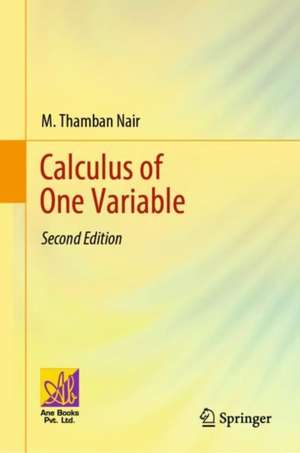
Calculus of One Variable
Autor M. Thamban Nairen Limba Engleză Hardback – 23 ian 2022
Preț: 516.37 lei
Puncte Express: 775
Carte tipărită la comandă
Livrare economică 27 noiembrie-11 decembrie
Livrare prin curier în România Termenul estimat este afișat lângă disponibilitate.
Transport gratuit pentru acest produs Plată online sau ramburs, în funcție de opțiunile comenzii.
Retur gratuit în 14 zile Comandă securizată și suport în română.
Specificații
ISBN-13: 9783030886363
ISBN-10: 3030886360
Pagini: 360
Ilustrații: XIX, 340 p. 43 illus., 32 illus. in color.
Dimensiuni: 160 x 241 x 25 mm
Greutate: 0.65 kg
Ediția:Second Edition 2021
Editura: Springer
Locul publicării:Cham, Switzerland
ISBN-10: 3030886360
Pagini: 360
Ilustrații: XIX, 340 p. 43 illus., 32 illus. in color.
Dimensiuni: 160 x 241 x 25 mm
Greutate: 0.65 kg
Ediția:Second Edition 2021
Editura: Springer
Locul publicării:Cham, Switzerland
Cuprins
Sequence and Series of Real Numbers.- Limit, Continuity and Differentiability of Functions.- Definite Integral.- Improper Integrals.- Sequence and Series of Functions.- Fourier Series.- References.- Index.
Notă biografică
M. Thamban Nair is a professor of mathematics at the Indian Institute of Technology Madras, Chennai, India. He completed his Ph.D. at the Indian Institute of Technology Bombay, Mumbai, India, in 1986. His research interests include functional analysis and operator theory, specifically spectral approximation, the approximate solution of integral and operator equations, regularization of inverse and ill-posed problems. He has published three books, including a textbook, Functional Analysis: A First Course (PHI Learning), and a text-cum-monograph, Linear Operator Equations: Approximation and Regularization (World Scientific), and over 90 papers in reputed journals and refereed conference proceedings. He has guided six Ph.D. students and is an editorial board member of the Journal of Analysis and Number Theory, and Journal of Mathematical Analysis. He is a life member of academic bodies such as Indian Mathematical Society and Ramanujan Mathematical Society. Arindama Singh is a professor of mathematics at the Indian Institute of Technology Madras, Chennai, India. He completed his Ph.D. at the Indian Institute of Technology Kanpur, India, in 1990. His research interests include knowledge compilation, singular perturbation, mathematical learning theory, image processing, and numerical linear algebra. He has published five books, including Elements of Computation Theory (Springer), and over 47 papers in reputed journals and refereed conference proceedings. He has guided five Ph.D. students and is a life member of many academic bodies, including Indian Society for Industrial and Applied Mathematics, Indian Society of Technical Education, Ramanujan Mathematical Society, Indian Mathematical Society, and The Association of Mathematics Teachers of India
Textul de pe ultima copertă
The book is designed to serve as a textbook for courses offered to undergraduate and graduate students enrolled in Mathematics. The first edition of this book was published in 2015. As there is a demand for the next edition, it is quite natural to take note of the several suggestions received from the users of the earlier edition over the past six years. This is the prime motivation for bringing out a revised second edition with a thorough revision of all the chapters. The book provides a clear understanding of the basic concepts of differential and integral calculus starting with the concepts of sequences and series of numbers, and also introduces slightly advanced topics such as sequences and series of functions, power series, and Fourier series which would be of use for other courses in mathematics for science and engineering programs. The salient features of the book are - precise definitions of basic concepts; several examples for understanding the concepts and for illustrating the results; includes proofs of theorems; exercises within the text; a large number of problems at the end of each chapter as home-assignments. The student-friendly approach of the exposition of the book would be of great use not only for students but also for the instructors. The detailed coverage and pedagogical tools make this an ideal textbook for students and researchers enrolled in a mathematics course.