
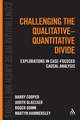
Challenging the Qualitative-Quantitative Divide: Explorations in Case-focused Causal Analysis: Continuum Research Methods
Autor Professor Barry Cooper, Dr Judith Glaesser, Dr Roger Gomm, Professor Martyn Hammersleyen Limba Engleză Hardback – 8 mar 2012
| Toate formatele și edițiile | Preț | Express |
|---|---|---|
| Paperback (1) | 315.12 lei 6-8 săpt. | |
| Bloomsbury Publishing – 8 mar 2012 | 315.12 lei 6-8 săpt. | |
| Hardback (1) | 1098.58 lei 6-8 săpt. | |
| Bloomsbury Publishing – 8 mar 2012 | 1098.58 lei 6-8 săpt. |



Preț: 1098.58 lei
Preț vechi: 1481.44 lei
-26% Nou
Puncte Express: 1648
Preț estimativ în valută:
194.42€ • 227.22$ • 168.80£
194.42€ • 227.22$ • 168.80£
Carte tipărită la comandă
Livrare economică 17 februarie-03 martie
Preluare comenzi: 021 569.72.76
Specificații
ISBN-13: 9781441171443
ISBN-10: 1441171444
Pagini: 288
Dimensiuni: 156 x 234 x 20 mm
Greutate: 0.58 kg
Editura: Bloomsbury Publishing
Colecția Continuum
Seria Continuum Research Methods
Locul publicării:London, United Kingdom
ISBN-10: 1441171444
Pagini: 288
Dimensiuni: 156 x 234 x 20 mm
Greutate: 0.58 kg
Editura: Bloomsbury Publishing
Colecția Continuum
Seria Continuum Research Methods
Locul publicării:London, United Kingdom
V-ar putea interesa
-
 Key Concepts in Social Research MethodsDr Roger GommPreț: 227.42 lei
 -
 Social Research Methodology: A Critical IntroductionDr Roger GommPreț: 323.61 lei
 -
 Mental Health MattersDr Roger GommPreț: 318.53 lei
 -
 -39%Preț: 5600.36 lei9187.63 lei
 -
 Preț: 403.88 lei
 -
 -18%Preț: 1076.67 lei1313.01 lei
 -
 After a Fall: A Sociomedical SojournLaurel RichardsonPreț: 374.91 lei
 -
 Inheriting as People Think It Should BeJacqueline J. Goodnow-19%Preț: 622.82 lei768.92 lei
 -
 Left Behind in the Race to the TopJulie Gorlewski-19%Preț: 478.83 lei591.15 lei
 -
 A Feast of LearningPhilippe Carre-19%Preț: 565.42 lei698.06 lei
 -
 Advancing Cross-Cultural Perspectives on Educational PsychologyAllan B. I. Bernardo-19%Preț: 655.94 lei809.80 lei
 -
 The Mismeasure of EducationJim HornPreț: 227.38 lei
 -
 The Mismeasure of Education (Hc)Jim HornPreț: 480.26 lei
 -
 Online Learner CompetenciesMichael Beaudoin-19%Preț: 564.07 lei696.38 lei
 -
 Reflection and the College TeacherRachel Wlodarsky-19%Preț: 561.34 lei693.01 lei
 -
 Life StoriesLinda C. Morice-19%Preț: 623.74 lei770.05 lei
 -
 Adolescence in the 21st CenturyPaul D. Schwartz-19%Preț: 622.39 lei768.38 lei
 -
 Developing and Sustaining Adult Learners (Hc)Carrie J. Boden-McGill-19%Preț: 658.64 lei813.14 lei
 -
 Evaluating the Undergraduate Research ExperienceGabriel M. Della-Piana-19%Preț: 566.95 lei699.94 lei
 -
 Enacted Mathematics CurriculumDenisse R. Thompson-19%Preț: 565.59 lei698.26 lei
 -
 What is Qualitative Research?Professor Martyn Hammersley-26%Preț: 792.67 lei1069.50 lei
 -
 Contribution du profil entrepreneurial à la réussite des PMEAhmed Ramzi Siagh-18%Preț: 640.25 lei780.80 lei
 -
 Preț: 399.78 lei
Cuprins
Introduction
Part I: Problems with Quantitative and Qualitative Research
1. What's Wrong with Quantitative Research?
2. Quantitative Research on Meritocracy: The Problem of Inference from Outcomes to Opportunities
3. Qualitative Causal Analysis: Grounded Theorising and the Qualitative Survey
4. Qualitative Research and the Fallacies of Composition and Division: The Case of Ethnic Inequalities in Educational Achievement
Part II: Exploring Case-Focused Approaches to Causal Analysis
5. Set Theoretic versus Correlational Methods: the Case of Ability and Educational Achievement
6. Creating Typologies: Comparing Fuzzy Qualitative Comparative Analysis with Fuzzy Cluster Analysis
7. Analytic Induction versus Qualitative Comparative Analysis
Conclusion
References
Index
Part I: Problems with Quantitative and Qualitative Research
1. What's Wrong with Quantitative Research?
2. Quantitative Research on Meritocracy: The Problem of Inference from Outcomes to Opportunities
3. Qualitative Causal Analysis: Grounded Theorising and the Qualitative Survey
4. Qualitative Research and the Fallacies of Composition and Division: The Case of Ethnic Inequalities in Educational Achievement
Part II: Exploring Case-Focused Approaches to Causal Analysis
5. Set Theoretic versus Correlational Methods: the Case of Ability and Educational Achievement
6. Creating Typologies: Comparing Fuzzy Qualitative Comparative Analysis with Fuzzy Cluster Analysis
7. Analytic Induction versus Qualitative Comparative Analysis
Conclusion
References
Index
Recenzii
Highly Commended - Society for Educational Studies Annual Book Prize 2013
This book does three important things. It provides a useful account of how the qualitative-quantitative divide in research methods arose and became entrenched, it sets out the various reasons why we need to move beyond this divide, and it offers a vision and a demonstration of how this can be done using an approach that combines a focus on cases with the search for the causes of the social phenomena under investigation. It combines philosophical discussion with empirical illustration in an accessible way that will make readers reconsider their ideas about how to deal with depth and breadth in social research.
This book does three important things. It provides a useful account of how the qualitative-quantitative divide in research methods arose and became entrenched, it sets out the various reasons why we need to move beyond this divide, and it offers a vision and a demonstration of how this can be done using an approach that combines a focus on cases with the search for the causes of the social phenomena under investigation. It combines philosophical discussion with empirical illustration in an accessible way that will make readers reconsider their ideas about how to deal with depth and breadth in social research.