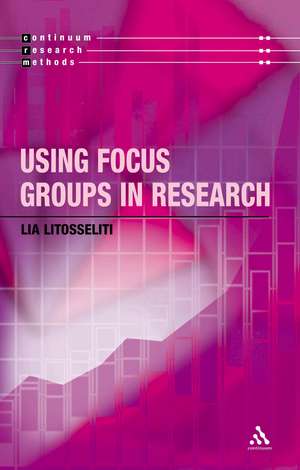
Using Focus Groups in Research: Continuum Research Methods
Autor Dr. Lia Litosselitien Limba Engleză Paperback – dec 2003


Preț: 237.84 lei
Preț vechi: 302.35 lei
-21%
Puncte Express: 357
Carte tipărită la comandă
Livrare economică 02-16 decembrie
Livrare prin curier în România Termenul estimat este afișat lângă disponibilitate.
Transport gratuit de la 400.00 lei Plată online sau ramburs, în funcție de opțiunile comenzii.
Retur gratuit în 14 zile Comandă securizată și suport în română.
Specificații
ISBN-13: 9780826464729
ISBN-10: 0826464726
Pagini: 114
Ilustrații: further reading, references
Dimensiuni: 138 x 216 x 6 mm
Greutate: 0.15 kg
Editura: Bloomsbury Publishing
Colecția Continuum
Seria Continuum Research Methods
Locul publicării:London, United Kingdom
ISBN-10: 0826464726
Pagini: 114
Ilustrații: further reading, references
Dimensiuni: 138 x 216 x 6 mm
Greutate: 0.15 kg
Editura: Bloomsbury Publishing
Colecția Continuum
Seria Continuum Research Methods
Locul publicării:London, United Kingdom
V-ar putea interesa
-
 302 Preguntas IntensivasEdmundo LlamasPreț: 116.06 lei
 -
 GampangDanish Danial Bin AnuarPreț: 126.26 lei
 -
 Educating Generation NextLucas WalshPreț: 383.44 lei
 -
 Research Methods in LinguisticsLia LitosselitiPreț: 180.90 lei
 -
 The Way We AreRobert Paul GwynnePreț: 72.09 lei
 -
 "Asleep in my Sunshine Chair"David W. JardinePreț: 199.11 lei
 -
 As Philosophy Revision Guide for Edexcel Unit 1Brian PoxonPreț: 257.99 lei
 -
 It's Cotton Blossom TimeS. Earl Wilson IIIPreț: 99.84 lei
 -
 The Carrot RaceSigal AdlerPreț: 149.64 lei
 -
 Preț: 141.06 lei
 -
 COGAT Grade 5 Level 11 Practice Test Form 7 And 8Gifted & Talented Cogat Test Prep TeamPreț: 147.54 lei
 -
 2 Practice Tests for the OLSAT Grade 3 (4th Grade Entry) Level DOrigins PublicationsPreț: 150.57 lei
 -
 LEARN TO PRINT (Level 2)Karen Firtel ClarkPreț: 123.28 lei
 -
 -19%Preț: 423.86 lei523.29 lei
 -
 L'évaluation en FLERicardo LeuroPreț: 395.69 lei
 -
 Trabajo y derechoOtto Kahn-FreundPreț: 453.58 lei
 -
 Einstein, el salto cuánticoJordi BayarriPreț: 114.09 lei
Cuprins
1. Introducing focus groups-
Preliminaries and definitions
-What kind of focus group
-Focus groups as a qualitative research method in the social sciences
2. Benefits and limitations of focus group methodology
-When to use groups and for what kinds of questions
-Limitations of focus groups
3. Planning and organising focus groups
-Selecting the participants
-The role of the moderator
-Selecting a location and other praticalities of setting up focus groups
-Ethical issues
4. Developing and asking questions
-The topic guide of questioning route
-Types of questions-Kinds of questions
5. Conducting focus groups
-Before the focus group session
-Stages of the focus group session
-After the session
6. Analysing focus group data
Further reading
References
Preliminaries and definitions
-What kind of focus group
-Focus groups as a qualitative research method in the social sciences
2. Benefits and limitations of focus group methodology
-When to use groups and for what kinds of questions
-Limitations of focus groups
3. Planning and organising focus groups
-Selecting the participants
-The role of the moderator
-Selecting a location and other praticalities of setting up focus groups
-Ethical issues
4. Developing and asking questions
-The topic guide of questioning route
-Types of questions-Kinds of questions
5. Conducting focus groups
-Before the focus group session
-Stages of the focus group session
-After the session
6. Analysing focus group data
Further reading
References
Recenzii
'Intended as an introduction to Focus Groups for research students, this book is a god-send for anyone considering the pros and cons of this approach, and a valuable practical toolkit for putting focus groups together. Its academic background makes this even more useful. It is properly referenced throughout, and sufficiently rigorous for its stated purpose - supporting MPhil and PHD students. Despite this - or perhaps because of it - it is written in clear, accessible English and introduces all the necessary concepts as it goes along.'