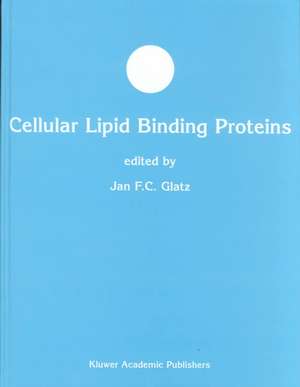
Cellular Lipid Binding Proteins: Developments in Molecular and Cellular Biochemistry, cartea 38
Editat de Jan Jansenen Limba Engleză Hardback – 30 noi 2002
Din seria Developments in Molecular and Cellular Biochemistry
- 5%
 Preț: 374.40 lei
 - 24%
 Preț: 1203.50 lei
 - 18%
 Preț: 1172.00 lei
 - 18%
 Preț: 1176.08 lei
 - 24%
 Preț: 1203.62 lei
 -
 Preț: 388.93 lei
 - 5%
 Preț: 360.18 lei
 - 24%
 Preț: 1793.83 lei
 - 18%
 Preț: 1751.29 lei
 - 5%
 Preț: 754.46 lei
 - 24%
 Preț: 1778.99 lei
 - 24%
 Preț: 1787.81 lei
 - 24%
 Preț: 1798.79 lei
 - 18%
 Preț: 1745.23 lei
 - 24%
 Preț: 1221.74 lei
 - 18%
 Preț: 1183.70 lei
 - 24%
 Preț: 1795.90 lei
 - 18%
 Preț: 1161.85 lei
 - 24%
 Preț: 910.85 lei
 - 24%
 Preț: 1251.71 lei
 - 18%
 Preț: 903.61 lei
 - 18%
 Preț: 1169.43 lei
 - 5%
 Preț: 1143.68 lei
 - 5%
 Preț: 1055.09 lei
 - 18%
 Preț: 983.68 lei
 - 18%
 Preț: 899.36 lei
 - 24%
 Preț: 907.13 lei
 - 24%
 Preț: 1201.54 lei
 - 15%
 Preț: 618.19 lei
 - 18%
 Preț: 914.35 lei
 - 20%
 Preț: 660.56 lei
 - 15%
 Preț: 617.89 lei
 - 24%
 Preț: 914.34 lei
 - 24%
 Preț: 950.18 lei
 - 24%
 Preț: 852.30 lei
 - 5%
 Preț: 1125.46 lei
 - 5%
 Preț: 1095.21 lei
 - 24%
 Preț: 915.15 lei
Preț: 919.97 lei
Preț vechi: 1210.48 lei
-24%
Puncte Express: 1380
Carte tipărită la comandă
Livrare economică 23-28 noiembrie
Livrare prin curier în România Termenul estimat este afișat lângă disponibilitate.
Transport gratuit pentru acest produs Plată online sau ramburs, în funcție de opțiunile comenzii.
Retur gratuit în 14 zile Comandă securizată și suport în română.
Specificații
ISBN-13: 9781402072208
ISBN-10: 1402072201
Pagini: 248
Ilustrații: 237 p.
Dimensiuni: 215 x 286 x 20 mm
Greutate: 0.86 kg
Ediția:2002
Editura: Springer Us
Colecția Developments in Molecular and Cellular Biochemistry
Seria Developments in Molecular and Cellular Biochemistry
Locul publicării:New York, NY, United States
ISBN-10: 1402072201
Pagini: 248
Ilustrații: 237 p.
Dimensiuni: 215 x 286 x 20 mm
Greutate: 0.86 kg
Ediția:2002
Editura: Springer Us
Colecția Developments in Molecular and Cellular Biochemistry
Seria Developments in Molecular and Cellular Biochemistry
Locul publicării:New York, NY, United States
V-ar putea interesa
-
 Schaum's Outline of Biochemistry, Third EditionPhilip Kuchel-16%Preț: 215.44 lei256.91 lei
 -
 Clinical BiochemistryNessar Ahmed-27%Preț: 799.90 lei1095.76 lei
 -
 LipidsDenis J. Murphy-19%Preț: 474.69 lei586.04 lei
 -
 Bioelectrochemistry of Biomembranes and Biomimetic MembranesRolando Guidelli-9%Preț: 1126.78 lei1238.23 lei
 -
 Fundamentals of Biochemical CalculationsKrish Moorthy-15%Preț: 419.58 lei493.62 lei
 -
 -27%Preț: 2299.54 lei3131.11 lei
Public țintă
ResearchCuprins
Cellular lipid binding proteins as facilitators and regulators of lipid metabolism.- Critical steps in cellular fatty acid uptake and utilization.- Mechanism of cellular uptake of long-chain fatty acids: Do we need cellular proteins?.- Similar mechanisms of fatty acid transfer from human anal rodent fatty acid-hinding proteins to membranes: Liver, intestine, heart muscle, and adipose tissue FABPs.- Cytosolic fatty acid binding proteins catalyze two distinct steps in intracellular transport of their ligands.- Insights into binding of fatty acids by fatty acid binding proteins.- The effect of charge reversal mutations in the ?-helical region of liver fatty acid binding protein on the binding of fatty-acyl CoAs, lysophospholipids and bile acids.- Solution structure of fatty acid-binding protein from human brain.- Evolution of the family of intracellular lipid binding proteins in vertebrates.- Intracellular lipid binding proteins of the small intestine.- Analysis on the phenotype of E-FABP-gene knockout mice.- Sterol carrier protein-2: Not just for cholesterol any more.- Fatty acid binding protein expression in different human adipose tissue depots in relation to rates of lipolysis and insulin concentration in obese individuals.- Protein acylation in the cardiac muscle like cell line, H9c2.- Alternative lipid mobilization: The insect shuttle system.- Giant membrane vesicles as a model to study cellular substrate uptake dissected from metabolism.- Peroxisomc proliferator-activated receptors: Lipid binding proteins controlling gene expression.- New insights into the fatty acid-binding protein (FABP) family in the small intestine.- Regulation of the ileal bile acid-binding protein gene: An approach to determine its physiological function(s).- Role of adipocyte lipid-bindingprotein (ALBP) and acyl-CoA binding protein (ACBP) in PPAR-mediated transactivation.- Analysis of tissue-specific and PPAR?-dependent induction of FABP gene expression in the mouse liver by an in vivo DNA electroporation method.- Characterization of a new fatty acid response element that controls the expression of the locust muscle FABP gene.- Regulation of fatty acid transport and membrane transporters in health and disease.- The impact of overexpression and deficiency of fatty acid translocase (FAT)/CD36.- Intestinal lipid absorption is not affected in CD36 deficient mice.- Surface expression of fatty acid translocase (FAT/CD36) on platelets in myeloproliferative disorders and non-insulin dependent diabetes mellitus: Effect on arachidonic acid uptake.- Sulfo-.V-succinimidyl esters of long chain fatty acids specifically inhibit fatty acid translocase (FAT/CD36)-mcdiated cellular fatty acid uptake.- Ex-FABP, extracellular fatty acid binding protein, is a stress lipocalin expressed during chicken embryo development.- Plasma concentration of intestinal- and liver- FABP in neonates suffering from nccrotizing cnterocolitis and in healthy preterm neonates.- 235-237.