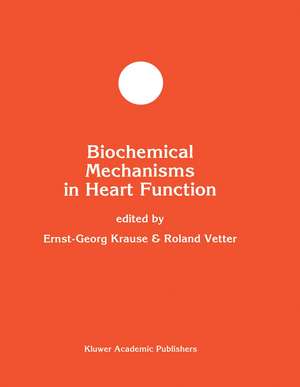
Biochemical Mechanisms in Heart Function: Developments in Molecular and Cellular Biochemistry, cartea 18
Editat de Roland Vetter, Ernst-Georg Krauseen Limba Engleză Hardback – 31 oct 1996
Din seria Developments in Molecular and Cellular Biochemistry
- 5%
 Preț: 374.40 lei
 - 24%
 Preț: 1203.50 lei
 - 18%
 Preț: 1172.00 lei
 - 18%
 Preț: 1176.08 lei
 - 24%
 Preț: 1203.62 lei
 -
 Preț: 388.93 lei
 - 5%
 Preț: 360.18 lei
 - 24%
 Preț: 1793.83 lei
 - 18%
 Preț: 1751.29 lei
 - 5%
 Preț: 754.46 lei
 - 24%
 Preț: 1778.99 lei
 - 24%
 Preț: 1798.79 lei
 - 18%
 Preț: 1745.23 lei
 - 24%
 Preț: 1221.74 lei
 - 18%
 Preț: 1183.70 lei
 - 24%
 Preț: 1795.90 lei
 - 18%
 Preț: 1161.85 lei
 - 24%
 Preț: 910.85 lei
 - 24%
 Preț: 1251.71 lei
 - 18%
 Preț: 903.61 lei
 - 18%
 Preț: 1169.43 lei
 - 5%
 Preț: 1143.68 lei
 - 5%
 Preț: 1055.09 lei
 - 18%
 Preț: 983.68 lei
 - 18%
 Preț: 899.36 lei
 - 24%
 Preț: 907.13 lei
 - 24%
 Preț: 1201.54 lei
 - 15%
 Preț: 618.19 lei
 - 18%
 Preț: 914.35 lei
 - 20%
 Preț: 660.56 lei
 - 15%
 Preț: 617.89 lei
 - 24%
 Preț: 914.34 lei
 - 24%
 Preț: 950.18 lei
 - 24%
 Preț: 919.97 lei
 - 24%
 Preț: 852.30 lei
 - 5%
 Preț: 1125.46 lei
 - 5%
 Preț: 1095.21 lei
 - 24%
 Preț: 915.15 lei
Preț: 1787.81 lei
Preț vechi: 2352.38 lei
-24%
Puncte Express: 2682
Carte tipărită la comandă
Livrare economică 24-30 noiembrie
Livrare prin curier în România Termenul estimat este afișat lângă disponibilitate.
Transport gratuit pentru acest produs Plată online sau ramburs, în funcție de opțiunile comenzii.
Retur gratuit în 14 zile Comandă securizată și suport în română.
Specificații
ISBN-13: 9780792341185
ISBN-10: 079234118X
Pagini: 340
Ilustrații: VI, 330 p.
Dimensiuni: 215 x 286 x 23 mm
Greutate: 1.01 kg
Ediția:Reprinted from MOLECULAR AND CELLULAR BIOCHEMISTRY, 160/161, 1996
Editura: Springer Us
Colecția Developments in Molecular and Cellular Biochemistry
Seria Developments in Molecular and Cellular Biochemistry
Locul publicării:New York, NY, United States
ISBN-10: 079234118X
Pagini: 340
Ilustrații: VI, 330 p.
Dimensiuni: 215 x 286 x 23 mm
Greutate: 1.01 kg
Ediția:Reprinted from MOLECULAR AND CELLULAR BIOCHEMISTRY, 160/161, 1996
Editura: Springer Us
Colecția Developments in Molecular and Cellular Biochemistry
Seria Developments in Molecular and Cellular Biochemistry
Locul publicării:New York, NY, United States
V-ar putea interesa
-
 -5%Preț: 1286.38 lei1354.08 lei
 -
 DreamlandDavid K. RandallPreț: 87.43 lei
 -
 Techniques in Free Radical ResearchA.T. Diplock-23%Preț: 468.04 lei607.85 lei
 -
 Integrated EndocrinologyJohn Laycock-5%Preț: 743.77 lei782.92 lei
 -
 -5%Preț: 1128.58 lei1187.98 lei
 -
 Biochemical Regulation of MyocardiumErnst-Georg Krause-24%Preț: 1798.79 lei2366.82 lei
 -
 -29%Preț: 672.48 lei945.49 lei
 -
 Neurovascular ImagingShoki Takahashi-5%Preț: 1482.42 lei1560.44 lei
 -
 Introductory Guide Anatomy Physiology PB (Revised)Louise Tucker-5%Preț: 161.86 lei170.37 lei
 -
 Imaging of Urogenital DiseasesLucio Olivetti-5%Preț: 1205.90 lei1269.37 lei
 -
 Male Infertility: Understanding, Causes and TreatmentRajender Singh-5%Preț: 1161.30 lei1222.42 lei
 -
 -5%Preț: 591.23 lei622.34 lei
 -
 -5%Preț: 912.93 lei960.98 lei
Public țintă
ResearchCuprins
I: Calcium movements and cellular metabolism.- Control of cardiac performance by Ca-turnover.- Deformation of the Bowditch staircase in Ca2+-overloaded mammalian cardiac tissue — A calcium phenomenon?.- Cooperative interaction between Ca2+ binding sites in the hydrophylic loop of the Na+-Ca2+ exchanger.- E-1020, a water soluble imidazopyridine, has direct effects on Ca2+-dependent force and ATP hydrolysis of canine and bovine cardiac myofilaments.- Primary cultures of cardiac muscle cells as models for investigation of protein glycosylation.- Influence of glycosylation inhibitors on dihydropyridine binding to cardiac cells.- Comparative study of cardiac electrophysiological effects of atrial natriuretic peptide.- Effect of TaiCatoxin (TCX) on the electrophysiological, mechanical and biochemical characteristics of spontaneously beating ventricular cardiomyocytes.- Pharmacological characteristics of endothelin receptors in the rabbit ventricular myocardium: The nonselective endothelin receptor antagonist PD 145065 antagonizes the positive inotropic effect of endothelin-3 but not of endothelin-1.- Involvement of nitric oxide synthase and protein kinase C activation on chagasic antibodies action upon cardiac contractility.- Kinetics of myocardial phospholipase D.- Is cysteine residue important in FITC-sensitive ATP-binding site of P-type ATPases? A commentary to the state of the art.- Reinstatement of the ATP high energy paradigm.- Regulation of and intervention into the oxidative pentose phosphate pathway and adenine nucleotide metabolism in the heart.- The endogenous digitalis-like factor.- Functional antagonism by a monoclonal antibody to digoxin in a test system of cultured rat heart myocytes.- II: Ischemia-reperfusion and cardioprotection.- Biphasic changes inrelaxation following reperfiision after myocardial ischemia.- Signal transduction in myocardial ischaemia and reperfusion.- Reversible and irreversible damage in reoxygenated ‘ischemic’ ventricular myocytes inculture.- Effects of hypoxia, simulated ischemia and reoxygenation on the contractile function of human atrial trabeculae.- The guanine nucleotide-binding regulatory proteins (G proteins) in myocardium with ischemia.- Role of reactive oxygen species in cardiovascular aging.- Uncoupling of mitochondrial oxidative phosphorylation alters lipid peroxidation-derived free radical production but not recovery of postischemic rat hearts and post-hypoxic endothelial cells.- Relationship between mechanical dysfunction and depression of sarcolemmal Ca2+-pump activity in hearts perfused with oxygen free radicals.- Relation between energy metabolism, glycolysis, noradrenaline release and duration of ischemia.- On the regulation of cellular energetics in health and disease.- Salvage of jeopardized myocardium by ischemic preconditioning: Is the quest over?.- Cytoprotective mechanisms in cultured cardiomyocytes.- Delayed cardioprotection is associated with the sub-cellular relocalisation of ventricular protein kinase C?, but not p42/44MAPK.- HSP25 in isolated perfused rat hearts: Localization and response to hyperthermia.- Molecular cloning, sequencing and expression analysis of a fatty acid transport gene in rat heart induced by ischemic preconditioning and oxidative stress.- Protaglandins and the antiarrhythmic effect of preconditioning in the isolated rat heart.- Prevention by 7-oxo-prostacyclin of the calcium paradox in rat heart: Role of the sarcolemmal (Na,K)-ATPase.- Donors of nitric oxide mimic effects of ischaemic preconditioning on reperfusion induced arrhythmias inisolated rat heart.- Crucial role of intracellular effectors on glycogenosis in the isolated rat heart: potential consequences on the myocardial tolerance to ischemia.- Probucol treatment reverses antioxidant and functional deficit in diabetic cardiomyopathy.- Glycogen phosphorylase isoenzyme BB in diagnosis of myocardial ischaemic injury and infarction.- Unaltered ryanodine receptor protein levels in ischemic cardiomyopathy.- Myocardial infarction and nitric oxide.- Estrogen effects in the heart.- Xenoreactive natural antibodies and induced antibodies — Their effects on beating cardiomyocytes as a model of a xenograft.- Index to Volumes 160 and 161.