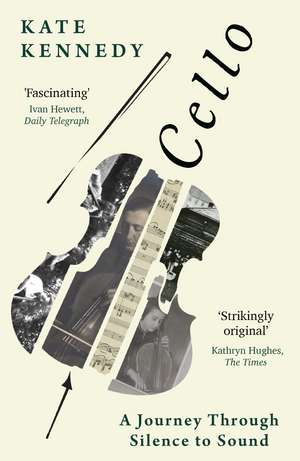
Cello: A Journey Through Silence to Sound
Autor Kate Kennedyen Limba Engleză Paperback – 14 aug 2025
Imaginați-vă un naufragiu în apropiere de Buenos Aires, unde un muzician este forțat să sară de pe o navă în flăcări, strângând la piept un violoncel Stradivarius „Mara”, doar pentru a vedea cum valurile îi răpesc prețiosul instrument. Apreciem cum Cello debutează nu doar ca o istorie muzicală, ci ca un tablou cinematic al rezilienței umane. Dacă The Cellist of Sarajevo de Steven Galloway folosea muzica drept simbol al demnității într-un oraș asediat, Kate Kennedy merge mai departe, documentând modul în care instrumentul devine o extensie a supraviețuirii fizice. În aceeași familie cu Violins of Hope, acest volum adaugă o dimensiune profund personală, împletind destinele unor artiști precum Anita Lasker-Wallfisch — care a supraviețuit la Auschwitz cântând în orchestră — cu propria experiență a autoarei, a cărei carieră interpretativă a fost retezată de o accidentare.
Remarcăm structura ingenioasă a cărții: cele patru părți oglindesc cele patru corzi ale violoncelului, fiecare având propriul timbru și propria poveste de suferință sau pierdere. Kate Kennedy demonstrează aceeași rigoare biografică și sensibilitate pentru destinele tragice pe care le-am întâlnit în Dweller in Shadows, lucrarea sa anterioară despre compozitorul Ivor Gurney. Aici, însă, cercetarea academică lasă loc unei narațiuni aproape detectivești, purtându-ne din stepele Siberiei, pe urmele primei violonceliste profesioniste, Lise Cristiani, până în celulele Gestapo-ului unde a pierit Pál Hermann. Este un omagiu adus sunetului care se naște din tăcere și un studiu fascinant despre cum un obiect din lemn și corzi poate purta întreaga greutate a memoriei umane.
Preț: 62.23 lei
Preț vechi: 81.40 lei
-24%
Carte disponibilă
Livrare economică 11-25 noiembrie
Livrare express 27-31 octombrie pentru 47.69 lei
Specificații
ISBN-10: 1803287047
Pagini: 496
Ilustrații: 60 integrated b&w
Dimensiuni: 126 x 196 x 30 mm
Greutate: 0.4 kg
Editura: Bloomsbury Publishing
Colecția Apollo
Locul publicării:London, United Kingdom
V-ar putea interesa
-
 The Violinist's SecretM. J. HollowsPreț: 71.38 lei
 -
 The Cello SuitesEric Siblin-19%Preț: 57.92 lei71.38 lei
 -
 -47%Preț: 63.66 lei120.36 lei
 -
 The Bach Cello SuitesSteven IsserlisPreț: 78.85 lei
 -
 The PianistWladyslaw Szpilman-27%Preț: 68.41 lei93.16 lei
 -
 A Song in the DarkKimberley WoodhousePreț: 85.29 lei
 -
 The Violinist of AuschwitzJean-Jacques FelsteinPreț: 142.96 lei
 -
 Preț: 124.04 lei
 -
 A Century of Wisdom: Lessons from the Life of Alice Herz-Sommer, Holocaust SurvivorCaroline Stoessinger-28%Preț: 65.85 lei90.96 lei
 -
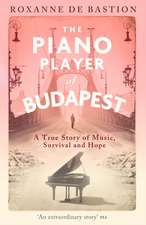 The Piano Player of Budapest: A True Story of Music, Survival and HopeRoxanne de Bastion-27%Preț: 67.79 lei92.95 lei
 -
 -27%Preț: 78.63 lei107.51 lei
 -
 -24%Preț: 84.08 lei110.52 lei
 -
 The Rebel Pianist of MajdanekNicola Pittam-12%Preț: 61.92 lei70.37 lei
 -
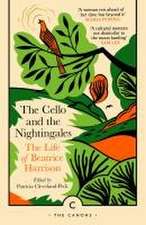 The Cello and the NightingalesBeatrice HarrisonPreț: 78.42 lei
 -
 -25%Preț: 53.74 lei71.94 lei
 -
 The Cellist of SarajevoSteven Galloway-19%Preț: 58.50 lei71.92 lei
 -
 The Bass PlayerStephen TraversPreț: 107.81 lei
 -
 The Auschwitz ViolinMaria Angels Anglada-28%Preț: 55.00 lei76.55 lei
 -
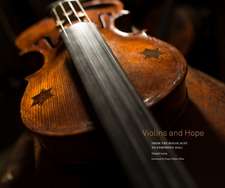 Violins and HopeDaniel LevinPreț: 317.62 lei
De ce să citești această carte
Recomandăm această carte cititorilor care caută o legătură profundă între istorie și artă. Cello nu este doar pentru melomani; este o explorare tulburătoare a supraviețuirii prin cultură. Veți descoperi cum muzica poate fi un colac de salvare în cele mai întunecate momente ale istoriei moderne, totul într-o ediție bogat ilustrată care transformă lectura într-o experiență multisenzorială despre pierdere și regăsire.
Despre autor
Kate Kennedy este unul dintre cei mai importanți critici muzicali de specialitate pentru secolul al XX-lea, fiind cercetător la Wolfson College, Oxford. Expertiza sa în viața scriitorilor și compozitorilor este recunoscută internațional, fiind autoarea biografiei de referință Dweller in Shadows (dedicată lui Ivor Gurney) și a volumului Lives of Houses. În calitate de director al Centrului pentru Studiul Femeilor Compozitoare și al Muzeului de Istorie a Muzicii, Kennedy își folosește vasta pregătire academică pentru a aduce la lumină perspective uitate, îmbinând analiza muzicologică cu o narativitate caldă și accesibilă.
Descriere
'Absorbing' Wall Street Journal
'Just as a cello's voice is divided across four strings, each with its own colour and character, this is a journey in four parts, in search of four players and their instruments...'
In Cello, Kate Kennedy weaves together the lives of four remarkable cellists who suffered various forms of persecution, injury and misfortune. The Hungarian Jewish cellist and composer Pál Hermann managed to keep one step ahead of the Gestapo for much of the Second World War but was eventually captured and murdered. Lise Cristiani, the first female professional cello soloist, undertook an epic - and ultimately fatal - concert tour of Siberia in the 1850s, taking with her one of the world's greatest Stradivari cellos. Anita Lasker-Wallfisch was incarcerated in both Auschwitz and Bergen-Belsen camps, only surviving because she was the cellist in the Auschwitz-Birkenau women's orchestra. Amedeo Baldovino of the Trieste Piano Trio was forced to jump from a burning ship with his 'Mara' Stradivari, losing the cello, and nearly losing his own life when the boat was shipwrecked near Buenos Aires.
Counterpointing the themes raised by these extraordinary stories are a sequence of interludes that draw together the author's reflections on the nature and history of the cello, and her many interviews and encounters with contemporary cellists. Kate Kennedy's own relationship with the cello is a complicated one. As a teenager, she suffered an injury to her arm that imposed severe limitations on her career as a performer on the instrument that was her first love. She realised that, in order to start to understand what the cello meant to her, she needed to find out what the cello - and, crucially, the absence of the cello - had meant to some other cellists, past and present.
Kate Kennedy has written an eloquent and multitextured homage to this warmest of stringed instruments - part quest narrative, part detective story, part philosophical meditation.
Recenzii
Kate Kennedy's quest across seas and continents, following the lives of four great cellists, is a rare musical adventure. Brimming with life, comic, thoughtful, and at times heartbreaking, Cello explores the bond between players and their instruments and its enduring power.
Kate Kennedy has followed her cello heart, and it has led her on a fascinating and unusual path. An excellently researched, thoroughly absorbing account of a personal voyage of musical discovery.
This is a beautiful, richly fascinating book - a love song to the cello which, as if a character, lives within the lives of those musicians who play it.
A wonderfully evocative journey of exploration and contemplation in the company of four remarkable cellists and their equally remarkable instruments.
Kate Kennedy's fascinating and deeply moving book about the cello weaves a lifetime's passion for the instrument as a performer with her skills as a historian. This absorbing exploration of remarkable instruments and their players through death camps, shipwrecks, and on into the cellos of the future is an embodiment of the deep companionship between musician and instrument. I was fascinated by insights which only a professional cellist could know and by entirely unexpected aspects of the instrument's physicality. Above all, Kennedy's book is a deeply humane tribute to the partnership between composer, musician and instrument, 'the soul of music' and is a huge achievement.
Fascinating
Strikingly original
Cello sings richly . The human leads are compelling and carefully drawn out by Kennedy's new research. But their instruments are almost more so ... fascinating
This lively, likable, and very sad book is structured as a series of movements and interludes ... Neither silence nor sound is absolute; the passage from one to the other is what matters.
Rigorously sourced and meticulously researched ... It's hard to think of another book about a specific instrument that goes quite as deep as this - or, indeed any other instrument that could have inspired one.
Absorbing