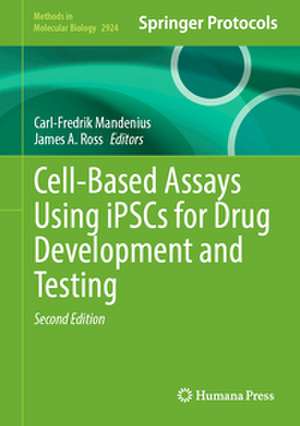
Cell-Based Assays Using iPSCs for Drug Development and Testing: Methods in Molecular Biology, cartea 2924
Editat de Carl-Fredrik Mandenius, James A. Rossen Limba Engleză Hardback – mai 2025
Protocolul de diferențiere într-un singur pas a celulelor stem pluripotente induse umane (iPSC) în podocite mature, prezentat în această a doua ediție a Cell-Based Assays Using iPSCs for Drug Development and Testing, exemplifică precizia tehnică a volumului. Suntem de părere că această lucrare, publicată în prestigioasa serie Methods in Molecular Biology de către Humana, reprezintă o resursă clinică și de laborator esențială pentru standardizarea testării medicamentelor. Structura capitolelor urmează rigoarea academică specifică seriei: introducere teoretică, liste de materiale și reactivi, urmate de protocoale de laborator pas-cu-pas și secțiuni critice de „troubleshooting”. Abordarea editorilor Carl-Fredrik Mandenius și James A. Ross reflectă o evoluție clară față de lucrările anterioare ale lui Mandenius, precum Measurement, Monitoring, Modelling and Control of Bioprocesses. Dacă în opera sa anterioară accentul cădea pe controlul automat al bioproceselor, acest volum integrează acele principii de inginerie în biologia celulară, evidențiind utilizarea bioreactoarelor cu rezervor agitat pentru expansiunea iPSC. Comparativ cu Stem Cell Assays de Nagarajan Kannan, care oferă o perspectivă largă asupra biologiei celulelor stem și a ingineriei CRISPR/Cas9, prezentul manual se concentrează strict pe dezvoltarea de assay-uri pentru farmacologie. De asemenea, acolo unde Induced Pluripotent Stem Cells and Human Disease acoperă modelarea generală a bolilor, volumul de față aprofundează metodele analitice avansate, cum ar fi metabolomica bazată pe LC-MS/MS și proteomica țintită. Progresia conținutului, de la generarea de monostraturi la maturarea cardiacă și măsurarea acizilor biliari în hepatocite derivate, indică o acoperire exhaustivă a principalelor linii celulare relevante în toxicologie și dezvoltarea farmaceutică.
Din seria Methods in Molecular Biology
- 5%
 Preț: 752.32 lei
 - 5%
 Preț: 753.38 lei
 - 5%
 Preț: 762.24 lei
 - 5%
 Preț: 767.04 lei
 - 15%
 Preț: 682.63 lei
 - 18%
 Preț: 1056.83 lei
 - 5%
 Preț: 756.75 lei
 - 18%
 Preț: 942.11 lei
 - 15%
 Preț: 683.53 lei
 - 15%
 Preț: 673.77 lei
 - 18%
 Preț: 1459.88 lei
 - 5%
 Preț: 762.94 lei
 - 18%
 Preț: 1001.24 lei
 - 15%
 Preț: 679.26 lei
 - 5%
 Preț: 759.52 lei
 - 18%
 Preț: 1014.54 lei
 - 5%
 Preț: 755.09 lei
 - 5%
 Preț: 760.91 lei
 - 18%
 Preț: 992.42 lei
 - 15%
 Preț: 672.54 lei
 - 5%
 Preț: 1087.05 lei
 - 18%
 Preț: 972.05 lei
 - 18%
 Preț: 2199.73 lei
 - 5%
 Preț: 1345.68 lei
 - 18%
 Preț: 1435.06 lei
 - 18%
 Preț: 1446.89 lei
 - 18%
 Preț: 1171.86 lei
 - 18%
 Preț: 1461.94 lei
 - 18%
 Preț: 1166.54 lei
 - 18%
 Preț: 1001.54 lei
 - 5%
 Preț: 1347.38 lei
 - 5%
 Preț: 1150.76 lei
 - 5%
 Preț: 755.42 lei
 - 18%
 Preț: 1160.38 lei
 - 18%
 Preț: 991.80 lei
 - 18%
 Preț: 1453.36 lei
 - 5%
 Preț: 1331.69 lei
 - 18%
 Preț: 1285.76 lei
 - 18%
 Preț: 1275.27 lei
 - 5%
 Preț: 1704.75 lei
 - 5%
 Preț: 1159.98 lei
 - 5%
 Preț: 1470.11 lei
 - 18%
 Preț: 771.93 lei
 - 5%
 Preț: 1674.66 lei
 - 18%
 Preț: 749.09 lei
 - 5%
 Preț: 1142.35 lei
 - 5%
 Preț: 1355.98 lei
 - 5%
 Preț: 1679.79 lei
 - 18%
 Preț: 786.39 lei
Preț: 1554.98 lei
Preț vechi: 1636.82 lei
-5%
Carte disponibilă
Livrare economică 07-21 noiembrie
Specificații
ISBN-10: 1071645293
Pagini: 284
Dimensiuni: 183 x 260 x 21 mm
Greutate: 0.73 kg
Ediția:Second Edition 2025
Editura: Springer
Colecția Methods in Molecular Biology
Seria Methods in Molecular Biology
De ce să citești această carte
Această ediție 2025 este indispensabilă cercetătorilor care au nevoie de protocoale reproductibile pentru transformarea iPSC în modele de țesuturi specifice (inimă, rinichi, ficat). Cititorul câștigă acces la metode de ultimă oră pentru screening-ul de înaltă performanță și analiza funcției mitocondriale, esențiale în testarea siguranței medicamentelor. Este un ghid practic care elimină erorile de laborator prin secțiuni dedicate de depanare.