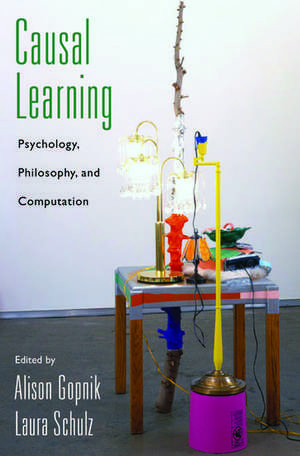
Causal Learning: Psychology, Philosophy, and Computation: Oxford Series in Cognitive Development
Editat de Alison Gopnik, Laura Schulzen Limba Engleză Hardback – 26 apr 2007

Preț: 355.19 lei
Preț vechi: 429.95 lei
-17%
Puncte Express: 533
Carte tipărită la comandă
Livrare economică 10-15 decembrie
Livrare prin curier în România Termenul estimat este afișat lângă disponibilitate.
Transport gratuit de la 400.00 lei Plată online sau ramburs, în funcție de opțiunile comenzii.
Retur gratuit în 14 zile Comandă securizată și suport în română.
Specificații
ISBN-13: 9780195176803
ISBN-10: 0195176804
Pagini: 384
Ilustrații: 108 line illustrations, 10 black and white photographs, 8 shaded line illustrations
Dimensiuni: 254 x 183 x 36 mm
Greutate: 0.82 kg
Editura: Oxford University Press
Colecția OUP USA
Seria Oxford Series in Cognitive Development
Locul publicării:New York, United States
ISBN-10: 0195176804
Pagini: 384
Ilustrații: 108 line illustrations, 10 black and white photographs, 8 shaded line illustrations
Dimensiuni: 254 x 183 x 36 mm
Greutate: 0.82 kg
Editura: Oxford University Press
Colecția OUP USA
Seria Oxford Series in Cognitive Development
Locul publicării:New York, United States
V-ar putea interesa
-
 -33%Preț: 706.30 lei1051.45 lei
 -
 -19%Preț: 434.52 lei536.45 lei
 -
 Introduction to Infant DevelopmentAlan Slater-20%Preț: 476.65 lei597.82 lei
 -
 The Natural Musician: On abilities, giftedness, and talentDina Kirnarskaya-30%Preț: 596.18 lei855.04 lei
 -
 Child Psychology: A Very Short IntroductionUsha Goswami-20%Preț: 56.97 lei70.82 lei
 -
 -19%Preț: 335.99 lei416.27 lei
 -
 Narrative Imagination and Everyday LifeMolly Andrews-21%Preț: 366.03 lei464.92 lei
 -
 Preț: 324.22 lei
 -
 How Babies Think: The Science of ChildhoodAlison Gopnik-25%Preț: 69.85 lei93.63 lei
 -
 Developmental PsychologyPenney UptonPreț: 383.12 lei
 -
 The Philosophical BabyAlison Gopnik-26%Preț: 91.02 lei123.22 lei
Recenzii
...well worth the effort of reading...a well-developed overview of the current state of research in the field of causal learning.
Cuprins
- Part I: Causation and Intervention
- 1: Interventionist Theories of Causation in Psychological Perspective
- 2: Infants' Causal Learning: Intervention, Observation, Imitation
- 3: Detecting Causal Structure: The Role of Interventions in Infants' Understanding of Psychological and Physical Causal Relations
- 4: An Interventionist Approach to Causation in Psychology
- 5: Learning From Doing: Intervention and Causal Inference
- 6: Causal Reasoning Through Intervention
- 7: On the Importance of Causal Taxonomy
- Part II: Causation and Probability
- Introduction to Part II: Causation and Probability
- 8: Teaching the Normative Theory of Causal Reasoning
- 9: Interactions Between Causal and Statistical Learning
- 10: Beyond Covariation: Cues to Causal Structure
- 11: Theory Unification and Graphical Models in Human Categorization
- 12: Essentialism as a Generative Theory of Classification
- 13: Data-Mining Probalists or Experimental Determinists? A Dialogue on the Principles Underlying Causal Learning in Children
- 14: Learning the Structure of Deterministic Systems
- Part III: Causation, Theories, and Mechanisms
- Introduction to Part III: Causation, Theories, and Mechanisms
- 15: Why Represent Causal Relations?
- 16: Causal Reasoning as Informed by the Early Development of Explanations
- 17: Dynamic Interpretations of Covariation Data
- 18: Statistical Jokes and Social Effects: Intervention and Invariance in Causal Relations
- 19: Intuitive Theories as Grammars for Causal Inference
- 20: Two Proposals for Causal Grammars
Notă biografică
Alison Gopnik is Professor of Psychology at the University of California at Berkeley. She is the coauthor of Words, Thoughts and Theories (1997), and The Scientist mn the Crib (1999). She has written over a hundred scientific articles as well as articles for The New York Times, The New York Review of Books and Slate.com. Laura Schulz is Assistant Professor of Brain and Cognitive Sciences at the Massachussets Institute of Technology. She has been the recipient of National Science Foundation and American Association of University Women fellowships. She has published in Developmental Psychology, Child Development, Psychological Review and Trends in Cognitive Sciences.