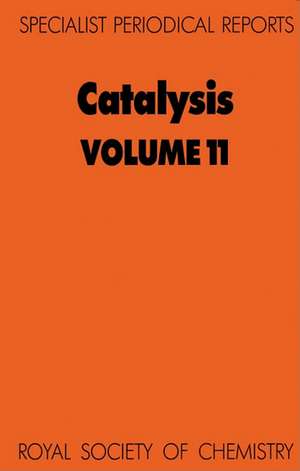
Catalysis
en Limba Engleză Hardback – sep 1994
There is an increasing challenge for chemical industry and research institutions to find cost-efficient and environmentally sound methods of converting natural resources into fuels chemicals and energy. Catalysts are essential to these processes and the Catalysis Specialist Periodical Report series serves to highlight major developments in this area. This series provides systematic and detailed reviews of topics of interest to scientists and engineers in the catalysis field. The coverage includes all major areas of heterogeneous and homogeneous catalysis and also specific applications of catalysis such as NOx control kinetics and experimental techniques such as microcalorimetry. Each chapter is compiled by recognised experts within their specialist fields and provides a summary of the current literature. This series will be of interest to all those in academia and industry who need an up-to-date critical analysis and summary of catalysis research and applications. Catalysis will be of interest to anyone working in academia and industry that needs an up-to-date critical analysis and summary of catalysis research and applications. Specialist Periodical Reports provide systematic and detailed review coverage in major areas of chemical research. Compiled by teams of leading experts in their specialist fields, this series is designed to help the chemistry community keep current with the latest developments in their field. Each volume in the series is published either annually or biennially and is a superb reference point for researchers. www.rsc.org/spr
Preț: 2218.58 lei
Preț vechi: 3039.15 lei
-27%
Puncte Express: 3328
Carte tipărită la comandă
Livrare economică 30 noiembrie-14 decembrie
Livrare prin curier în România Termenul estimat este afișat lângă disponibilitate.
Transport gratuit pentru acest produs Plată online sau ramburs, în funcție de opțiunile comenzii.
Retur gratuit în 14 zile Comandă securizată și suport în română.
Specificații
ISBN-13: 9780851866543
ISBN-10: 0851866549
Pagini: 484
Dimensiuni: 140 x 216 x 32 mm
Greutate: 0.76 kg
Ediția:Edition.
ISBN-10: 0851866549
Pagini: 484
Dimensiuni: 140 x 216 x 32 mm
Greutate: 0.76 kg
Ediția:Edition.
V-ar putea interesa
-
 Love SenseSue JohnsonPreț: 185.50 lei
 -
 Capillarity and Wetting PhenomenaPierre Gilles de Gennes-15%Preț: 613.01 lei721.19 lei
 -
 Cosmetics Greening UpSahota-9%Preț: 973.06 lei1069.30 lei
 -
 -14%Preț: 970.28 lei1128.24 lei
 -
 -9%Preț: 1061.48 lei1166.47 lei
 -
 -9%Preț: 1187.89 lei1305.37 lei
 -
 CrystallographyWalter Borchardt-Ott-15%Preț: 534.69 lei629.04 lei
 -
 -15%Preț: 693.29 lei815.64 lei
 -
 Plasma Chemistry IIIS. Veprek-15%Preț: 636.56 lei748.89 lei
Cuprins
Front matter; Preface; Contents; Applications of secondary ion mass spectrometry in catalysis and surface chemistry; Frequency response techniques for the characterization of porous catalytic solids; H2 adsorption on supported noble metals and its use in determining metal dispersion; Binding properties of hydroxyl groups on substrates in aqueous environments: Their relationship to catalyst preparation; Viriation in the mechanism of catalytic reactions with crytal face; Partial oxidation and ammoxidation of propane: Catalysts and processes; Selective oxidations of C4 paraffins; Bimetallic catalysts: Structure and reactivity; Catalytic dehydrogenation of lower alkanes; Catalytic partial oxidation of methane to synthesis gas (syngas); Characterization of catalysts with microcalorimetry;
Notă biografică
Professor Spivey is the McLaurin Shivers Professor of Chemical Engineering at Louisiana State University and Director of the DOE Energy Frontier Research Center at LSU. Professor Spivey's research interests include the application of the principles of heterogeneous catalysis to catalytic combustion, control of sulfur and nitrogen oxides from combustion processes, acid/base catalysis (e.g., for condensation reactions), hydrocarbon synthesis, and the study of catalyst deactivation.
Descriere
Catalysis will be of interest to anyone working in academia and industry that needs an up-to-date critical analysis and summary of catalysis research and applications.
Textul de pe ultima copertă
The current volume of this series focuses on a number of different areas of our discipline. As in past volumes, the number of chapters related to energy and fuel conversion continue to reflect the importance of these areas to researchers and funding agencies. Chapters presented here also deal with material synthesis (e.g., zeolites) and fundamental catalyst properties (e.g., cluster size effects). First, Arno de Klerk (U. Alberta, Canada) reviews two types of acid catalysts for upgrading of Fischer–Tropsch syncrude. Roberto Lanza, Jorge Velasco and Sven Järås (KTH, Stockholm) examine recent literature on partial oxidation of methane and the effect of steam this reaction. John Kuhn (U. South Florida, USA) reports on noble metal catalysts for deep hydrodesulfurization. Tatsuo Matsushima (Hokkaido Univ., Japan) and Kosuke Shobatake (Nagoya Univ., Japan) show how a technique known as angle-resolved product desorption can be used as a direct approach to probe the active sites responsible for product formation or active intermediates. Dmitry Murzin (Abo Akademi Univ., Finland) and Valentin Parmon (Boreskov Institute., Russia) review the subject of metal cluster size effects in heterogeneous catalysis. Vasile Parvelscu (U. Bucharest, Romania) and Hermenegildo Garcia (U. Politecnica de Valencia, Spain) discuss developments in the widely studied area of photocatalysis, especially for destruction of toxic compounds. D. P. Serrano and J. M. Escola (U. Rey Juan Carlos, Spain), along with J. Aguado (IMDEA Energy Institute, Spain) review a class of materials known as hierarchical zeolites. Eduardo Sousa-Aguiar (Federal University of Rio de Janeiro, Brazil) and Lucia Appel (National Technology Institute, Brazil) examine recent studies on the catalytic reactions leading to dimethyl ether (DME), and its use as a fuel additive, among others. Finally, Mizuki Tada (Institute for Molecular Science, Japan) discusses selective oxidation on rhenium-based catalysts. This chapter reviews attempts to minimize sublimation (e.g., with Sb or NH3), and highlights reactions such as selective oxidation and ammoxidation of isobutylene.