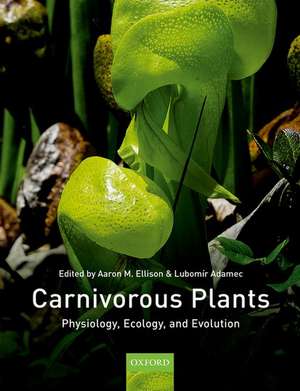
Carnivorous Plants: Physiology, ecology, and evolution
Editat de Aaron Ellison, Lubomír Adamecen Limba Engleză Hardback – 21 dec 2017
Preț: 1057.74 lei
Preț vechi: 1526.57 lei
-31%
Puncte Express: 1587
Carte tipărită la comandă
Livrare economică 20 noiembrie-01 decembrie
Livrare prin curier în România Termenul estimat este afișat lângă disponibilitate.
Transport gratuit pentru acest produs Plată online sau ramburs, în funcție de opțiunile comenzii.
Retur gratuit în 14 zile Comandă securizată și suport în română.
Specificații
ISBN-13: 9780198779841
ISBN-10: 0198779844
Pagini: 548
Ilustrații: 110
Dimensiuni: 196 x 252 x 29 mm
Greutate: 1.38 kg
Editura: OUP OXFORD
Colecția OUP Oxford
Locul publicării:Oxford, United Kingdom
ISBN-10: 0198779844
Pagini: 548
Ilustrații: 110
Dimensiuni: 196 x 252 x 29 mm
Greutate: 1.38 kg
Editura: OUP OXFORD
Colecția OUP Oxford
Locul publicării:Oxford, United Kingdom
V-ar putea interesa
-
 -23%Preț: 486.30 lei631.57 lei
 -
 -23%Preț: 558.83 lei725.75 lei
 -
 -20%Preț: 459.56 lei575.00 lei
 -
 Experimental Design for the Life SciencesGraeme D. Ruxton-12%Preț: 329.93 lei373.37 lei
 -
 -31%Preț: 716.15 lei1038.12 lei
 -
 Wildlife Conservation on Farmland Volume 2: Conflict in the countrysideDavid W. Macdonald-31%Preț: 747.88 lei1080.68 lei
 -
 Wildlife Conservation on Farmland: Two volume setDavid W. Macdonald-32%Preț: 843.48 lei1233.33 lei
 -
 The Lioness in Winter – Writing an Old Woman`s LifeAnn Burack–weissPreț: 188.18 lei
 -
 Ecological GeneticsLeslie RealPreț: 430.05 lei
 -
 Sensory InhibitionGeorg von BekesyPreț: 382.21 lei
 -
 Leo TolstoyRichard F. Gustafson-23%Preț: 1257.51 lei1633.13 lei
 -
 LeksJacob Höglund-23%Preț: 904.99 lei1175.31 lei
 -
 Han Yu and the T'ang Search for UnityCharles Hartman-23%Preț: 1169.36 lei1518.66 lei
 -
 My Thirty-Three Year's DreamMiyazaki Toten-23%Preț: 854.10 lei1109.22 lei
 -
 Our Creative WorldBhowanie BenimadhuPreț: 54.09 lei
 -
 Essentials of Free Radical Biology and MedicineRobert Z Hopkins-9%Preț: 927.99 lei1019.77 lei
 -
 Anatomic Atlas of Aquatic and Wetland Plant StemsFritz H. Schweingruber-24%Preț: 1544.58 lei2032.33 lei
 -
 -8%Preț: 398.71 lei433.38 lei
 -
 Quand Une Molecule Repulsive Devient Attractive: Tome 1Guillaume CaulierPreț: 418.98 lei
Recenzii
As a review of the most up to date research on carnivorous plants, this is ideal for senior undergraduate or graduate students, academics, and those with a keen interest in carnivorous plants...It rewards the careful and thorough reader who is passionate about botany.
Carnivorous Plants is an essential review of numerous recent studies on the evolution and systematics, physiology, and ecology of insectivorous plants. The updated taxonomic index alone makes this work invaluable.... Essential.
Carnivorous Plants is a comprehensive, well sourced, text [...] Any library that holds volumes on the biological sciences will surely want to own a copy.
Carnivorous Plants: Physiology, ecology, and evolution is a remarkable work of scholarship for a remarkable group of plants (by a remarkable band of enthusiasts).
Carnivorous Plants is an essential review of numerous recent studies on the evolution and systematics, physiology, and ecology of insectivorous plants. The updated taxonomic index alone makes this work invaluable.... Essential.
Carnivorous Plants is a comprehensive, well sourced, text [...] Any library that holds volumes on the biological sciences will surely want to own a copy.
Carnivorous Plants: Physiology, ecology, and evolution is a remarkable work of scholarship for a remarkable group of plants (by a remarkable band of enthusiasts).
Notă biografică
Aaron M. Ellison is the Senior Research Fellow in Ecology at Harvard University, and a semi-professional photographer and writer. He studies the disintegration and reassembly of ecosystems following natural and anthropogenic disturbances; thinks about the relationship between the Dao and the intermediate disturbance hypothesis and reflects on the critical and reactionary stance of Ecology relative to Modernism.Lubomír Adamec is the Senior Research Scientist in the Section of Plant Ecology of the Institute of Botany CAS at Trebon, Czech Republic, where he has been working since 1986. Since graduating in plant physiology from the Charles University in Prague, Czechoslovakia, he has been studying the ecophysiology of aquatic and wetland plants, especially carnivorous ones: mineral nutrition, photosynthesis, growth traits, Utricularia trap ecophysiology, and biophysics. He is the curator of the world's largest collection of aquatic carnivorous plants, currently including more than 80 species or populations, which is used extensively for research and plant conservation.
Cuprins
- Part I: Overview
- 1: Aaron M. Ellison and Lubomír Adamec: Introduction
- 2: J. Stephen Brewer and Jan Schlauer: Biogeography and habitats of carnivorous plants
- 3: Andreas Fleischmann, Jan Schlauer, Stephen A. Smith, and Thomas J. Givnish: Evolution of carnivory in angiosperms
- Part II: Systematics and evolution of carnivorous plants
- 4: Andreas Fleischmann, Adam T. Cross, Robert Gibson, Paulo M. Gonella, and Kingsley W. Dixon: Systematics and evolution of Droseraceae
- 5: Charles Clarke, Jan Schlauer, Jonathan Moran, and Alastair Robinson: Systematics and evolution of Nepenthes
- 6: Andreas Fleischmann and Aymeric Roccia: Systematics and evolution of Lentibulariaceae: I. Pinguicula
- 7: Andreas Fleischmann: Systematics and evolution of Lentibulariaceae: II. Genlisea
- 8: Richard W. Jobson, Paulo C. Baleeiro, and Cástor Guisande: Systematics and evolution of Lentibulariaceae: III. Utricularia
- 9: Robert F.C. Naczi: Systematics and evolution of Sarraceniaceae
- 10: Adam T. Cross, Maria Paniw, André Vito Scatigna, Nick Kalfas, Bruce Anderson, Thomas J. Givnish, and Andreas Fleischmann: Systematics and evolution of small genera of carnivorous plants
- 11: Tanya Renner, Tianying Lan, Kimberly M. Farr, Enrique Ibarra-Laclette, Luis Herrera- Esrella, Stephan C. Schuster, Mitsuyasu Hasebe, Kenji Fukushima, and Victor A. Albert: Carnivorous plant genomes
- Part III: Physiology, form, and function
- 12: John D. Horner, Bartosz J. Plachno, Ulrike Bauer, and Bruno Di Giusto: Attraction of prey
- 13: Bartosz J. Plachno and Lyudmila E. Muravnik: Functional anatomy of carnivorous traps
- 14: Simon Poppinga, Ulrike Bauer, Thomas Speck, and Alexander G. Volkov: Motile traps
- 15: Ulrike Bauer, Reinhard Jetter, and Simon Poppinga: Non-motile traps
- 16: Ildikó Matuiková, Andrej Pavlovic, and Tanya Renner: Biochemistry of prey digestion and nutrient absorption
- 17: Lubomír Adamec and Andrej Pavlovic: Mineral nutrition of terrestrial carnivorous plants
- 18: Thomas J. Givnish, K. William Sparks, Steven J. Hunter, and Andrej Pavlovic: Why are plants carnivorous? Cost/benefit analysis, whole-plant growth, and the context- specific advantages of botanical carnivory
- 19: Lubomír Adamec: Ecophysiology of aquatic carnivorous plants
- 20: Laurent Legendre and Douglas W. Darnowski: Biotechnology with carnivorous plants
- Part IV: Ecology
- 21: Douglas W. Darnowski, Ulrike Bauer, Marcos Méndez, John D. Horner, and Bartosz J. Plachno: Prey selection and specialization by carnivorous plants
- 22: Adam T. Cross, Arthur R. Davis, Andreas Fleischmann, John D. Horner, Andreas Jürgens, David J. Merritt, Gillian L. Murza, and Shane R. Turner: Reproductive biology and prey-pollinator conflicts
- 23: Leonora S. Bittleston: Commensals of Nepenthes pitchers
- 24: Thomas E. Miller, William E. Bradshaw, and Christina M. Holzapfel: Pitcher-plant communities as model systems for addressing fundamental questions in ecology and evolution
- 25: Dagmara Sirová, Jirí Bárta, Jakub Borovec, and Jaroslav Vrba: The Utricularia-associated microbiome: composition, function, and ecology
- 26: Jonathan A. Moran, Bruce Anderson, Lijin Chin, Melinda Greenwood, and Charles Clarke: Nutritional mutualisms of Nepenthes and Roridula
- Part V: The future of carnivorous plants
- 27: Charles Clarke, Adam Ross, and Barry Rice: Conservation of carnivorous plants
- 28: Matthew C. Fitzpatrick and Aaron M. Ellison: Estimating the exposure of carnivorous plants to rapid climatic change
- 29: Aaron M. Ellison and Lubomír Adamec: The future of research with carnivorous plants