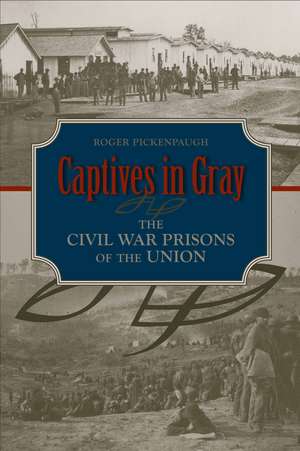
Captives in Gray: The Civil War Prisons of the Union
Autor Roger Pickenpaughen Limba Engleză Hardback – 24 mai 2009
Contains contemporary reports from prisoners and witnesses humanize the grim realities of the POW camps
Captives in Gray is Civil War prison camp authority Roger Pickenpaugh’s acclaimed and definitive account of the Union’s POW camps. Combining his own extensive research into official records and a rich variety of letters and diaries with the best contemporary scholarship, Pickenpaugh covers every major northern camp.
Because the Union won few victories in 1861 and took few prisoners, the North had time to plan and build prison camps, an opportunity it largely squandered. Pickenpaugh gives illuminating accounts of the role and leadership of thrifty Lieutenant Colonel William Hoffman, the commissary general of prisoners for most of the conflict, and President Abraham Lincoln's secretaries of war, the incompetent Simon Cameron and the malignant Edwin M. Stanton.
Death came in many ways. Soldiers from the Deep South had no experience with extreme cold, and they died by the hundreds each winter. In one memorable freeze, Rock Island, Illinois, saw temperatures between twenty-eight and thirty-one degrees below zero. With insufficient fuel and inadequate shelter, clothing, and blankets, prisoners there and in other camps froze to death. Food rations varied widely. A few Confederates enjoyed better rations than they had in the CSA armies, but the majority supplemented their meager rations by eating rats, dogs, cats, and seagulls.
Poor medical care added to the death toll. Treatment was bad even by the standards of Civil War medicine, often due to Hoffman's reluctance to spend. Prisoners suffered from lice and scurvy, as well as pneumonia, measles, and a variety of fevers. As in both armies, diarrhea and dysentery were chronic. Smallpox epidemics killed many. Poor sanitation and drainage caused 385 deaths at Elmira, New York, in September 1864 alone.
During the war, over 12 percent of rebel prisoners, or 25,976 of the 214,865, died in captivity. Together with his Captives in Blue, Captives in Gray gives the fullest account of the experiences of prisoners of war in the American Civil War.
| Toate formatele și edițiile | Preț | Express |
|---|---|---|
| Paperback (1) | 236.27 lei 3-5 săpt. | |
| University Of Alabama Press – 15 iul 2025 | 236.27 lei 3-5 săpt. | |
| Hardback (1) | 339.62 lei 3-5 săpt. | +33.83 lei 6-10 zile |
| University Of Alabama Press – 24 mai 2009 | 339.62 lei 3-5 săpt. | +33.83 lei 6-10 zile |
Preț: 339.62 lei
Nou
Puncte Express: 509
Preț estimativ în valută:
60.10€ • 70.47$ • 52.78£
60.10€ • 70.47$ • 52.78£
Carte disponibilă
Livrare economică 21 ianuarie-04 februarie 26
Livrare express 06-10 ianuarie 26 pentru 43.82 lei
Preluare comenzi: 021 569.72.76
Specificații
ISBN-13: 9780817316525
ISBN-10: 0817316523
Pagini: 400
Ilustrații: 22 B&W illustrations
Dimensiuni: 156 x 235 x 30 mm
Greutate: 0.68 kg
Ediția:First Edition
Editura: University Of Alabama Press
Colecția University Alabama Press
ISBN-10: 0817316523
Pagini: 400
Ilustrații: 22 B&W illustrations
Dimensiuni: 156 x 235 x 30 mm
Greutate: 0.68 kg
Ediția:First Edition
Editura: University Of Alabama Press
Colecția University Alabama Press
V-ar putea interesa
-
 Roosevelt's Second ACTRichard MoePreț: 136.71 lei
 -
 Preț: 117.94 lei
 -
 Selling Ronald Reagan: The Emergence of a PresidentGerard DeGroot-18%Preț: 331.63 lei405.67 lei
 -
 America: From White Settlement to World HegemonyVictor Kiernan-16%Preț: 130.27 lei154.86 lei
Notă biografică
Roger Pickenpaugh is the author of a dozen works of history, including Rescue by Rail: Troop Transfer and the Civil War in the West, 1863 and Camp Chase and the Evolution of Union Prison Policy.
Cuprins
List of Illustrations
Acknowledgments
Chapter 1. “Arrangements should be at once made”: Plans and Prisoners, 1861
Chapter 2. “I fear they will prove an elephant”: The First Wave of Prisoners, 1862
Chapter 3. “All seem rejoiced at the idea of going”: Prisoner Exchange, 1862–63
Chapter 4. “In view of the awful vortex”: The Collapse of the Cartel and the Second Wave of Prisoners
Chapter 5. “The first time I ever desired to be in a penitentiary”: Capture and Transport
Chapter 6. “Nothing to do & nothing to do it with”: The Constant Battle with Boredom
Chapter 7. “i had rather bee hear then to bee a marching”: Keepers in Blue
Chapter 8. “Don’t be so hasty and you may get out”: The Possibility of Escape
Chapter 9. “Almost starving in a land of plenty”: Rations and Retaliation
Chapter 10. “Inevitable death awaited its victims”: The Health of the Prisoners
Chapter 11. “Our honor could in no way be compromised”: The Road to Release
Notes
Bibliography
Index
Acknowledgments
Chapter 1. “Arrangements should be at once made”: Plans and Prisoners, 1861
Chapter 2. “I fear they will prove an elephant”: The First Wave of Prisoners, 1862
Chapter 3. “All seem rejoiced at the idea of going”: Prisoner Exchange, 1862–63
Chapter 4. “In view of the awful vortex”: The Collapse of the Cartel and the Second Wave of Prisoners
Chapter 5. “The first time I ever desired to be in a penitentiary”: Capture and Transport
Chapter 6. “Nothing to do & nothing to do it with”: The Constant Battle with Boredom
Chapter 7. “i had rather bee hear then to bee a marching”: Keepers in Blue
Chapter 8. “Don’t be so hasty and you may get out”: The Possibility of Escape
Chapter 9. “Almost starving in a land of plenty”: Rations and Retaliation
Chapter 10. “Inevitable death awaited its victims”: The Health of the Prisoners
Chapter 11. “Our honor could in no way be compromised”: The Road to Release
Notes
Bibliography
Index
Recenzii
“This is a vivid description of conditions and events rarely described: the imprisonment of captured Confederate soldiers during the Civil War. Its many parallels to circumstances in Andersonville are especially intriguing.”
—Jimmy Carter, 39th President of the United States
"The Civil War produced a seminal guide for proper treatment of POWs in the form of US Army General Orders No. 100 (24 April 1863), called the "Lieber Code." Bickering about application of these rules has obscured historical understanding of POW life in Union hands. Pickenpaugh shows that both sides lacked suitable personnel, food, and shelter for large catches of POWs produced by battles of unforeseen magnitude. Breakdown of parole and exchange of captives meant that thousands were held for months and years. Camps formed little communities struggling against boredom with handicrafts, hobbies, sports, gambling, escape attempts, canteens, music, and sometimes hard liquor. Hospitals of mixed effectiveness were unable to reduce a 12 percent mortality rate caused in part by unsanitary conditions in camps. Diaries of lesser-rank soldiers reflect common life in POW camps. Recommended. All levels/libraries."
—CHOICE
—Jimmy Carter, 39th President of the United States
"The Civil War produced a seminal guide for proper treatment of POWs in the form of US Army General Orders No. 100 (24 April 1863), called the "Lieber Code." Bickering about application of these rules has obscured historical understanding of POW life in Union hands. Pickenpaugh shows that both sides lacked suitable personnel, food, and shelter for large catches of POWs produced by battles of unforeseen magnitude. Breakdown of parole and exchange of captives meant that thousands were held for months and years. Camps formed little communities struggling against boredom with handicrafts, hobbies, sports, gambling, escape attempts, canteens, music, and sometimes hard liquor. Hospitals of mixed effectiveness were unable to reduce a 12 percent mortality rate caused in part by unsanitary conditions in camps. Diaries of lesser-rank soldiers reflect common life in POW camps. Recommended. All levels/libraries."
—CHOICE
“An ambitious examination of almost all Union military prisons, [which] . . . addresses a specific historical category that has, to my knowledge, not yet been treated.”
—William Marvel, author of Lee’s Last Retreat: The Flight to Appomattox and Andersonville: The Last Depot
"Roger Pickenpaugh has provided us with a reliable work and I highly recommend Captives in Gray to any student of the Civil War, whether professional or lay person. This is a well-written, deeply moving story and I believe will become the standard for the subject." —Blue Gray Magazine
Descriere
Step into the harrowing world of Civil War prison camps with Roger Pickenpaugh’s gripping account of the Union’s treatment of Confederate POWs. Drawing from official records, personal letters, and diaries, Pickenpaugh exposes the chilling realities of northern camps—where cold, disease, and mismanagement claimed thousands of lives. A must-read for history enthusiasts, this book offers a rare and vivid perspective on a neglected chapter of America's past.