
Capitalist Dispossessions: Critiques and Alternatives to Capitalism
Autor Daniel Binen Limba Engleză Paperback – 29 sep 2025
| Toate formatele și edițiile | Preț | Express |
|---|---|---|
| Paperback (1) | 384.25 lei 6-8 săpt. | |
| Taylor & Francis Ltd. – 29 sep 2025 | 384.25 lei 6-8 săpt. | |
| Hardback (1) | 1013.90 lei 6-8 săpt. | |
| Taylor & Francis – 30 iul 2024 | 1013.90 lei 6-8 săpt. |
Din seria Critiques and Alternatives to Capitalism
-
 Preț: 334.22 lei
 -
 Preț: 181.55 lei
 -
 Preț: 334.07 lei
 -
 Preț: 310.61 lei
 -
 Preț: 180.92 lei
 -
 Preț: 367.70 lei
 -
 Preț: 375.44 lei
 -
 Preț: 374.74 lei
 - 18%
 Preț: 1013.61 lei
 - 18%
 Preț: 1014.21 lei
 -
 Preț: 388.72 lei
 - 18%
 Preț: 1070.76 lei
 - 18%
 Preț: 1017.08 lei
 - 18%
 Preț: 960.22 lei
 - 18%
 Preț: 1016.64 lei
 - 18%
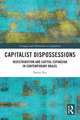 Preț: 1013.90 lei
 - 18%
 Preț: 963.42 lei
 - 18%
 Preț: 1013.30 lei
 - 18%
 Preț: 1021.07 lei
 - 18%
 Preț: 1018.23 lei
Preț: 384.25 lei
Nou
Puncte Express: 576
Preț estimativ în valută:
67.100€ • 79.73$ • 59.71£
67.100€ • 79.73$ • 59.71£
Carte tipărită la comandă
Livrare economică 11-25 februarie 26
Preluare comenzi: 021 569.72.76
Specificații
ISBN-13: 9781032645964
ISBN-10: 1032645962
Pagini: 186
Dimensiuni: 156 x 234 mm
Greutate: 0.37 kg
Editura: Taylor & Francis Ltd.
Seria Critiques and Alternatives to Capitalism
ISBN-10: 1032645962
Pagini: 186
Dimensiuni: 156 x 234 mm
Greutate: 0.37 kg
Editura: Taylor & Francis Ltd.
Seria Critiques and Alternatives to Capitalism
Cuprins
Introduction 1. Primitive, Redistributive, and Capital-Expanding Dispossessions 2. Agricultural Dispossessions during the Military Rule 3. Dispossessing Neoliberal Economic Policy 4. Olympic Urban Dispossessions 5. A Dispossessing Legislative Coup d’État 6. Dispossessions during the Pandemic 7. Capital-Expanding and Capital-Exhausting Dispossession Afterword
Recenzii
"This is an excellent, timely, and compelling book. Focusing on Brazil, it scrutinizes the secret of capitalist accumulation as a violent process of dispossession and destruction. I urge you to read it."
Werner Bonefeld, Professor Emeritus of Politics, University of York, UK, and Adjunct Professor, Postgraduate School ZRC SAZU, Slovenia
"This is a wonderful new look at capitalism, and in particular, how different types of dispossessions relate to accumulation. It shows how proletarianization, capitalization, and commodification all contribute to accumulation in different ways. This book thus draws together disparate lines of Marxist thought in a novel and important way."
Rebecca Jean Emigh, Professor of Sociology, University of California, Los Angeles, USA
"Primitive accumulation gave birth to capitalism and during neoliberalism we have observed various types of dispossessions that assure capital’s reproduction. Daniel Bin’s book analyzes dispossession in Brazil between the military regime and the pandemic, distinguishing dispossessions that redistribute surpluses from those that expand capital. Both threaten capital with its exhaustion. Quite thought-provoking!"
Maria de Lourdes Rollemberg Mollo, Professor of Economics, University of Brasilia, Brazil
"Daniel Bin’s highly original work weaves together analyzes of the specific forms of dispossession in a highly important country in the periphery, with the examination of a wide range of concrete processes of dispossession taking place over time. Bin shows that dispossession can not only enhance exploitation, but also generate new forms of inequality while, simultaneously, supporting the reproduction of the system of accumulation. This book offers an important set of contributions to scholarship, across development studies, value theory, uneven and combined development, and Latin American studies."
Alfredo Saad Filho, Professor of Political Economy and International Development, King’s College London, UK, Distinguished Visiting Professor, University of Johannesburg, South Africa, Visiting Professor, LUT University, Finland, and Visiting Professor, Luigi Vanvitelli University, Italy
Werner Bonefeld, Professor Emeritus of Politics, University of York, UK, and Adjunct Professor, Postgraduate School ZRC SAZU, Slovenia
"This is a wonderful new look at capitalism, and in particular, how different types of dispossessions relate to accumulation. It shows how proletarianization, capitalization, and commodification all contribute to accumulation in different ways. This book thus draws together disparate lines of Marxist thought in a novel and important way."
Rebecca Jean Emigh, Professor of Sociology, University of California, Los Angeles, USA
"Primitive accumulation gave birth to capitalism and during neoliberalism we have observed various types of dispossessions that assure capital’s reproduction. Daniel Bin’s book analyzes dispossession in Brazil between the military regime and the pandemic, distinguishing dispossessions that redistribute surpluses from those that expand capital. Both threaten capital with its exhaustion. Quite thought-provoking!"
Maria de Lourdes Rollemberg Mollo, Professor of Economics, University of Brasilia, Brazil
"Daniel Bin’s highly original work weaves together analyzes of the specific forms of dispossession in a highly important country in the periphery, with the examination of a wide range of concrete processes of dispossession taking place over time. Bin shows that dispossession can not only enhance exploitation, but also generate new forms of inequality while, simultaneously, supporting the reproduction of the system of accumulation. This book offers an important set of contributions to scholarship, across development studies, value theory, uneven and combined development, and Latin American studies."
Alfredo Saad Filho, Professor of Political Economy and International Development, King’s College London, UK, Distinguished Visiting Professor, University of Johannesburg, South Africa, Visiting Professor, LUT University, Finland, and Visiting Professor, Luigi Vanvitelli University, Italy
Notă biografică
Daniel Bin is an associate professor at the Universidade de Brasília, Brazil. He is the author of The Politics of Public Debt and currently serves as an associate editor of the journal Critical Sociology.