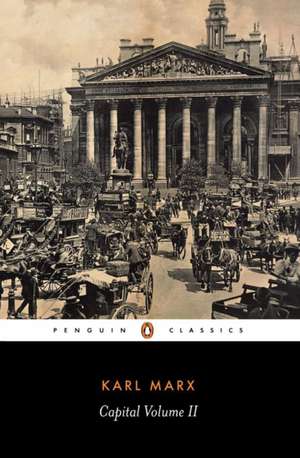
Capital: Capital
Autor Karl Marx Traducere de David Fernbachen Limba Engleză Paperback – 28 mai 1992
Înțelegerea mecanismelor economice globale nu este un exercițiu teoretic opțional, ci o urgență pentru oricine dorește să descifreze crizele și inegalitățile lumii contemporane. Capital rămâne instrumentul fundamental pentru această analiză, oferind nu doar o critică a economiei politice, ci o radiografie a „legilor de mișcare” ale societății moderne. Considerăm că forța acestui text rezidă în capacitatea de a demonta structura invizibilă a modului de producție capitalist, dezvăluind cum proprietatea asupra mijloacelor de producție și exploatarea muncii generează profitul și acumularea. Pe linia analitică a lucrării Marx's 'Capital' de Ben Fine, care oferă un ghid de studiu, volumul original al lui Marx merge mult mai adânc, axându-se pe fundamentele filosofice și economice ale valorii de schimb. Dacă în The Communist Manifesto găsim un apel revoluționar la acțiune, în Capital descoperim rigoarea savantului care a petrecut decenii în biblioteca British Museum pentru a demonstra matematic și dialectic contradicțiile sistemului. Găsim în această ediție o organizare metodică ce pornește de la analiza mărfii și a caracterului dual al muncii, avansând spre procesul complex de circulație și acumulare a capitalului. Este o progresie logică, susținută de prefețele lui Friedrich Engels, care ancorează textul în contextul istoric al luptei de clasă și al dezvoltării industriale.


Preț: 102.84 lei
Preț vechi: 124.30 lei
-17%
Carte disponibilă
Livrare economică 12-18 noiembrie
Livrare express 24-30 octombrie pentru 54.58 lei
Specificații
ISBN-10: 0140445692
Pagini: 624
Dimensiuni: 129 x 201 x 39 mm
Greutate: 0.49 kg
Ediția:2. Auflage
Editura: Penguin Books
Colecția Capital
Seria Capital
Locul publicării:London, United Kingdom
V-ar putea interesa
-
 The PrinceNiccolo MachiavelliPreț: 28.01 lei
 -
 The Origins of the Second World WarA. J. P. TaylorPreț: 93.77 lei
 -
 The Wealth of NationsAdam SmithPreț: 95.16 lei
 -
 The Conquest of BreadPeter KropotkinPreț: 78.83 lei
 -
 The Communist ManifestoFriedrich Engels-39%Preț: 17.49 lei28.48 lei
 -
 The Communist ManifestoKarl MarxPreț: 84.95 lei
 -
 The Communist ManifestoKarl Marx-19%Preț: 28.86 lei35.70 lei
 -
 On AnarchismNoam Chomsky-20%Preț: 51.13 lei63.84 lei
 -
 The Accumulation of CapitalRosa LuxemburgPreț: 142.29 lei
 -
 The Amber SpyglassPhilip PullmanPreț: 65.41 lei
 -
 Quo VadisHenryk SienkiewiczPreț: 141.61 lei
 -
 Das KapitalKarl MarxPreț: 113.35 lei
 -
 Preț: 378.52 lei
 -
 -24%Preț: 147.89 lei193.34 lei
 -
 Wealth of NationsAdam SmithPreț: 50.72 lei
 -
 The Revolutions of 1848Karl MarxPreț: 176.37 lei
 -
 -5%Preț: 419.08 lei441.14 lei
 -
 Price TheoryMilton FriedmanPreț: 133.68 lei
 -
 Writings of Rosa LuxemburgRosa LuxemburgPreț: 124.16 lei
 -
 Lohn, Preis und ProfitKarl MarxPreț: 131.24 lei
 -
 Eighteenth Brumaire of Louis BonaparteKarl MarxPreț: 128.02 lei
 -
 Der Bürgerkrieg in FrankreichKarl MarxPreț: 101.62 lei
 -
 Preț: 150.26 lei
 -
 Selected EssaysKarl MarxPreț: 141.18 lei
De ce să citești această carte
Veți câștiga o înțelegere profundă a modului în care funcționează economia la nivel structural, dincolo de retorica pieței libere. Este o lectură esențială pentru studenții la economie, sociologie sau filozofie politică, oferind rigoarea necesară pentru a critica sistemul de pe o poziție informată. Veți învăța să identificați sursa profitului în producție și rolul acumulării în modelarea societății.
Despre autor
Karl Marx (1818–1883) a fost un filozof, economist și teoretician politic german, a cărui operă a redefinit cursul istoriei moderne. După studii de drept și filozofie la Bonn și Berlin, a trăit cea mai mare parte a vieții în exil la Londra, unde a colaborat strâns cu Friedrich Engels. Gândirea sa, fundamentată pe materialismul istoric, susține că societățile evoluează prin conflictul de clasă între burghezie și proletariat. Prin Capital, Marx a oferit baza teoretică pentru marxism, influențând decisiv mișcările sociale și politice globale ale secolelor XIX și XX.
Notă biografică
Ernst Mandel was a member of the Belgian TUV from 1954 to 1963 and was chosen for the annual Alfred Marshall Lectures by Cambridge University in 1978. He died in 1995 and the Guardian described him as 'one of the most creative and independent-minded revolutionary Marxist thinkers of the post-war world.'
Cuprins
Translator's Preface
Preface (Frederick Engels)
Preface to the Second Edition (Frederick Engels)
Book II: The Process of Circulation of Capital
Part One: The Metamorphoses of Capital and their CircuitChapter 1: The Circuit of Money Capital
1. First Stage. M-C
2. Second Stage. The Function of Productive Capital
3. Third Stage. C'-M'
4. The Circuit as a Whole
Chapter 2: The Circuit of Productive Capital
1. Simple Reproduction
2. Accumulation and Reproduction on an Expanded Scale
3. Accumulation of Money
4. The Reserve Fund
Chapter 3: The Circuit of Commodity Capital
Chapter 4: The Three Figures of the Circuit
(Natural Economy, Money Economy and Credit Economy)
(The Matching of Demand and Supply)
Chapter 5: Circulation Time
Chapter 6: The Costs of Circulation
1. Pure Circulation Costs
(a) Buying and Selling Time
(b) Book-keeping
(c) Money
2. Costs of Storage
(a) Stock Formation in General
(b) The Commodity Stock Proper
3. Transport Costs
Part Two: The Turnover of CapitalChapter 7: Turnover Time and Number of Turnovers
Chapter 8: Fixed Capital and Circulating Capital
1. The Formal Distinctions
2. Components, Replacement, Repairs and Accumulation of the Fixed Capital
Chapter 9: The Overall Turnover of the Capital Advanced. Turnover Cycles
Chapter 10: Theories of Fixed and Circulating Capital. The Physiocrats and Adam Smith
Chapter 11: Theories of Fixed and Circulating Capital. Ricardo
Chapter 12: The Working Period
Chapter 13: Production Time
Chapter 14: Circulation Time
Chapter 15: Effect of Circulation Time on the Magnitude of the Capital Advanced
1. Working Period and Circulation Period Equal
2. Working Period Longer than Circulation Period
3. Working Period Shorter than Circulation Period
4. Results
5. Effect of Changes in Price
Chapter 16: The Turnover of Variable Capital
1. The Annual Rate of Surplus-Value
2. The Turnover of an Individual Variable Capital
3. The Turnover of Variable Capital Considered from the Social Point of View
Chapter 17: The Circulation of Surplus-Value
1. Simple Reproduction
2. Accumulation and Expanded Reproduction
Part Three: The Reproduction and Circulation of the Total Social CapitalChapter 18: Introduction
1. The Object of the Inquiry
2. The Role of Money Capital
Chapter 19: Former Presentations of the Subject
1. The Physiocrats
2. Adam Smith
(a) Smith's General Perspectives
(b) Smith's Resolution of Exchange-Value into v+s
(c) The Constant Capital Component
(d) Capital and Revenue in Adam Smith
(e) Summary
3. Later Writers
Chapter 20: Simple Reproduction
1. Formulation of the Problem
2. The Two Departments of Social Production
3. Exchange Between the Two Departments: I against II
4. Exchange Within Department II. Necessary Means of Subsistence and Luxury Items
5. The Mediation of the Exchanges by Monetary Circulation
6. The Constant Capital in Department I
7. Variable Capital and Surplus-Value in the Two Departments
8. The Constant Capital in Both Departments
9. A Look Back at Adam Smith, Storch and Ramsay
10. Capital and Revenue: Variable Capital and Wages
11. Replacement of the Fixed Capital
(a) Replacement of the Depreciation Component in the Money Form
(b) Replacement of the Fixed Capital in Kind
(c) Results
12. The Reproduction of the Money Material
13. Destutt de Tracy's Theory of Reproduction
Chapter 21: Accumulation and Reproduction on an Expanded Scale
1. Accumulation in Department I
(a) Hoard Formation
(b) The Additional Constant Capital
(c) The Additional Variable Capital
2. Accumulation in Department II
3. Schematic Presentation of Accumulation
(a) First Example
(b) Second Example
(c) The Exchange of II in the Case of Accumulation
4. Supplementary Remarks
Quotations in Languages Other than English and German
Index of Authorities Quoted
General Index
Note on Previous Editions of the Works of Marx and Engels
Chronology of Works by Marx and Engels