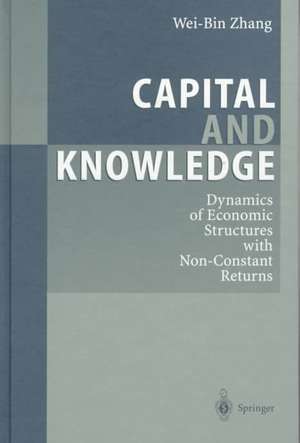
Capital and Knowledge: Dynamics of Economic Structures with Non-Constant Returns
Autor Wei-Bin Zhangen Limba Engleză Hardback – 21 ian 1999
Preț: 628.86 lei
Preț vechi: 739.84 lei
-15%
Puncte Express: 943
Carte tipărită la comandă
Livrare economică 07-21 noiembrie
Livrare prin curier în România Termenul estimat este afișat lângă disponibilitate.
Transport gratuit pentru acest produs Plată online sau ramburs, în funcție de opțiunile comenzii.
Retur gratuit în 14 zile Comandă securizată și suport în română.
Specificații
ISBN-13: 9783540651345
ISBN-10: 3540651349
Pagini: 448
Ilustrații: XI, 431 p.
Dimensiuni: 155 x 235 x 30 mm
Greutate: 0.8 kg
Ediția:1999
Editura: Springer Berlin, Heidelberg
Colecția Springer
Locul publicării:Berlin, Heidelberg, Germany
ISBN-10: 3540651349
Pagini: 448
Ilustrații: XI, 431 p.
Dimensiuni: 155 x 235 x 30 mm
Greutate: 0.8 kg
Ediția:1999
Editura: Springer Berlin, Heidelberg
Colecția Springer
Locul publicării:Berlin, Heidelberg, Germany
V-ar putea interesa
-
 The Wealth of NationsAdam SmithPreț: 93.84 lei
 -
 Knowledge and Coordination: A Liberal InterpretationDaniel B. Klein-12%Preț: 283.41 lei323.10 lei
 -
 Keynes: A Very Short IntroductionRobert Skidelsky-20%Preț: 56.64 lei70.65 lei
 -
 Institutional Diversity and Political Economy: The Ostroms and BeyondPaul Dragos Aligica-34%Preț: 693.31 lei1053.19 lei
 -
 -32%Preț: 1103.83 lei1632.38 lei
 -
 How Much is Enough?Edward Skidelsky-31%Preț: 62.52 lei91.20 lei
 -
 -27%Preț: 1191.42 lei1632.08 lei
 -
 The Economics of InequalityThomas PikettyPreț: 276.06 lei
 -
 Wolf, M: Shifts and the ShocksMartin Wolf-18%Preț: 76.46 lei93.20 lei
 -
 For a New WestKarl PolanyiPreț: 191.44 lei
 -
 G.L.S. ShackleP. Earl-15%Preț: 644.24 lei757.93 lei
 -
 Business AdventuresJohn BrooksPreț: 113.53 lei
 -
 -26%Preț: 677.94 lei916.37 lei
 -
 Modern Analysis of Value TheoryY. FujimoriPreț: 368.79 lei
 -
 -15%Preț: 616.28 lei725.04 lei
 -
 Preț: 380.09 lei
 -
 An Economic Theory of CitiesWei-Bin ZhangPreț: 387.73 lei
 -
 A Theory of Interregional DynamicsWei-Bin ZhangPreț: 388.00 lei
 -
 -18%Preț: 864.33 lei1054.07 lei
 -
 Preț: 458.50 lei
 -
 Preț: 408.64 lei
 -
 Applied Mathematics for EconomicsJati SenguptaPreț: 409.25 lei
Public țintă
ResearchCuprins
1 Introduction.- 1.1 Classical Economics.- 1.2 General Equilibrium Theory.- 1.3 Neoclassical Growth Theory.- 1.4 Disequilibrium Economics.- 1.5 Economic Structure.- 1.6 Economics with Returns to Scale.- 1.7 Modern Vision of Economic Processes by Complex Theory.- 1.8 Structure of the Study.- 2 One-Sector Growth Models under Constant Returns to Scale.- 2.1 The One-Sector Growth Model.- 2.2 Growth with Home Capital.- 2.3 Time Distribution in the One-Sector Growth Model.- 2.4 Conclusions.- A. 2.1 Production Functions in Growth Theory.- A. 2.2 Preference and Utility Functions.- A. 2.3 The Solow-Swan Model.- A. 2.4 The Ramsey Growth Model.- 3 One-Sector Economies under Non-Constant Returns to Scale.- 3.1 The Growth Model with Public Goods.- 3.2 Knowledge, Population, Environment and Economic Growth.- 3.3 An Economic Dynamics with Livestock.- 3.4 Economic Development with Human Capital and Opening.- 3.5 On Returns to Scale.- A. 3.1 Economic Growth with Money.- A. 3.2 Economic Chaos with Endogenous Population.- 4 Knowledge, Growth and Economic Structures.- 4.1 An Agricultural Economy with Land Ownership Distribution.- 4.2 A Two-Sector Ricardian Economy.- 4.3 The Ricardian System with Knowledge and Infrastructures.- 4.4 A Structural Dynamics of Agriculture, Industry and Service.- 4.5 Economic Structure with Multiple Capital Goods.- 4.6 On Economic Structures.- A. 4.1 The Neoclassical Two-Sector Growth Model.- A.4.2 The Neoclassical Multiple Sector Models.- A.4.3 Proving Proposition 4.2.1.- A.4.4 Proving Proposition 4.4.1.- A.4.5 Proving Proposition 4.5.1.- 5 Knowledge, Growth and Wealth Distribution.- 5.1 Income Distribution with Human Capital, Diligence and Frugality.- 5.2 Growth with Government’s Redistribution Policy.- 5.3 Economic Structure with Multiple Groups and JobAmenities.- 5.4 A Two-Group Growth Model with Capital and Knowledge.- 5.5 On Economic Evolution with Multiple Groups.- A.5.1 Distribution of Income and Wealth in Sato’s Model.- A.5.2 Proving Propositions 5.1.1 and5.1.2.- A.5.3 Proving Proposition 5.3.1.- A.5.4 Proving Proposition 5.4.1.- 6 Education, Research and Growth.- 6.1 Education and Saving in the Growth Model.- 6.2 The Research Model with Job Amenities.- 6.3 The Two-Group Model with Research and Job Amenities.- 6.4 Growth with Capital, Human Capital and Knowledge.- A.6.1 Proving Proposition 6.1.1.- 7 Unemployment in Disequilibrium Dynamics.- 7.1 Growth and Unemployment in a Two-Group Economy.- 7.2 Unemployment with Endogenous Knowledge.- 7.3 Unemployment in a ‘Welfare Economy’.- 7.4 Conclusions.- A. 7.1 Proving Lemmas 7.1.3 and 7.1.4 and Examining the Case of Different Preferences.- A. 7.2 Proving Proposition 7.2.1.- 8 Economic Development with Sexual Division of Labor.- 8.1 Sexual Division of Labor with Home Capital and Time Distribution.- 8.2 The Impact of Female Labor Participation on Knowledge Economies.- 8.3 Sexual Division of Labor with Capital and Knowledge.- 8.4 Economic Growth with Sexual Discrimination.- 8.5 On Complex of Sexual Division of Labor and Consumption.- A.8.1 Proving Lemmas 8.1.3 and 8.1.4.- A.8.2 Proving Lemma 8.2.1.- A.8.3 Proving Propositions 8.3.1 and 8.3.2.- 9 Preference Change with Capital and Knowledge.- 9.1 Preference Change in the One-Sector Growth Model.- 9.2 Dynamics of Capital, Knowledge and Preference.- 9.3 Dynamic Economic Structure with Preference Change.- 9.4 Growth and Preference Change with Sexual Division of Labor.- 9.5 Concluding Remarks.- 10 Summary.- Name Index.
Caracteristici
The author tries to combine different economic theories to a new theory that can explain economic phenomena which cannot be explained by traditional works