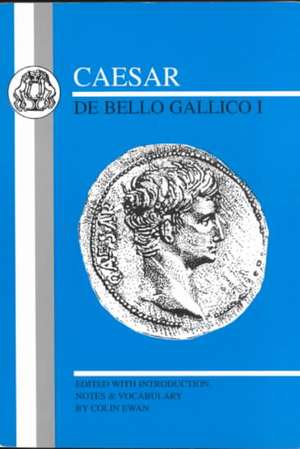
Caesar: Gallic War I: Latin Texts
Autor Julius Caesar Colin Ewanen Limba Engleză Paperback – iun 1991
Din seria Latin Texts
- 17%
 Preț: 176.83 lei
- 17%
 Preț: 162.48 lei
- 17%
 Preț: 185.44 lei
- 16%
 Preț: 179.23 lei
- 15%
 Preț: 169.95 lei
- 15%
 Preț: 168.74 lei
- 16%
 Preț: 167.75 lei
- 16%
 Preț: 182.83 lei
- 15%
 Preț: 221.40 lei
- 21%
 Preț: 164.50 lei
-
 Preț: 170.55 lei
- 16%
 Preț: 167.74 lei
- 18%
 Preț: 171.55 lei
-
 Preț: 167.25 lei
- 16%
 Preț: 216.16 lei
- 20%
 Preț: 147.67 lei
- 15%
 Preț: 184.44 lei
- 15%
 Preț: 168.62 lei
- 15%
 Preț: 169.62 lei
- 16%
 Preț: 168.12 lei
- 15%
 Preț: 168.65 lei
-
 Preț: 187.19 lei
- 15%
 Preț: 224.30 lei
- 16%
 Preț: 191.12 lei
- 8%
 Preț: 225.02 lei
- 22%
 Preț: 136.31 lei
- 15%
 Preț: 184.94 lei
- 20%
 Preț: 187.08 lei
Preț: 169.18 lei
Preț vechi: 209.38 lei
-19%
Puncte Express: 254
Carte tipărită la comandă
Livrare economică 18 decembrie 26 - 01 ianuarie 27
Livrare prin curier în România Termenul estimat este afișat lângă disponibilitate.
Transport gratuit de la 400.00 lei Plată online sau ramburs, în funcție de opțiunile comenzii.
Retur gratuit în 14 zile Comandă securizată și suport în română.
Specificații
ISBN-13: 9780862921774
ISBN-10: 0862921775
Pagini: 160
Dimensiuni: 148 x 226 x 12 mm
Greutate: 0.23 kg
Editura: Bloomsbury Publishing
Colecția Bristol Classical Press
Seria Latin Texts
Locul publicării:London, United Kingdom
ISBN-10: 0862921775
Pagini: 160
Dimensiuni: 148 x 226 x 12 mm
Greutate: 0.23 kg
Editura: Bloomsbury Publishing
Colecția Bristol Classical Press
Seria Latin Texts
Locul publicării:London, United Kingdom
V-ar putea interesa
-
 Literature in the Roman World: A New PerspectiveOliver Taplin-12%Preț: 266.21 lei300.85 lei
-
 De Rerum Natura VLucretius-12%Preț: 293.94 lei333.77 lei
-
 Homeric Soundings: The Shaping of the IliadOliver Taplin-32%Preț: 660.84 lei965.20 lei
-
 Horace: Odes II: Vatis AmiciHorace-28%Preț: 510.66 lei705.99 lei
-
 Oxford Readings in Greek ReligionRichard Buxton-28%Preț: 412.80 lei575.78 lei
-
 -19%Preț: 332.08 lei409.32 lei
-
 -21%Preț: 431.76 lei543.56 lei
-
 Aristophanes: PeaceS. Douglas Olson-33%Preț: 569.54 lei844.43 lei
-
 A Companion to The Iliad of HomerMalcolm M. WillcockPreț: 183.39 lei
-
 Reading GreekJoint Association Of Classical TeachersPreț: 301.61 lei
-
 The Crooked Kings of Ancient GreeceProfessor Daniel Ogden-27%Preț: 605.67 lei831.65 lei
-
 Sophocles: ElectraMichael LloydPreț: 180.69 lei
-
 Classics and the Bible: Hospitality and RecognitionDr John Taylor-9%Preț: 265.88 lei292.29 lei
-
 Nation, Empire, Decline: Studies in Rhetorical Continuity from the Romans to the Modern EraProfessor Nancy Shumate-16%Preț: 196.86 lei234.85 lei
-
 Euripides: Suppliant WomenIan C. Storey-17%Preț: 180.85 lei217.03 lei
-
 -25%Preț: 834.25 lei1105.08 lei
-
 Aeschylean TragedyAlan H. SommersteinPreț: 335.66 lei
-
 Latrinae et Foricae: Toilets in the Roman WorldBarry Hobson-37%Preț: 149.67 lei239.38 lei
-
 Writing Ancient PersiaDr Thomas Harrison-13%Preț: 169.32 lei195.74 lei
-
 Homer: Iliad IHomer-21%Preț: 167.44 lei211.10 lei
-
 Preț: 104.05 lei
-
 Preț: 143.86 lei
Cuprins
Introduction
I. Caesar's Governorship in Gaul, and his Commentaries on the Gallic War
II. Rome and her Empire
III. Caesar
IV. The Composition, Purpose, and Reliability ofr the Commentaries
V. Gaul
VI. How the Romans entered Gaul
VII. The Roman Army
Text
Notes
Index of Proper Names
Vocabulary
I. Caesar's Governorship in Gaul, and his Commentaries on the Gallic War
II. Rome and her Empire
III. Caesar
IV. The Composition, Purpose, and Reliability ofr the Commentaries
V. Gaul
VI. How the Romans entered Gaul
VII. The Roman Army
Text
Notes
Index of Proper Names
Vocabulary
Notă biografică
Julius Caesar combined military brilliance with political ambition, shaping the fate of Rome. Born in 100 BC, he rose through the ranks to become one of the most powerful figures in Roman history. A belief in decisive action, leadership, and the power of strategy guided both his career and his writings.Clarity and firsthand perspective define the heart of his work. In works such as Commentaries on the Gallic War, he presented detailed accounts of military campaigns with a style that is direct, controlled, and persuasive. Cohesive and fluid narrative reveals strategy, discipline, and the mindset of command, offering insight into both warfare and leadership.Enduring influence has made him a central figure in both history and literature. Leaders, historians, and readers have long studied his life and writings for lessons in power and governance. Today, his legacy remains vast, valued for its impact on politics, military thought, and historical storytelling.