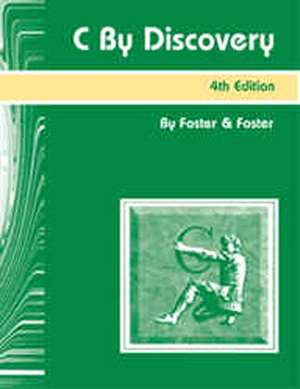
C by Discovery
Autor Mel Foster, W. D. Foster, L. S. Fosteren Limba Engleză Paperback – 31 iul 2004
This book provides an introduction to the C programming language. It is widely known for its accurate and precise descriptions, its careful annotation of code, and its comprehensive coverage of topics. This book includes numerous "Learning Activities" which allowreaders to immediately "do it" after they "read it" in the book. This book is for readersinterested inlearning the C programming language."
Preț: 1192.79 lei
Preț vechi: 1549.08 lei
-23%
Puncte Express: 1789
Carte tipărită la comandă
Livrare economică 28 noiembrie-12 decembrie
Livrare prin curier în România Termenul estimat este afișat lângă disponibilitate.
Transport gratuit pentru acest produs Plată online sau ramburs, în funcție de opțiunile comenzii.
Retur gratuit în 14 zile Comandă securizată și suport în română.
Specificații
ISBN-13: 9781576761700
ISBN-10: 1576761703
Pagini: 996
Dimensiuni: 186 x 230 x 47 mm
Greutate: 1.52 kg
Ediția:Nouă
Editura: Pearson
Locul publicării:Boston, United States
ISBN-10: 1576761703
Pagini: 996
Dimensiuni: 186 x 230 x 47 mm
Greutate: 1.52 kg
Ediția:Nouă
Editura: Pearson
Locul publicării:Boston, United States
V-ar putea interesa
-
 -20%Preț: 641.11 lei801.39 lei
 -
 Modern C++ Design: Generic Programming and Design Patterns AppliedAndrei Alexandrescu-20%Preț: 385.84 lei482.30 lei
 -
 Structure and Interpretation of Computer Programs, second editionGerald Jay Sussman-20%Preț: 552.11 lei690.14 lei
 -
 Java Concurrency in PracticeBrian Goetz-20%Preț: 303.96 lei379.95 lei
 -
 Java and SoapRobert Englander-20%Preț: 272.39 lei340.49 lei
 -
 J2EE Design PatternsWilliam Crawford-20%Preț: 250.39 lei313.00 lei
 -
 C Pocket ReferencePeter Prinz & Ulla Kirch-Prinz-20%Preț: 110.22 lei137.78 lei
 -
 C++ Pocket ReferenceKyle Loudon-20%Preț: 110.10 lei137.63 lei
 -
 -25%Preț: 84.25 lei111.93 lei
Cuprins
Chap. 1 Getting Started
1.1 What to Expect from C
1.2 Fundamentals-Reserved Words, Identifiers, the Character Set
1.3 Subprograms or Functions in C
1.4 An Introduction to Output in C
1.5 Input and Output with Variables
1.6 Arithmetic Operations
1.7 Introduction to Functions and Structured Programming in C
Language Elements Introduced in This Chapter: A Review
Things to Remember
Exercises and Programming Problems
Chap. 2 Gaining Control
2.1 Expressions and Statements
2.2 Blocks and Compound Statements
2.3 The if and if-else Statements
2.4 Relational Operators and Expressions
2.5 The while Loop
2.6 Logical Operators and Expressions
2.7 The for Loop
2.8 Making C Readable-Programming Style
Language Elements Introduced in This Chapter: A Review
Things to Remember
Exercises and Programming Problems
Chap. 3 Basic Data Types
3.1 Introduction to Scalar Types in C
3.2 Integers and Different Integer Bases
3.3 The Integer Types
3.4 The size of() Operator
3.5 Character Variables
3.6 Unsigned Types
3.7 ANSI C and Integer Types
3.8 If There's Time or Need: Bit Operations on the Integer Types
3.9 Floating Point Types
3.10 Types of Expressions and Automatic Conversions
3.11 Forced Type Conversions
Language Elements Introduced in This Chapter: A Review
Things to Remember
Exercises and Programming Problems
Chap. 4 Arrays and Pointers
4.1 One Dimensional Arrays
4.2 Initialization of Arrays
4.3 Arrays as Parameters to Functions
4.4 Getting Started with Pointers
4.5 Pointer Arithmetic
4.6 Dereferencing a Pointer Variable
4.7 An Array as a Pointer
4.8 Passing Parameters to Functions
4.9 Searching and Sorting Arrays
4.10 Pointers and Dynamic Memory Allocation
Language Elements Introduced in This Chapter: A Review
Things to Remember
Exercises and Programming Problems
Chap. 5 Strings
5.1 Introduction to Strings
5.2 Variable Strings
5.3 Input and Output of Strings
5.4 The Common String Library Functions
5.5 Examples with strlen() and strchr()
5.6 More Functions in the C String Library
5.6 Two Versions of strcat()
Language Elements Introduced in This Chapter: A Review
Things to Remember
Exercises and Programming Problems
Chap. 6 Keeping Control
6.1 Introduction
6.2 The do-while Statement
6.3 The switch Statement
6.4 Altering the Flow of Control
6.5 Getting Out Gracefully
6.6 If There's Time or Need: Using Recursion
Language Elements Introduced in This Chapter: A Review
Things to Remember
Exercises and Programming Problems
Chap. 7 Structuring the Data
7.1 Introduction to Structures
7.2 Operations on Structures
7.3 Using Structures with Arrays and Pointers
7.4 Bit Fields
7.5 Enumerated Types
7.6 Unions
Language Elements Introduced in This Chapter: A Review
Things to Remember
Exercises and Programming Problems
Chap. 8 Intra-program Communication
8.1 Introduction
8.2 Automatic versus Static Variables
8.3 Global versus Local Variables
8.4 Modules and External Variables
8.5 Typedefs
8.6 Function Definitions
8.7 Function Declarations and Calls
8.8 Pointers to Functions
Language Elements Introduced in This Chapter: A Review
Things to Remember
Exercises and Programming Problems
Chap. 9 Multidimensional Arrays and Double Indirection
9.1 Two-Dimensional Arrays
9.2 Storage Class and Scope of Multidimensional Arrays
9.3 Multidimensional Arrays as Parameters to Functions
9.4 Arrays with More Than Two Dimensions
9.5 Arrays of Pointers
9.6 Double Indirection
9.7 Command Line Parameters
Language Elements Introduced in This Chapter: A Review
Exercises and Programming Problems
Chap. 10 Input and Output
10.1 Review of Input and Output
10.2 An Introduction to Files in C
10.3 Character Input and Output
10.4 String Input and Output
10.5 Reading Blocks of Data at a Time
10.6 Formatted Input and Output
10.7 Random versus Sequential Access in Files
Language Elements Introduced in This Chapter: A Review
Things to Remember
Exercises and Programming Problems
Chap. 11 C Library and Preprocessor Facilities
11.1 Introduction to the C Library
11.2 Error Handling with the ANSI C Library
11.3 Using Mathematical Functions
11.4 Character Manipulation
11.5 Dynamic Allocation and De-allocation of Memory
11.6 A Linked List-The Theory and an Example
11.7 Defining Macros
11.8 Conditional Compilation
Language Elements Introduced in This Chapter: A Review
Things to Remember
Exercises and Programming Problems
Chap. 12 Discovering C++
12.1 Introduction
12.2 Some Added Features
12.3 C++ and OOP - Data Abstraction and Encapsulation
12.4 C++ and OOP - Polymorphism
12.5 C++ and OOP - Inheritance
12.6 More about I/O
12.7 Libraries
C++ Language Elements Introduced in This Chapter: A Review
Things to Remember
Exercises and Programming Problems
Part II The Programmer's Handbook
A Identifiers in ANSI C
B Keywords in C
C Declarations in C
Storage Class Specifiers C-1
Type Qualifiers C-1
Type Specifications . C-2
Initializers C-2
Reading C Declarations . C-3
D Operators and Expressions
Operator Prescendence Chart
E Control Statements in C
F The Ansi C Library
1.1 What to Expect from C
1.2 Fundamentals-Reserved Words, Identifiers, the Character Set
1.3 Subprograms or Functions in C
1.4 An Introduction to Output in C
1.5 Input and Output with Variables
1.6 Arithmetic Operations
1.7 Introduction to Functions and Structured Programming in C
Language Elements Introduced in This Chapter: A Review
Things to Remember
Exercises and Programming Problems
Chap. 2 Gaining Control
2.1 Expressions and Statements
2.2 Blocks and Compound Statements
2.3 The if and if-else Statements
2.4 Relational Operators and Expressions
2.5 The while Loop
2.6 Logical Operators and Expressions
2.7 The for Loop
2.8 Making C Readable-Programming Style
Language Elements Introduced in This Chapter: A Review
Things to Remember
Exercises and Programming Problems
Chap. 3 Basic Data Types
3.1 Introduction to Scalar Types in C
3.2 Integers and Different Integer Bases
3.3 The Integer Types
3.4 The size of() Operator
3.5 Character Variables
3.6 Unsigned Types
3.7 ANSI C and Integer Types
3.8 If There's Time or Need: Bit Operations on the Integer Types
3.9 Floating Point Types
3.10 Types of Expressions and Automatic Conversions
3.11 Forced Type Conversions
Language Elements Introduced in This Chapter: A Review
Things to Remember
Exercises and Programming Problems
Chap. 4 Arrays and Pointers
4.1 One Dimensional Arrays
4.2 Initialization of Arrays
4.3 Arrays as Parameters to Functions
4.4 Getting Started with Pointers
4.5 Pointer Arithmetic
4.6 Dereferencing a Pointer Variable
4.7 An Array as a Pointer
4.8 Passing Parameters to Functions
4.9 Searching and Sorting Arrays
4.10 Pointers and Dynamic Memory Allocation
Language Elements Introduced in This Chapter: A Review
Things to Remember
Exercises and Programming Problems
Chap. 5 Strings
5.1 Introduction to Strings
5.2 Variable Strings
5.3 Input and Output of Strings
5.4 The Common String Library Functions
5.5 Examples with strlen() and strchr()
5.6 More Functions in the C String Library
5.6 Two Versions of strcat()
Language Elements Introduced in This Chapter: A Review
Things to Remember
Exercises and Programming Problems
Chap. 6 Keeping Control
6.1 Introduction
6.2 The do-while Statement
6.3 The switch Statement
6.4 Altering the Flow of Control
6.5 Getting Out Gracefully
6.6 If There's Time or Need: Using Recursion
Language Elements Introduced in This Chapter: A Review
Things to Remember
Exercises and Programming Problems
Chap. 7 Structuring the Data
7.1 Introduction to Structures
7.2 Operations on Structures
7.3 Using Structures with Arrays and Pointers
7.4 Bit Fields
7.5 Enumerated Types
7.6 Unions
Language Elements Introduced in This Chapter: A Review
Things to Remember
Exercises and Programming Problems
Chap. 8 Intra-program Communication
8.1 Introduction
8.2 Automatic versus Static Variables
8.3 Global versus Local Variables
8.4 Modules and External Variables
8.5 Typedefs
8.6 Function Definitions
8.7 Function Declarations and Calls
8.8 Pointers to Functions
Language Elements Introduced in This Chapter: A Review
Things to Remember
Exercises and Programming Problems
Chap. 9 Multidimensional Arrays and Double Indirection
9.1 Two-Dimensional Arrays
9.2 Storage Class and Scope of Multidimensional Arrays
9.3 Multidimensional Arrays as Parameters to Functions
9.4 Arrays with More Than Two Dimensions
9.5 Arrays of Pointers
9.6 Double Indirection
9.7 Command Line Parameters
Language Elements Introduced in This Chapter: A Review
Exercises and Programming Problems
Chap. 10 Input and Output
10.1 Review of Input and Output
10.2 An Introduction to Files in C
10.3 Character Input and Output
10.4 String Input and Output
10.5 Reading Blocks of Data at a Time
10.6 Formatted Input and Output
10.7 Random versus Sequential Access in Files
Language Elements Introduced in This Chapter: A Review
Things to Remember
Exercises and Programming Problems
Chap. 11 C Library and Preprocessor Facilities
11.1 Introduction to the C Library
11.2 Error Handling with the ANSI C Library
11.3 Using Mathematical Functions
11.4 Character Manipulation
11.5 Dynamic Allocation and De-allocation of Memory
11.6 A Linked List-The Theory and an Example
11.7 Defining Macros
11.8 Conditional Compilation
Language Elements Introduced in This Chapter: A Review
Things to Remember
Exercises and Programming Problems
Chap. 12 Discovering C++
12.1 Introduction
12.2 Some Added Features
12.3 C++ and OOP - Data Abstraction and Encapsulation
12.4 C++ and OOP - Polymorphism
12.5 C++ and OOP - Inheritance
12.6 More about I/O
12.7 Libraries
C++ Language Elements Introduced in This Chapter: A Review
Things to Remember
Exercises and Programming Problems
Part II The Programmer's Handbook
A Identifiers in ANSI C
B Keywords in C
C Declarations in C
Storage Class Specifiers C-1
Type Qualifiers C-1
Type Specifications . C-2
Initializers C-2
Reading C Declarations . C-3
D Operators and Expressions
Operator Prescendence Chart
E Control Statements in C
F The Ansi C Library
Caracteristici
Attention to detail
Carefully annotated code
Precise descriptions
Comprehensive coverage
Learning Activities, so students can "do it" immediately after they "see it"
Carefully annotated code
Precise descriptions
Comprehensive coverage
Learning Activities, so students can "do it" immediately after they "see it"
Caracteristici noi
- Expanded coverage of the C string library functions in Ch. 5
- Discussion and examples of additional library functions
- More detailed discussions of searching and sorting algorithms
- Enhanced exercises and programming problems
Descriere
This book provides an introduction to the C programming language. It is widely known for its accurate and precise descriptions, its careful annotation of code, and its comprehensive coverage of topics. It also includes numerous "Learning Activities" which allow students to immediately "do it" after they "read it" in the book.