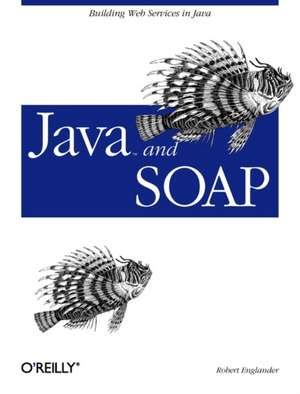
Java and Soap
Autor Robert Englanderen Limba Engleză Paperback – 25 iun 2002
Preț: 272.39 lei
Preț vechi: 340.49 lei
-20%
Puncte Express: 409
Carte tipărită la comandă
Livrare economică 26 noiembrie-10 decembrie
Livrare prin curier în România Termenul estimat este afișat lângă disponibilitate.
Transport gratuit de la 400.00 lei Plată online sau ramburs, în funcție de opțiunile comenzii.
Retur gratuit în 14 zile Comandă securizată și suport în română.
Specificații
ISBN-13: 9780596001759
ISBN-10: 0596001754
Pagini: 276
Dimensiuni: 179 x 236 x 27 mm
Greutate: 0.45 kg
Ediția:/ CD Special.
Editura: O'Reilly
ISBN-10: 0596001754
Pagini: 276
Dimensiuni: 179 x 236 x 27 mm
Greutate: 0.45 kg
Ediția:/ CD Special.
Editura: O'Reilly
V-ar putea interesa
-
 Core Java for the ImpatientCay Horstmann-20%Preț: 364.02 lei455.03 lei
 -
 Java for ProgrammersPaul Deitel-20%Preț: 350.53 lei438.16 lei
 -
 Java Server and Servlets: Building portable web applicationsPeter Rossbach-20%Preț: 326.32 lei407.90 lei
 -
 Internet & World Wide Web: How to ProgramHarvey Deitel-20%Preț: 605.11 lei756.38 lei
 -
 -26%Preț: 92.01 lei123.52 lei
 -
 -27%Preț: 68.55 lei93.37 lei
 -
 Java and XMLBrett Mclaughlin-20%Preț: 217.75 lei272.18 lei
 -
![An Introduction to Java Programming and Object-Oriented Application Development [With CD-ROM]: With the Unified Process](https://i1.books-express.ro/bt/9780619217464/an-introduction-to-java-programming-and-object-oriented-application-development-with-cd-rom.jpg) -25%Preț: 900.62 lei1201.94 lei
-25%Preț: 900.62 lei1201.94 lei -
 Test Automation Using Selenium Webdriver with JavaMR Navneesh Garg-20%Preț: 290.32 lei362.90 lei
 -
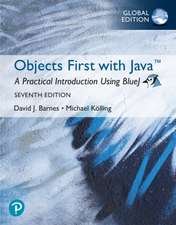 Objects First with JavaDavid Barnes-9%Preț: 489.49 lei537.89 lei
 -
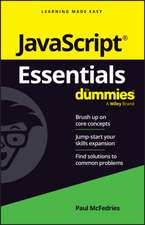 JavaScript Essentials For DummiesPaul McFedries-20%Preț: 79.76 lei99.71 lei
 -
 Real-World Java: Helping You Navigate the Java Eco systemJeanne Boyarsky-20%Preț: 320.06 lei400.08 lei
 -
 -20%Preț: 430.70 lei538.38 lei
 -
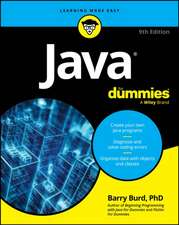 Java For DummiesBarry Burd-20%Preț: 97.60 lei122.00 lei
 -
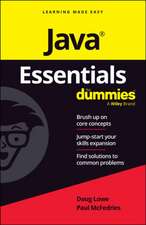 Java Essentials for DummiesDoug Lowe-20%Preț: 78.97 lei98.70 lei
 -
 Coding For Dummies, All New EditionPaul McFedries-20%Preț: 117.52 lei146.90 lei
 -
 Camel in ActionClaus Ibsen-20%Preț: 497.44 lei621.80 lei
 -
 Troubleshooting Java, Second EditionLaurentiu Spilca-20%Preț: 337.22 lei421.52 lei
 -
 How to Be Happy at WorkAnnie MckeePreț: 147.77 lei
 -
 How to Be Happy at WorkAnnie MckeePreț: 86.45 lei
 -
 Mobile ApplicationsKrzysztof Kulacz-20%Preț: 260.78 lei325.98 lei
 -
 .NET 10 RevealedKajetan Duszy¿ski-20%Preț: 240.60 lei300.75 lei
Cuprins
Dedication;
Preface;
Intended Audience;
A Moment in Time;
How This Book Is Organized;
Conventions Used in This Book;
How to Contact Us;
Retrieving Examples Online;
Acknowledgments;
Chapter 1: Introduction;
1.1 RPC and Message-Oriented Distributed Systems;
1.2 Self-Describing Data;
1.3 XML;
1.4 API Specs Versus Wire-Level Specs;
1.5 Overview of SOAP;
1.6 SOAP Implementations;
1.7 The Approach;
1.8 Getting Started;
Chapter 2: The SOAP Message;
2.1 The HTTP Binding;
2.2 HTTP Request;
2.3 HTTP Response;
2.4 The SOAP Envelope;
2.5 The Envelope Element;
2.6 The Header Element;
2.7 The actor Attribute;
2.8 The mustUnderstand Attribute;
2.9 The encodingStyle Attribute;
2.10 Envelope Versioning;
2.11 The Body Element;
2.12 SOAP Faults;
Chapter 3: SOAP Data Encoding;
3.1 Schemas and Namespaces;
3.2 Serialization Rules;
3.3 Indicating Type;
3.4 Default Values;
3.5 The SOAP Root Attribute;
Chapter 4: RPC-Style Services;
4.1 SOAP RPC Elements;
4.2 A Simple Service;
4.3 Deploying the Service;
4.4 Writing Service Clients;
4.5 Deploying with Request-Level Scope;
4.6 Deploying with Session-Level Scope;
4.7 Passing Parameters;
Chapter 5: Working with Complex Data Types;
5.1 Passing Arrays as Parameters;
5.2 Returning Arrays;
5.3 Passing Custom Types as Parameters;
5.4 Returning Custom Types;
Chapter 6: Custom Serialization;
6.1 Custom Type Encoding;
Chapter 7: Faults and Exceptions;
7.1 Throwing Server-Side Exceptions in Apache SOAP;
7.2 Creating a Fault Listener in Apache SOAP;
7.3 Throwing and Catching Exceptions in GLUE;
Chapter 8: Alternative Techniques;
8.1 SOAP Messaging;
8.2 Literal Encoding;
Chapter 9: SOAP Interoperability and WSDL;
9.1 Web Services Definition Language;
9.2 Calling a GLUE Service from an ApacheSOAP Client;
9.3 A Proxy Service Using Apache SOAP;
9.4 Calling an Apache SOAP Service from a GLUE Client;
9.5 Accessing .NET Services;
9.6 Writing an Apache Axis Client;
Chapter 10: SOAP Headers;
10.1 Apache SOAP Providers and Routers;
10.2 Replacing the Provider and Router Classes;
10.3 An Apache SOAP Service That Handles SOAP Headers;
Chapter 11: JAX-RPC and JAXM;
11.1 JAX-RPC;
11.2 Working Without Ant;
11.3 Creating a JAX-RPC Service;
11.4 Creating a JAX-RPC Client;
11.5 Generating Stubs from WSDL;
11.6 Dynamic Invocation Interface;
11.7 JAXM, in Less Than a Nutshell;
11.8 What Next?;
Colophon;
Preface;
Intended Audience;
A Moment in Time;
How This Book Is Organized;
Conventions Used in This Book;
How to Contact Us;
Retrieving Examples Online;
Acknowledgments;
Chapter 1: Introduction;
1.1 RPC and Message-Oriented Distributed Systems;
1.2 Self-Describing Data;
1.3 XML;
1.4 API Specs Versus Wire-Level Specs;
1.5 Overview of SOAP;
1.6 SOAP Implementations;
1.7 The Approach;
1.8 Getting Started;
Chapter 2: The SOAP Message;
2.1 The HTTP Binding;
2.2 HTTP Request;
2.3 HTTP Response;
2.4 The SOAP Envelope;
2.5 The Envelope Element;
2.6 The Header Element;
2.7 The actor Attribute;
2.8 The mustUnderstand Attribute;
2.9 The encodingStyle Attribute;
2.10 Envelope Versioning;
2.11 The Body Element;
2.12 SOAP Faults;
Chapter 3: SOAP Data Encoding;
3.1 Schemas and Namespaces;
3.2 Serialization Rules;
3.3 Indicating Type;
3.4 Default Values;
3.5 The SOAP Root Attribute;
Chapter 4: RPC-Style Services;
4.1 SOAP RPC Elements;
4.2 A Simple Service;
4.3 Deploying the Service;
4.4 Writing Service Clients;
4.5 Deploying with Request-Level Scope;
4.6 Deploying with Session-Level Scope;
4.7 Passing Parameters;
Chapter 5: Working with Complex Data Types;
5.1 Passing Arrays as Parameters;
5.2 Returning Arrays;
5.3 Passing Custom Types as Parameters;
5.4 Returning Custom Types;
Chapter 6: Custom Serialization;
6.1 Custom Type Encoding;
Chapter 7: Faults and Exceptions;
7.1 Throwing Server-Side Exceptions in Apache SOAP;
7.2 Creating a Fault Listener in Apache SOAP;
7.3 Throwing and Catching Exceptions in GLUE;
Chapter 8: Alternative Techniques;
8.1 SOAP Messaging;
8.2 Literal Encoding;
Chapter 9: SOAP Interoperability and WSDL;
9.1 Web Services Definition Language;
9.2 Calling a GLUE Service from an ApacheSOAP Client;
9.3 A Proxy Service Using Apache SOAP;
9.4 Calling an Apache SOAP Service from a GLUE Client;
9.5 Accessing .NET Services;
9.6 Writing an Apache Axis Client;
Chapter 10: SOAP Headers;
10.1 Apache SOAP Providers and Routers;
10.2 Replacing the Provider and Router Classes;
10.3 An Apache SOAP Service That Handles SOAP Headers;
Chapter 11: JAX-RPC and JAXM;
11.1 JAX-RPC;
11.2 Working Without Ant;
11.3 Creating a JAX-RPC Service;
11.4 Creating a JAX-RPC Client;
11.5 Generating Stubs from WSDL;
11.6 Dynamic Invocation Interface;
11.7 JAXM, in Less Than a Nutshell;
11.8 What Next?;
Colophon;