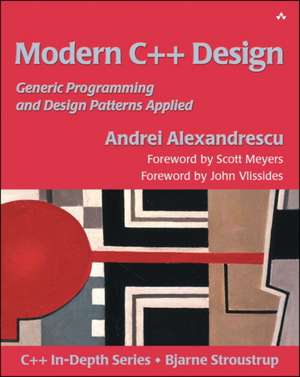
Modern C++ Design: Generic Programming and Design Patterns Applied
Autor Andrei Alexandrescuen Limba Engleză Paperback – 13 feb 2001
Dacă Hands-On Design Patterns with C++ v-a oferit cadrul teoretic al șabloanelor de proiectare clasice, Modern C++ Design: Generic Programming and Design Patterns Applied face un pas decisiv către implementări avansate, oferind instrumentele practice pentru automatizarea designului software. Remarcăm cum Andrei Alexandrescu reușește să redefinească utilizarea șabloanelor prin introducerea conceptului de 'policy-based class design', o metodă care permite asamblarea componentelor complexe din elemente simple, interschimbabile. Considerăm că forța acestui volum rezidă în structura sa tehnică riguroasă. Prima parte a cărții este dedicată tehnicilor de metaprogramare, explorând mecanisme precum 'Typelists' și specializarea parțială a template-urilor, în timp ce partea a doua aplică aceste abstracțiuni în scenarii concrete: gestiunea resurselor, implementarea obiectelor de tip Singleton sau a vizitatorilor generici. Spre deosebire de lucrarea sa anterioară, C++ Coding Standards: 101 Rules, Guidelines, and Best Practices, unde accentul era pus pe reguli de bune practici și mentenanță, aici autorul explorează limitele limbajului C++, propunând o fuziune între programarea generică și design patterns. Abordarea este una de înaltă precizie tehnică, iar includerea bibliotecii Loki oferă cititorului posibilitatea de a vedea aceste concepte în acțiune. Ritmul este dens, specific unui manual de inginerie software care nu doar explică 'ce', ci mai ales 'cum' pot fi construite sisteme flexibile și reutilizabile cu un cost minim de recodare. Este o lucrare fundamentală care transformă C++ dintr-un limbaj orientat pe obiecte într-un instrument puternic de generare a codului.
Preț: 385.84 lei
Preț vechi: 482.30 lei
-20%
Carte disponibilă
Livrare economică 05-19 noiembrie
Livrare express 21-27 octombrie pentru 41.72 lei
Specificații
ISBN-10: 0201704315
Pagini: 352
Dimensiuni: 187 x 235 x 20 mm
Greutate: 0.64 kg
Ediția:1. Auflage
Editura: Pearson
Locul publicării:Boston, United States
V-ar putea interesa
-
 The Darkest Hour: Warrior Cats vol 6Erin HunterPreț: 58.87 lei
 -
 Preț: 73.73 lei
 -
 Light BoxesShane JonesPreț: 115.20 lei
 -
 Writing Without TeachersPeter Elbow-20%Preț: 83.33 lei104.61 lei
 -
 -20%Preț: 440.00 lei550.01 lei
 -
 -20%Preț: 223.35 lei279.20 lei
 -
 The Wise Man's Fear: The Kingkiller Chronicle: Book 2Patrick Rothfuss-23%Preț: 97.58 lei126.83 lei
 -
 Code Complete: A practical handbook of software constructionSteve McConnell-20%Preț: 285.38 lei356.73 lei
 -
 The People of PaperSalvador Plascencia-40%Preț: 79.23 lei131.80 lei
 -
 Professional Assembly LanguageRichard Blum-20%Preț: 188.59 lei235.74 lei
 -
 Shell ScriptingSteve Parker-20%Preț: 268.03 lei335.04 lei
 -
 Fundamentals of Traffic SimulationJaume Barceló-18%Preț: 1891.12 lei2306.25 lei
 -
 Furies Of Calderon: The Codex Alera: Book OneJim Butcher-25%Preț: 60.74 lei80.52 lei
 -
 Infernal CityGreg Keyes-19%Preț: 52.33 lei64.54 lei
De ce să citești această carte
Recomandăm această carte programatorilor C++ care doresc să treacă de la simpla utilizare a claselor la arhitectura sistemelor complexe. Cititorul câștigă o înțelegere profundă a metaprogramării prin template-uri, învățând să creeze componente generice care se adaptează automat la cerințele de design. Este un salt calitativ necesar pentru oricine vrea să stăpânească eleganța și eficiența în dezvoltarea software modernă.
Despre autor
Andrei Alexandrescu este un cercetător și informatician de renume mondial, recunoscut pentru contribuțiile sale inovatoare în domeniul programării C++ și pentru dezvoltarea bibliotecii Loki. Expertiza sa se extinde dincolo de C++, fiind co-autor al limbajului D, aspect detaliat în lucrarea sa The D Programming Language. Cu o carieră ce îmbină mediul academic cu cel industrial, Alexandrescu este apreciat pentru capacitatea de a sintetiza paradigme de programare complexe — imperativă, funcțională și meta — în soluții practice. Lucrările sale sunt considerate puncte de referință în literatura tehnică, influențând generații de arhitecți software.
Cuprins
Foreword by Scott Meyers.
Foreword by John Vlissides.
Preface.
Acknowledgments.
I. TECHNIQUES.
1. Policy-Based Class Design.
The Multiplicity of Software Design.The Failure of the Do-It-All Interface.Multiple Inheritance to the Rescue?Templates Bring Hope.Policies and Policy Classes.Enriched Policies.Destructors of Policy Classes.Optional Functionality Through Incomplete Instantiation.Combining Policy Classes.Customizing Structure with Policy Classes.Compatible and Noncompatible Policies.Decomposing a Class in Policies.Summary.2. Techniques.
Compile-Time Assertions.Partial Template Specialization.Local Classes 28 2.4 Mapping Integral Constants to Types.Type-to-Type Mapping.Type Selection.Detecting Convertibility and Inheritance at Compile Time.A Wrapper Around type_info.NullType and EmptyType.Type Traits.Summary.3. Typelists.
The Need for Typelists.Defining Typelists.Linearizing Typelist Creation.Calculating Length.Intermezzo.Indexed Access.Searching Typelists.Appending to Typelists.Erasing a Type from a Typelist.Erasing Duplicates.Replacing an Element in a Typelist.Partially Ordering Typelists.Class Generation with Typelists.Summary.Typelist Quick Facts.4. Small-Object Allocation.
The Default Free Store Allocator.The Workings of a Memory Allocator.A Small-Object Allocator.Chunks.The Fixed-Size Allocator.The SmallObjAllocator Class.A Hat Trick.Simple, Complicated, Yet Simple in the End.Administrivia.Summary.Small-Object Allocator Quick Facts.II. COMPONENTS.
5. Generalized Functors.
The Command Design Pattern.Command in the Real World.C11 Callable Entities.The Functor Class Template Skeleton.Implementing the Forwarding Functor::operator().Handling Functors.Build One, Get One Free.Argument and Return Type Conversions.Handling Pointers to Member Functions.Binding.Chaining Requests.Real-World Issues I: The Cost of Forwarding Functions.Real-World Issues II: Heap Allocation.Implementing Undo and Redo with Functor.Summary.Functor Quick Facts.6. Implementing Singletons.
Static Data + Static Functions != Singleton.The Basic C11 Idioms Supporting Singleton.Enforcing the Singleton's Uniqueness.Destroying the Singleton.The Dead Reference Problem.Addressing the Dead Reference Problem (I):.Addressing the Dead Reference Problem (II):.Implementing Singletons with Longevity.Living in a Multithreaded World.Putting It All Together.Working With SingletonHolder.Summary.SingletonHolder Class Template Quick Facts.7. Smart Pointers.
Smart Pointers 101.The Deal.Smart Pointers' Storage.Smart Pointer Member Functions.Ownership-Handling Strategies.The Address-of Operator.Implicit Conversion to Raw Pointer Type.Equality and Inequality.Ordering Comparisons.Checking and Error Reporting.Smart Pointers to const and const Smart Pointers.Arrays.Smart Pointers and Multithreading.Putting It All Together.Summary.SmartPtr Quick Facts.8. Object Factories.
The Need for Object Factories.Object Factories in C11: Classes and Objects.Implementing an Object Factory.Type Identifiers.Generalization.Minutiae.Clone Factories.Using Object Factories with Other Generic Components.Summary.Factory Class Template Quick Facts.CloneFactory Class Template Quick Facts.9. Abstract Factory.
The Architectural Role of Abstract Factory.A Generic Abstract Factory Interface.Implementing AbstractFactory.A Prototype-Based Abstract Factory Implementation.Summary.AbstractFactory and ConcreteFactory Quick Facts.10. Visitor.
Visitor Basics.Overloading: The Catch-All Function.An Implementation Refinement: The Acyclic Visitor.A Generic Implementation of Visitor.Back to the “Cyclic” Visitor.Hooking Variations.Summary.Visitor Generic Component Quick Facts.11. Multimethods.
What Are Multimethods?When Are Multimethods Needed?Double Switch-on-Type: Brute Force.The Brute-Force Approach Automated.Symmetry with the Brute-Force Dispatcher.The Logarithmic Double Dispatcher.FnDispatcher and Symmetry.Double Dispatch to Functors.Converting Arguments: static_cast or dynamic_cast?Constant-Time Multimethods: Raw Speed.BasicDispatcher and BasicFastDispatcher as Policies.Looking Forward.Summary.Double Dispatcher Quick Facts.Appendix A. Minimalist Multithreading Library.
A Critique of Multithreading.Loki's Approach.Atomic Operations on Integral Types.Mutexes.Locking Semantics in Object-Oriented Programming.Optional volatile Modifier.Semaphores, Events, and Other Good Things.Summary.Bibliography.
Index. 0201704315T04062001
Notă biografică
Textul de pe ultima copertă
Modern C++ Design is an important book. Fundamentally, it demonstrates 'generic patterns' or 'pattern templates' as a powerful new way of creating extensible designs in C++-a new way to combine templates and patterns that you may never have dreamt was possible, but is. If your work involves C++ design and coding, you should read this book. Highly recommended.
-Herb Sutter
What's left to say about C++ that hasn't already been said? Plenty, it turns out.
-From the Foreword by John Vlissides
In Modern C++ Design, Andrei Alexandrescu opens new vistas for C++ programmers. Displaying extraordinary creativity and programming virtuosity, Alexandrescu offers a cutting-edge approach to design that unites design patterns, generic programming, and C++, enabling programmers to achieve expressive, flexible, and highly reusable code.
This book introduces the concept of generic components-reusable design templates that produce boilerplate code for compiler consumption-all within C++. Generic components enable an easier and more seamless transition from design to application code, generate code that better expresses the original design intention, and support the reuse of design structures with minimal recoding.
The author describes the specific C++ techniques and features that are used in building generic components and goes on to implement industrial strength generic components for real-world applications. Recurring issues that C++ developers face in their day-to-day activity are discussed in depth and implemented in a generic way. These include:
- Policy-based design for flexibility
- Partial template specialization
- Typelists-powerful type manipulation structures
- Patterns such as Visitor, Singleton, Command, and Factories
- Multi-method engines
For each generic component, the book presents the fundamental problems and design options, and finally implements a generic solution.
In addition, an accompanying Web site, http: //www.awl.com/cseng/titles/0-201-70431-5, makes the code implementations available for the generic components in the book and provides a free, downloadable C++ library, called Loki, created by the author. Loki provides out-of-the-box functionality for virtually any C++ project.
Get a value-added service! Try out all the examples from this book at www.codesaw.com. CodeSaw is a free online learning tool that allows you to experiment with live code from your book right in your browser.
0201704315B11102003