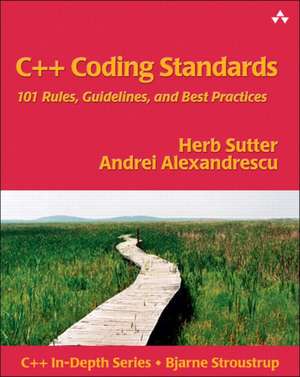
C++ Coding Standards: 101 Rules, Guidelines, and Best Practices
Autor Herb Sutter, Andrei Alexandrescuen Limba Engleză Paperback – 25 oct 2004
Descoperim în C++ Coding Standards: 101 Rules, Guidelines, and Best Practices o resursă tehnică esențială, construită pe baza experienței cumulate a comunității globale de programatori. Volumul nu se limitează la teorie, ci oferă un set de 101 reguli concrete, menite să optimizeze calitatea codului și viteza de dezvoltare. Observăm că abordarea autorilor, Herb Sutter și Andrei Alexandrescu, este una pragmatică: fiecare regulă este prezentată succint, fiind ușor de implementat în fluxul de lucru al unei echipe de software engineering. Remarcăm faptul că această lucrare funcționează ca un punct de referință pentru standardizarea proceselor interne. Cititorul care a aplicat deja ideile din Effective C++: 55 Specific Ways to Improve Your Programs and Designs de Scott Meyers va găsi aici o completare necesară, orientată mai mult spre consistența echipei și bunele practici de colaborare, decât spre subtilitățile individuale ale limbajului. În timp ce alte volume se concentrează pe 'cum' să rezolvi o problemă, acest ghid stabilește 'ce' ar trebui să fie considerat un cod corect și sustenabil. Poziționată în contextul operei lui Herb Sutter, această carte reprezintă o evoluție naturală de la provocările de inginerie prezentate în Exceptional C++: 47 Engineering Puzzles, Programming Problems, and Solutions. Dacă lucrarea anterioară testa limitele programatorului prin puzzle-uri complexe, C++ Coding Standards oferă cadrul normativ pentru a evita erorile de design încă din faza de scriere. Este un instrument de lucru care transformă cunoștințele disparate în standarde de execuție riguroase, esențiale pentru orice proiect C++ modern.
Preț: 334.15 lei
Preț vechi: 417.69 lei
-20%
Carte tipărită la comandă
Livrare economică 23-30 noiembrie
Specificații
ISBN-10: 0321113586
Pagini: 240
Dimensiuni: 187 x 235 x 14 mm
Greutate: 0.45 kg
Ediția:1. Auflage
Editura: Pearson International
Locul publicării:Boston, United States
V-ar putea interesa
-
 The Darkest Hour: Warrior Cats vol 6Erin HunterPreț: 58.87 lei
 -
 Chalked UpJennifer SeyPreț: 95.48 lei
 -
 The Magnificent Meaulnes (Le Grand MeaulHenri Alain-FournierPreț: 93.71 lei
 -
 How I Live NowMeg RosoffPreț: 64.54 lei
 -
 -20%Preț: 297.14 lei371.42 lei
 -
 Accelerated C++: Practical Programming by ExampleAndrew Koenig-20%Preț: 291.08 lei363.85 lei
 -
 The Gypsy GameZilpha Keatley SnyderPreț: 51.70 lei
 -
 The Elder Scrolls NovelGreg Keyes-27%Preț: 51.88 lei70.70 lei
 -
 Preț: 196.21 lei
 -
 Infernal CityGreg Keyes-19%Preț: 52.33 lei64.54 lei
 -
 Phantoms in the BrainSandra Blakeslee-5%Preț: 87.40 lei92.00 lei
 -
 Snow White and the HuntsmanLily BlakePreț: 114.80 lei
De ce să citești această carte
Recomandăm acest volum liderilor de echipă și dezvoltatorilor care doresc să elimine subiectivismul din procesul de code review. Cititorul câștigă un set de reguli validate de experți, care reduc timpul pierdut în dezbateri tehnice sterile. Este o investiție în mentenabilitatea codului și în eficiența colectivă, oferind argumente clare pentru fiecare decizie de design software.
Despre autor
Herb Sutter este o figură centrală în universul C++, ocupând funcția de președinte al comitetului de standardizare ISO C++. În calitate de arhitect software la Microsoft, a coordonat designul extensiilor de limbaj pentru programarea .NET. Este autorul unor lucrări de referință precum seria 'Exceptional C++'. Andrei Alexandrescu este recunoscut la nivel mondial pentru contribuțiile sale inovatoare în designul de software bazat pe șabloane și este co-autor al limbajului D, expertiza sa completând viziunea tehnică a lui Sutter în acest ghid de bune practici.
Descriere
The authors cover virtually every facet of C++ programming: design and coding style, functions, operators, class design, inheritance, construction/destruction, copying, assignment, namespaces, modules, templates, genericity, exceptions, STL containers and algorithms, and more. Each standard is described concisely, with practical examples. From type definition to error handling, this book presents C++ best practices, including some that have only recently been identified and standardized-techniques you may not know even if you've used C++ for years. Along the way, you'll find answers to questions like
- What's worth standardizing--and what isn't?
- What are the best ways to code for scalability?
- What are the elements of a rational error handling policy?
- How (and why) do you avoid unnecessary initialization, cyclic, and definitional dependencies?
- When (and how) should you use static and dynamic polymorphism together?
- How do you practice "safe" overriding?
- When should you provide a no-fail swap?
- Why and how should you prevent exceptions from propagating across module boundaries?
- Why shouldn't you write namespace declarations or directives in a header file?
- Why should you use STL vector and string instead of arrays?
- How do you choose the right STL search or sort algorithm?
- What rules should you follow to ensure type-safe code?
Cuprins
1. Organizational and Policy Issues.
Don't sweat the small stuff. (Or: Know what not to standardize.).
Compile cleanly at high warning levels.
Use an automated build system.
Use a version control system.
Invest in code reviews.
2. Design Style.
Give one entity one cohesive responsibility.
Correctness, simplicity, and clarity come first.
Know when and how to code for scalability.
Don't optimize prematurely.
Don't pessimize prematurely.
Minimize global and shared data.
Hide information.
Know when and how to code for concurrency.
Ensure resources are owned by objects. Use explicit RAII and smart pointers.
3. Coding Style.
Prefer compile- and link-time errors to run-time errors.
Use const proactively.
Avoid macros.
Avoid magic numbers.
Declare variables as locally as possible.
Always initialize variables.
Avoid long functions. Avoid deep nesting.
Avoid initialization dependencies across compilation units.
Minimize definitional dependencies. Avoid cyclic dependencies.
Make header files self-sufficient.
Always write internal #include guards. Never write external #include guards.
4. Functions and Operators.
Take parameters appropriately by value, (smart) pointer, or reference.
Preserve natural semantics for overloaded operators.
Prefer the canonical forms of arithmetic and assignment operators.
Prefer the canonical form of ++ and --. Prefer calling the prefix forms.
Consider overloading to avoid implicit type conversions.
Avoid overloading &&, ||, or , (comma).
Don't write code that depends on the order of evaluation of functionarguments.
5. Class Design and Inheritance.
Be clear what kind of class you're writing.
Prefer minimal classes to monolithic classes.
Prefer composition to inheritance.
Avoid inheriting from classes that were not designed to be base classes.
Prefer providing abstract interfaces.
Public inheritance is substitutability.
Inherit, not to reuse, but to be reused.
Practice safe overriding.
Consider making virtual functions nonpublic, and public functions nonvirtual.
Avoid providing implicit conversions.
Make data members private, except in behaviorless aggregates (C-stylestructs).
Don't give away your internals.
Pimpl judiciously.
Prefer writing nonmember nonfriend functions.
Always provide new and delete together.
If you provide any class-specific new, provide all of the standard forms (plain, in-place, and nothrow).
6. Construction, Destruction, and Copying.
Define and initialize member variables in the same order.
Prefer initialization to assignment in constructors.
Avoid calling virtual functions in constructors and destructors.
Make base class destructors public and virtual, or protected and nonvirtual.
Destructors, deallocation, and swap never fail.
Copy and destroy consistently.
Explicitly enable or disable copying.
Avoid slicing. Consider Clone instead of copying in base classes.
Prefer the canonical form of assignment.
Whenever it makes sense, provide a no-fail swap (and provide it correctly).
7. Namespaces and Modules.
Keep a type and its nonmember function interface in the same namespace.
Keep types and functions in separate namespaces unless they're specifically intended to work together.
Don't write namespace usings in a header file or before an #include.
Avoid allocating and deallocating memory in different modules.
Don't define entities with linkage in a header file.
Don't allow exceptions to propagate across module boundaries.
Use sufficiently portable types in a module's interface.
8. Templates and Genericity.
Blend static and dynamic polymorphism judiciously.
Customize intentionally and explicitly.
Don't specialize function templates.
Don't write unintentionally nongeneric code.
9. Error Handling and Exceptions.
Assert liberally to document internal assumptions and invariants.
Establish a rational error handling policy, and follow it strictly.
Distinguish between errors and non-errors.
Design and write error-safe code.
Prefer to use exceptions to report errors.
Throw by value, catch by reference.
Report, handle, and translate errors appropriately.
Avoid exception specifications.
10. STL: Containers.
Use vector by default. Otherwise, choose an appropriate container.
Use vector and string instead of arrays.
Use vector (and string::c_str) to exchange data with non-C++ APIs.
Store only values and smart pointers in containers.
Prefer push_back to other ways of expanding a sequence.
Prefer range operations to single-element operations.
Use the accepted idioms to really shrink capacity and really erase elements.
11. STL: Algorithms.
Use a checked STL implementation.
Prefer algorithm calls to handwritten loops.
Use the right STL search algorithm.
Use the right STL sort algorithm.
Make predicates pure functions.
Prefer function objects over functions as algorithm and comparer arguments.
Write function objects correctly.
12. Type Safety.
Avoid type switching; prefer polymorphism.
Rely on types, not on representations.
Avoid using reinterpret_cast.
Avoid using static_cast on pointers.
Avoid casting away const.
Don't use C-style casts.
Don't memcpy or memcmp non-PODs.
Don't use unions to reinterpret representation.
Don't use varargs (ellipsis).
Don't use invalid objects. Don't use unsafe functions.
Don't treat arrays polymorphically.
Bibliography.
Summary of Summaries.
Index.
Notă biografică
Andrei Alexandrescu is the author of the award-winning book Modern C++ Design (Addison-Wesley, 2001) and is a columnist for C/C++ Users Journal.
Descriere scurtă
Essential guidelines for writing high-quality C++ code--taught by two foremost masters in the field.
- Provides a collection of programming rules (101) that is terse, easy to understand and follow, and self-sufficient.
- Teaches basic rules and widely-accepted and authoritative practices for writing sound software in C++.
- Herb Sutter and Andrei Alexandrescu are two of the world's foremost experts on software development in general and C++ in particular.