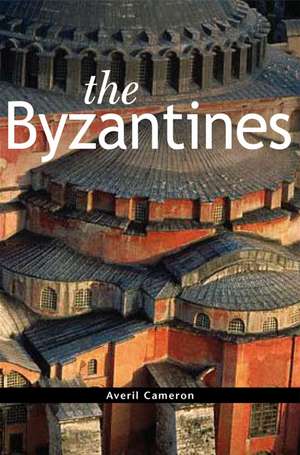
Byzantines
Autor Cameronen Limba Engleză Hardback – 29 dec 2006
This book introduces the reader to the complex history, ethnicity, and identity of the Byzantines.
- This volume brings Byzantium - often misconstrued as a vanished successor to the classical world - to the forefront of European history
- Deconstructs stereotypes surrounding Byzantium
- Beautifully illustrated with photographs and maps
Preț: 392.58 lei
Puncte Express: 589
Carte tipărită la comandă
Livrare economică 12-26 noiembrie
Livrare prin curier în România Termenul estimat este afișat lângă disponibilitate.
Transport gratuit de la 400.00 lei Plată online sau ramburs, în funcție de opțiunile comenzii.
Retur gratuit în 14 zile Comandă securizată și suport în română.
Specificații
ISBN-13: 9780631202622
ISBN-10: 0631202625
Pagini: 296
Dimensiuni: 157 x 235 x 21 mm
Greutate: 0.58 kg
Editura: Wiley
Locul publicării:Chichester, United Kingdom
ISBN-10: 0631202625
Pagini: 296
Dimensiuni: 157 x 235 x 21 mm
Greutate: 0.58 kg
Editura: Wiley
Locul publicării:Chichester, United Kingdom
V-ar putea interesa
-
 Queen AnneAnne SomersetPreț: 122.11 lei
 -
 To Hell and BackIan Kershaw-27%Preț: 99.54 lei135.75 lei
 -
 A People of One Book: The Bible and the VictoriansTimothy Larsen-17%Preț: 283.41 lei339.94 lei
 -
 Europe Isn't WorkingLarry ElliottPreț: 80.40 lei
 -
 Procopius and the Sixth CenturyAveril CameronPreț: 408.22 lei
 -
 The Last Great FrenchmanCharles WilliamsPreț: 154.69 lei
 -
 -23%Preț: 2063.23 lei2679.53 lei
 -
 The Cambridge Ancient HistoryAveril Cameron-30%Preț: 1841.90 lei2620.21 lei
 -
 She-WolvesHelen CastorPreț: 93.66 lei
 -
 Russia and the RussiansGeoffrey Hosking-22%Preț: 112.41 lei143.63 lei
 -
 -26%Preț: 67.80 lei92.13 lei
 -
 Procopius and the Sixth CenturyAveril Cameron-18%Preț: 1112.48 lei1356.68 lei
 -
 The Balfour Declaration: The Origins of the Arab-Israeli ConflictJonathan Schneer-26%Preț: 89.38 lei120.91 lei
 -
 Coming Up TrumpsJean Trumpington-31%Preț: 45.14 lei65.77 lei
 -
 -25%Preț: 74.71 lei100.23 lei
 -
 -23%Preț: 1032.98 lei1341.52 lei
 -
 -23%Preț: 1032.57 lei1341.00 lei
 -
 -23%Preț: 1029.86 lei1337.48 lei
 -
 The Parliament Rolls of Medieval England, 1275–1 – VII – Richard II. 1385–1397Christopher Given–wilson-23%Preț: 1030.00 lei1337.66 lei
 -
 The Parliament Rolls of Medieval England, 1275–1 – IX: Henry V. 1413–1422Chris Given–wilson-23%Preț: 711.72 lei924.31 lei
 -
 -23%Preț: 1035.82 lei1345.22 lei
 -
 -23%Preț: 923.86 lei1199.82 lei
 -
 -23%Preț: 1032.98 lei1341.52 lei
 -
 Preț: 361.73 lei
 -
 Arguing it Out: Discussion in Twelfth-Century ByzantiumAveril CameronPreț: 176.75 lei
Public țintă
Students and scholars interested in the history of the late antique and medieval periods; general readersNotă biografică
Averil Cameron is Professor of Late Antique and Byzantine History at Oxford and the Warden of Keble College, and was recently awarded a DBE. Her publications include Changing Cultures in Early Byzantium (1996) and Eusebius, Life of Constantine (ed. with Stuart G. Hall, 1999), and she is a co-editor of volumes XII, XIII and XIV of the Cambridge Ancient History.
Cuprins
Figures. Maps.
Preface.
Abbreviations.
Acknowledgements.
1. What was Byzantium?.
2. The changing shape of Byzantium: from late antiquity to the tenth century.
3. The changing shape of Byzantium: from the tenth century to 1453.
4. The Byzantine mirage.
5. Ruling the Byzantine state.
6. An orthodox society?.
7. How people lived.
8. Education and culture.
9. Byzantium and Europe.
10. Byzantium and the Mediterranean.
Conclusion.
Chronology.
References.
Index
Preface.
Abbreviations.
Acknowledgements.
1. What was Byzantium?.
2. The changing shape of Byzantium: from late antiquity to the tenth century.
3. The changing shape of Byzantium: from the tenth century to 1453.
4. The Byzantine mirage.
5. Ruling the Byzantine state.
6. An orthodox society?.
7. How people lived.
8. Education and culture.
9. Byzantium and Europe.
10. Byzantium and the Mediterranean.
Conclusion.
Chronology.
References.
Index
Descriere
Byzantium occupies an uncertain place in European history. Though often misconstrued as a vanished successor to the classical world, Byzantium belongs in the mainstream history of Europe and the Mediterranean; its impact is still felt throughout the Balkans, Eastern Europe and the Middle East.