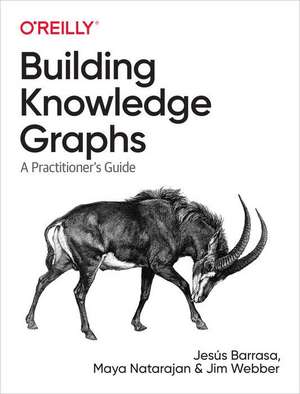
Building Knowledge Graphs: A Practitioner's Guide
Autor Jesus Barrasa, Jim Webberen Limba Engleză Paperback – 11 iul 2023
Găsim în această carte un exercițiu fundamental pentru orice arhitect de date modern: procesul de import și armonizare a datelor eterogene — de la baze de date relaționale la text nestructurat — pentru a crea un graf de cunoștințe funcțional. Building Knowledge Graphs nu se limitează la concepte abstracte, ci ghidează cititorul prin implementări concrete ale unor sisteme de detecție a amenințărilor cibernetice sau de gestionare a conformității GDPR. Observăm o structură riguroasă, unde bazele de date graf sunt prezentate ca fundație tehnică, urmate rapid de aplicarea algoritmilor de graf și a modelelor de machine learning pentru a extrage valoare din conexiunile identificate. Autorii Jesús Barrasa și Jim Webber, ambii cu o vastă experiență în cadrul Neo4j, propun o abordare orientată spre inginerie. Merită menționat că volumul explorează tipare avansate, precum grafurile de dependență și procesarea limbajului natural (NLP) pentru dezvoltarea de chatbot-uri inteligente. Complementar volumului Knowledge Graphs de Aidan Hogan, care oferă o introducere academică și teoretică cuprinzătoare asupra abstracțiunilor de date, lucrarea de față acoperă zona de implementare în producție și fluxurile de lucru specifice inginerilor de date. În timp ce Aidan Hogan definește cadrul conceptual, Building Knowledge Graphs oferă instrumentele necesare pentru a construi efectiv aceste sisteme într-un mediu enterprise. Stilul este tehnic și pragmatic, evitând divagațiile și concentrându-se pe soluționarea problemelor de management al cunoștințelor prin structuri interconectate. Este o resursă esențială pentru cei care doresc să transforme datele disparate în active strategice, utilizând tehnologii moderne de graf.
Preț: 426.13 lei
Preț vechi: 532.66 lei
-20%
Carte disponibilă
Livrare economică 05-19 noiembrie
Livrare express 22-28 octombrie pentru 71.52 lei
Specificații
ISBN-10: 1098127102
Pagini: 350
Dimensiuni: 179 x 230 x 15 mm
Greutate: 0.5 kg
Editura: O'Reilly
V-ar putea interesa
-
 Using Artificial Intelligence Absolute Beginner's GuideMichael Miller-20%Preț: 201.24 lei251.56 lei
 -
 Just Enough Data Science and Machine LearningMark LevenePreț: 342.01 lei
 -
 The Infinite AlphabetCésar A. HidalgoPreț: 191.23 lei
 -
 Knowledge GraphsCraig Knoblock-20%Preț: 383.38 lei480.97 lei
 -
 -39%Preț: 394.79 lei646.62 lei
 -
 Preț: 103.34 lei
 -
 Data & AI ImperativeLillian Pierson-20%Preț: 172.87 lei216.09 lei
 -
 The Data Hero PlaybookMalcolm HawkerPreț: 202.67 lei
 -
 Generative Knowledge: Think, Learn, Create with AIPaolo Granata-20%Preț: 170.74 lei213.43 lei
 -
 Machine Learning For DummiesLuca Massaron-20%Preț: 149.88 lei187.36 lei
 -
 Agentic AI For DummiesPam Baker-20%Preț: 145.95 lei182.44 lei
 -
 -35%Preț: 50.43 lei77.10 lei
 -
 Graph-Powered Machine LearningAlessandro Nego-20%Preț: 391.75 lei489.69 lei
 -
 Graph Databases in ActionDan Bechberger-20%Preț: 365.55 lei456.93 lei
 -
 Graph Algorithms for Data ScienceTomaz Bratanic-20%Preț: 333.10 lei416.37 lei
 -
 Knowledge Graphs and LLMs in ActionAlessandro Negro-20%Preț: 350.04 lei437.55 lei
 -
 Knowledge Engineering: Principles, Methods & ApplicationsAlfonso Perez Gama-27%Preț: 1520.90 lei2074.31 lei
 -
 Further with Knowledge GraphsM. Alam-20%Preț: 617.07 lei771.34 lei
 -
 -36%Preț: 298.89 lei464.51 lei
 -
 How to Make AI UsefulMagnus Reiner-11%Preț: 84.37 lei94.27 lei
De ce să citești această carte
Recomandăm această carte inginerilor și oamenilor de știință de date care au nevoie de o metodologie clară pentru a trece de la baze de date tradiționale la grafuri de cunoștințe scalabile. Cititorul câștigă competențe practice în utilizarea algoritmilor de graf și a machine learning-ului pentru a rezolva probleme complexe de integrare și căutare, beneficiind de expertiza directă a specialiștilor de la Neo4j.
Despre autor
Jesús Barrasa și Jim Webber sunt figuri centrale în ecosistemul bazelor de date graf, activând în cadrul Neo4j. Jim Webber este Chief Scientist la Neo4j și este recunoscut la nivel mondial pentru contribuțiile sale în domeniul sistemelor distribuite și al tehnologiilor graf, având un doctorat în calculatoare de la Universitatea Newcastle. Jesús Barrasa conduce echipa de soluții de grafuri de cunoștințe, fiind expert în web semantic și integrarea datelor la scară largă. Împreună, aceștia combină rigoarea academică cu experiența practică din proiecte enterprise globale.
Descriere
Knowledge graphs integrate rich, complex data into a cohesive structure that follows an organizing principle. Knowledge graphs power medical research, cybersecurity threat intelligence, GDPR compliance, web user engagement, and much more. But how do you create a knowledge graph? What do you need to know to move knowledge graphs from theory into practice? This book, designed for anyone interested in building knowledge graphs, equips you with everything you need to start building your own knowledge graphs.
You'll learn about common patterns for knowledge graphs, with hands-on examples to work through. Knowledge graphs create a non-disruptive layer across complex data landscapes, enabling everything from self-service queries to visual data exploration to advanced AI. This book, written by experts familiar with many real-world knowledge graphs, empowers you to build knowledge graphs that solve today's pressing problems and that become exponentially more useful as you add more data.
Notă biografică
Descriere scurtă
Using hands-on examples, this practical book shows data scientists and data engineers how to build their own knowledge graphs. Authors Jesús Barrasa and Jim Webber from Neo4j illustrate common patterns for building knowledge graphs that solve many of today's pressing knowledge management problems. You'll quickly discover how these graphs become increasingly useful as you add data and augment them with algorithms and machine learning.
- Learn the organizing principles necessary to build a knowledge graph
- Explore how graph databases serve as a foundation for knowledge graphs
- Understand how to import structured and unstructured data into your graph
- Follow examples to build integration-and-search knowledge graphs
- Learn what pattern detection knowledge graphs help you accomplish
- Explore dependency knowledge graphs through examples
- Use examples of natural language knowledge graphs and chatbots
- Use graph algorithms and ML to gain insight into connected data