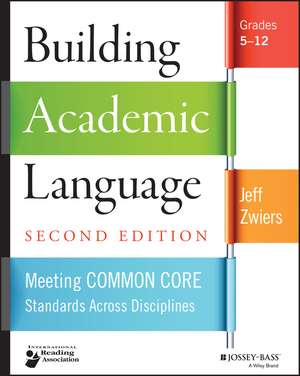
Building Academic Language
Autor Jeff Zwiersen Limba Engleză Paperback – 7 apr 2014
Observăm în această a doua ediție revizuită a lucrării Building Academic Language o adaptare necesară la noile rigori educaționale, punând un accent deosebit pe modul în care standardele Common Core redefinesc succesul școlar. Primul capitol stabilește fundamentul, explorând perspectivele sociale și culturale ale limbajului complex, oferind profesorilor instrumentele necesare pentru a naviga între utilizarea limbajului în viața de zi cu zi și cel academic, necesar pentru exprimarea ideilor abstracte. Remarcăm o structură pragmatică ce trece dincolo de memorarea mecanică a termenilor; autorul demonstrează că profesorii de științe, matematică sau istorie trebuie să devină, în egală măsură, instructori de limbaj pentru a facilita gândirea critică. Această lucrare ocupă un loc central în opera lui Jeff Zwiers, fiind o extensie firească a cercetărilor sale despre interacțiunea în clasă. Dacă în The K-3 Guide to Academic Conversations accentul cădea pe bazele dialogului la vârste fragede, volumul de față rafinează aceste concepte pentru nivelul gimnazial și liceal (clasele 5-12). Building Academic Language acoperă o arie tematică similară cu Academic Vocabulary in Middle and High School de Donna Ogle, însă abordarea lui Zwiers este mai profund axată pe discursul academic și gramatica funcțională, nu doar pe achiziția de vocabular specific disciplinelor. Structura cărții ghidează cititorul de la înțelegerea teoretică a competențelor lingvistice către aplicabilitatea lor în arii curriculare diverse. Este un instrument esențial pentru educatorii care doresc să transforme sala de clasă dintr-un spațiu al recepției pasive într-unul al comunicării autentice, unde elevii învață să utilizeze limbajul pentru a construi și argumenta idei complexe.
Preț: 160.77 lei
Carte disponibilă
Livrare economică 07-21 noiembrie
Specificații
ISBN-10: 1118744853
Pagini: 336
Dimensiuni: 179 x 231 x 30 mm
Greutate: 0.49 kg
Ediția:2nd Revised edition
Editura: Wiley
Locul publicării:Hoboken, United States
V-ar putea interesa
-
 Preț: 248.23 lei
 -
 Structuring Your Research ThesisSusan CarterPreț: 168.02 lei
 -
 Preț: 227.97 lei
 -
 How to Write Dissertations & Project ReportsJonathan WeyersPreț: 139.99 lei
 -
 The Handbook of Scholarly Writing and PublishingTimothy Gary HatcherPreț: 274.65 lei
 -
 Writing a Dissertation for Dummies, UK EditionCarrie WinstanleyPreț: 98.88 lei
 -
 Writing Essays for Dummies, UK EditionMary PagePreț: 97.06 lei
 -
 Preț: 258.52 lei
 -
 Preț: 106.64 lei
 -
 -17%Preț: 163.07 lei196.21 lei
 -
 -28%Preț: 65.32 lei90.96 lei
 -
 Preț: 256.71 lei
 -
 Perfect Written EnglishChris WestPreț: 68.39 lei
Public țintă
Teachers (grades 5–12) across the curricula; reading, writing, and ESL specialists; teacher educators.De ce să citești această carte
Recomandăm această carte profesorilor de gimnaziu și liceu care doresc să sprijine elevii, în special pe cei care învață limba engleză ca limbă secundară, să stăpânească discursul academic. Veți găsi strategii concrete pentru a integra dezvoltarea limbajului în lecțiile de matematică, istorie sau științe, transformând vocabularul tehnic într-un instrument de gândire critică și analiză profundă a conținutului educațional.
Despre autor
Jeff Zwiers este doctor în educație (Ed.D.) și cercetător la Universitatea Stanford, fiind o autoritate recunoscută la nivel internațional în dezvoltarea literației și a instruirii lingvistice. Activitatea sa de peste 15 ani se concentrează pe analiza conversațiilor din clasă și pe modul în care acestea pot fi optimizate pentru a crește angajamentul elevilor și capacitatea lor de agenție. Prin lucrări precum The Communication Effect și Next Steps with Academic Conversations, el pledează pentru o „justiție pedagogică” în cazul elevilor multilingvi, oferind cadrelor didactice metodologii bazate pe cercetare pentru a cultiva o comunicare autentică și meaningful în mediul școlar.