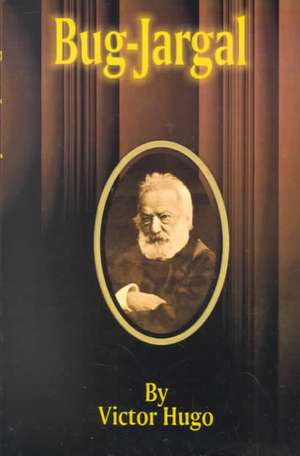
Bug-Jargal
Autor Victor Hugoen Limba Engleză Paperback – 31 mar 2001
Preț: 87.43 lei
Puncte Express: 131
Carte tipărită la comandă
Livrare economică 01-15 decembrie
Livrare prin curier în România Termenul estimat este afișat lângă disponibilitate.
Transport gratuit de la 400.00 lei Plată online sau ramburs, în funcție de opțiunile comenzii.
Retur gratuit în 14 zile Comandă securizată și suport în română.
Specificații
ISBN-13: 9781589631472
ISBN-10: 1589631471
Pagini: 156
Dimensiuni: 137 x 220 x 11 mm
Greutate: 0.2 kg
Editura: Fredonia Books (NL)
Colecția International Law … Taxation
Locul publicării:United States
ISBN-10: 1589631471
Pagini: 156
Dimensiuni: 137 x 220 x 11 mm
Greutate: 0.2 kg
Editura: Fredonia Books (NL)
Colecția International Law … Taxation
Locul publicării:United States
V-ar putea interesa
-
 PapillonHenri CharrièrePreț: 81.49 lei
 -
 -17%Preț: 79.20 lei95.36 lei
 -
 Explosion in a CathedralAlejo CarpentierPreț: 99.40 lei
 -
 The Black JacobinsC. L. R. James-29%Preț: 77.08 lei108.00 lei
 -
 Preț: 213.35 lei
 -
 Sugar MoneyJane HarrisPreț: 79.84 lei
 -
 Avengers of the New WorldLaurent DuboisPreț: 218.74 lei
 -
 The Black JacobinsC.L.R. JamesPreț: 108.48 lei
 -
 The Haitian Revolution: A Documentary HistoryDavid Geggus-17%Preț: 142.47 lei172.11 lei
 -
 A Concise History of the Haitian Revolution, Second EditionJeremy D. PopkinPreț: 260.62 lei
 -
 All Souls' RisingMadison Smartt BellPreț: 104.40 lei
 -
 -16%Preț: 73.46 lei87.91 lei
 -
 -16%Preț: 94.55 lei112.05 lei
 -
 Island Beneath the SeaIsabel Allende-22%Preț: 57.56 lei74.17 lei
 -
 Secret History; or, The Horrors of St. Domingo and LauraLeonora Sansay-20%Preț: 211.54 lei265.78 lei
 -
 Toilers of the SeaVictor HugoPreț: 63.91 lei
 -
 Les Misérables Volume TwoVictor HugoPreț: 38.00 lei
 -
 Classics Illustrated 7Victor HugoPreț: 57.23 lei
 -
 The Man Who LaughsVictor HugoPreț: 57.30 lei
Recenzii
Victor Hugo’s Bug-Jargal (1826) is one of the most important works of nineteenth-century colonial fiction, and quite possibly the most sustained novelistic treatment of the Haitian Revolution by a major European author. This Broadview edition makes Hugo’s novel available in a completely new English translation, the first in over one hundred years. Set in 1791, during the first months of a slave revolt that would eventually lead to the creation of the black republic of Haiti in 1804, Bug-Jargal is a stirring tale of interracial friendship and rivalry, a provocative account of the ties that bind a young Frenchman to one of the rebel leaders and the tragic misunderstandings that threaten to sever those ties completely.
This Broadview edition contains a critical introduction and a broad selection of appendices, including Hugo’s never-before-translated 1820 short story “Bug-Jargal,” contemporary reviews of the novel, documents pertaining to the young Hugo’s poetics and politics, and selections from his source materials about the Haitian Revolution.
“This superb edition of Bug-Jargal, which includes a wealth of contextualizing documentation, makes Hugo’s early representations of race and revolution fully accessible to a contemporary English-language audience. Bongie’s critical introduction, translations of both the 1826 novel and the original 1820 short story, and incorporation of contemporary reviews, literary sources, and historical materials reinvigorate Hugo’s work and enable the reader to engage with it from a fresh, postcolonial perspective.” — Kathryn M. Grossman, Pennsylvania State University
“Victor Hugo’s early novel of the Haitian Revolution has taken on a new significance in our postcolonial age preoccupied with race, subaltern resistance, and hybridity. Chris Bongie provides a richly contextualized version that will appeal to historians, literary scholars, and general readers alike. It combines meticulous documentation and a provocative argument about the conservative young poet’s ambivalent rendering of this ‘struggle of giants,’ which was written at a turning point in his political development.” — David Geggus, University of Florida
“Chris Bongie gives a highly readable and accurate translation of the novel, its 1820 short-story version, and of the supporting documents. He also devotes much of the introduction and notes to demonstrating how Hugo had pieced together portions of the novel from historical sources. [The translation and choice of documents] indicate the Broadview edition’s scholarly and pedagogical uses.” — Nineteenth-Century French Studies
This Broadview edition contains a critical introduction and a broad selection of appendices, including Hugo’s never-before-translated 1820 short story “Bug-Jargal,” contemporary reviews of the novel, documents pertaining to the young Hugo’s poetics and politics, and selections from his source materials about the Haitian Revolution.
“This superb edition of Bug-Jargal, which includes a wealth of contextualizing documentation, makes Hugo’s early representations of race and revolution fully accessible to a contemporary English-language audience. Bongie’s critical introduction, translations of both the 1826 novel and the original 1820 short story, and incorporation of contemporary reviews, literary sources, and historical materials reinvigorate Hugo’s work and enable the reader to engage with it from a fresh, postcolonial perspective.” — Kathryn M. Grossman, Pennsylvania State University
“Victor Hugo’s early novel of the Haitian Revolution has taken on a new significance in our postcolonial age preoccupied with race, subaltern resistance, and hybridity. Chris Bongie provides a richly contextualized version that will appeal to historians, literary scholars, and general readers alike. It combines meticulous documentation and a provocative argument about the conservative young poet’s ambivalent rendering of this ‘struggle of giants,’ which was written at a turning point in his political development.” — David Geggus, University of Florida
“Chris Bongie gives a highly readable and accurate translation of the novel, its 1820 short-story version, and of the supporting documents. He also devotes much of the introduction and notes to demonstrating how Hugo had pieced together portions of the novel from historical sources. [The translation and choice of documents] indicate the Broadview edition’s scholarly and pedagogical uses.” — Nineteenth-Century French Studies
Descriere
Descriere de la o altă ediție sau format:
Victor Hugo’s Bug-Jargal (1826) is one of the most important works of nineteenth-century colonial fiction, and quite possibly the most sustained novelistic treatment of the Haitian Revolution by a major European author. This Broadview edition makes Hugo’s novel available in a completely new English translation, the first in over one hundred years. Set in 1791, during the first months of a slave revolt that would eventually lead to the creation of the black republic of Haiti in 1804, Bug-Jargal is a stirring tale of interracial friendship and rivalry, a provocative account of the ties that bind a young Frenchman to one of the rebel leaders and the tragic misunderstandings that threaten to sever those ties completely.
This Broadview edition contains a critical introduction and a broad selection of appendices, including Hugo’s never-before-translated 1820 short story “Bug-Jargal,” contemporary reviews of the novel, documents pertaining to the young Hugo’s poetics and politics, and selections from his source materials about the Haitian Revolution.
Victor Hugo’s Bug-Jargal (1826) is one of the most important works of nineteenth-century colonial fiction, and quite possibly the most sustained novelistic treatment of the Haitian Revolution by a major European author. This Broadview edition makes Hugo’s novel available in a completely new English translation, the first in over one hundred years. Set in 1791, during the first months of a slave revolt that would eventually lead to the creation of the black republic of Haiti in 1804, Bug-Jargal is a stirring tale of interracial friendship and rivalry, a provocative account of the ties that bind a young Frenchman to one of the rebel leaders and the tragic misunderstandings that threaten to sever those ties completely.
This Broadview edition contains a critical introduction and a broad selection of appendices, including Hugo’s never-before-translated 1820 short story “Bug-Jargal,” contemporary reviews of the novel, documents pertaining to the young Hugo’s poetics and politics, and selections from his source materials about the Haitian Revolution.
Cuprins
Acknowledgements
Introduction
Victor Hugo: A Brief Chronology
A Note on the Text
Bug-Jargal
Appendix A: “Bug-Jargal” (1820)
Appendix B: “The Saint Domingue Revolt” (1845)
Appendix C: Politics and Poetics
Works Cited
Introduction
Victor Hugo: A Brief Chronology
A Note on the Text
Bug-Jargal
Appendix A: “Bug-Jargal” (1820)
Appendix B: “The Saint Domingue Revolt” (1845)
Appendix C: Politics and Poetics
- Review of Sir Walter Scott’s Quentin Durward (1823)
- Preface to Nouvelles Odes (1824)
- From Le Globe (Journal littéraire) (1826)
- From Le Drapeau blanc (1826)
- From Le Mercure du dix-neuvième siècle (1826)
- From C.A. Chauvet, “Des romans de M. Victor Hugo,” Revue encyclopédique (1831)
- From Charles-Augustin Sainte-Beuve, “Les Romans de Victor Hugo,” Journal des débats (1832)
- From Bryan Edwards, An Historical Survey of the French Colony in the Island of St. Domingo (1797)
- From Pamphile de Lacroix, Mémoires pour servir à l’histoire de la Révolution de Saint-Domingue (1819)
- From Henri Grégoire, De la littérature des nègres (1808)
- From Jean-Baptiste Picquenard, Adonis, ou Le bon nègre (1798)
- From Jean-Baptiste Picquenard, Zoflora; or, The Generous Negro Girl (1804)
Works Cited