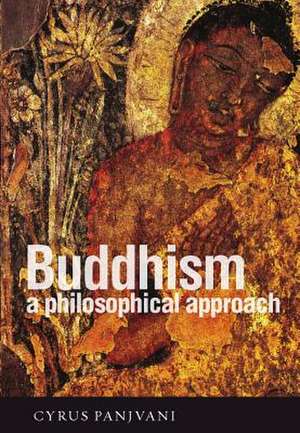
Buddhism: A Philosophical Approach
Autor Cyrus Panjvanien Limba Engleză Paperback – 13 dec 2013
Preț: 248.56 lei
Puncte Express: 373
Carte disponibilă
Livrare economică 30 octombrie-13 noiembrie
Livrare prin curier în România Termenul estimat este afișat lângă disponibilitate.
Transport gratuit de la 400.00 lei Plată online sau ramburs, în funcție de opțiunile comenzii.
Retur gratuit în 14 zile Comandă securizată și suport în română.
Specificații
ISBN-13: 9781551118536
ISBN-10: 155111853X
Pagini: 328
Dimensiuni: 152 x 229 x 18 mm
Greutate: 0.48 kg
Editura: BROADVIEW PR
Colecția Broadview Press
Locul publicării:Peterborough, Canada
ISBN-10: 155111853X
Pagini: 328
Dimensiuni: 152 x 229 x 18 mm
Greutate: 0.48 kg
Editura: BROADVIEW PR
Colecția Broadview Press
Locul publicării:Peterborough, Canada
V-ar putea interesa
-
 Bringing Yoga to LifeDonna FarhiPreț: 96.85 lei
 -
 The Art of WarSun Tzu-21%Preț: 43.88 lei55.66 lei
 -
 Indian Philosophy: A Very Short IntroductionSue Hamilton-20%Preț: 57.32 lei71.23 lei
 -
 Preț: 171.82 lei
 -
 A History of Islamic Philosophy 3eMajid FakhryPreț: 357.80 lei
 -
 Preț: 85.27 lei
 -
 -18%Preț: 64.98 lei79.50 lei
 -
 The Heart of Yoga: Developing a Personal PracticeT. K. V. Desikachar-21%Preț: 106.29 lei135.12 lei
 -
 -31%Preț: 77.73 lei113.02 lei
 -
 The Heart of AwarenessThomas Byrom-31%Preț: 99.78 lei145.17 lei
 -
 A Search In Secret IndiaPaul Brunton-43%Preț: 77.90 lei136.27 lei
 -
 The Yoga TraditionGeorg FeuersteinPreț: 237.83 lei
Recenzii
This book philosophically introduces the basic truths, doctrines, and principles of Buddhism. Its goal is to explain the teachings of the Buddha and of Buddhism clearly and consistently. Though the book treads beyond the Buddha’s life, including into the Abhidharma and Mahayana traditions, it remains throughout a philosophical discussion and elaboration of the Buddha’s thought. It is meant to be an accessible guide for those who have no background in Buddhism, and to be beneficial to the philosophical understanding of those who do.
“Readers looking for a clear, concise, and accessible introduction to the basic tenets of Buddhism will find Panjvani’s book ideally suited to their needs. The book covers such quintessentially Buddhist notions as the Four Noble Truths, the No-Self view of personal identity, and the causal principle of Dependent Arising. One of the book’s main strengths is its systematic and meticulous use of examples drawn from both canonical and contemporary sources to illustrate the pragmatic aspects of Buddhist teachings. With just the right blend of doctrinal exposition and philosophical analysis, Buddhism: A Philosophical Approach offers general audiences a useful resource for engaging Buddhist ideas in a critical and effective way.” — Christian Coseru, College of Charleston
“Buddhism: A Philosophical Approach is an excellent introduction to Buddhist philosophy. It includes a very lucid presentation not only of basic Buddhist teachings such as the Four Noble Truths and the Noble Eightfold Path, but also of such challenging concepts as emptiness and dependent origination. The work focuses on a general overview of fundamental issues, but also explores in some depth the complexities involved in crucial questions such as the nature of desire and the critique of self-identity. I highly recommend this work for introductory courses in Buddhist and Asian philosophy.” — John P. Clark, Loyola University New Orleans
“Readers looking for a clear, concise, and accessible introduction to the basic tenets of Buddhism will find Panjvani’s book ideally suited to their needs. The book covers such quintessentially Buddhist notions as the Four Noble Truths, the No-Self view of personal identity, and the causal principle of Dependent Arising. One of the book’s main strengths is its systematic and meticulous use of examples drawn from both canonical and contemporary sources to illustrate the pragmatic aspects of Buddhist teachings. With just the right blend of doctrinal exposition and philosophical analysis, Buddhism: A Philosophical Approach offers general audiences a useful resource for engaging Buddhist ideas in a critical and effective way.” — Christian Coseru, College of Charleston
“Buddhism: A Philosophical Approach is an excellent introduction to Buddhist philosophy. It includes a very lucid presentation not only of basic Buddhist teachings such as the Four Noble Truths and the Noble Eightfold Path, but also of such challenging concepts as emptiness and dependent origination. The work focuses on a general overview of fundamental issues, but also explores in some depth the complexities involved in crucial questions such as the nature of desire and the critique of self-identity. I highly recommend this work for introductory courses in Buddhist and Asian philosophy.” — John P. Clark, Loyola University New Orleans
Cuprins
Preface
I Indian Contexts
Glossary of Select Sanskrit, Pali and PhilosophicalTerms
Bibliography
Index
I Indian Contexts
- General Themes of the Indian Philosophical Tradition
A Short Account of the Vedas and Upanishads
The Philosophy of the Upanishads
The Identity of Brahman and Atman
- Introduction
The Early Life
The Four Signs
Renunciation
- Steering the Middle Course
A Symbolic Reading
Concluding Remarks
- Introduction
Pervasiveness and Eliminability
The First Understanding
The Second Understanding
The Third Understanding
The Five Aggregates
The Buddha and David Hume
Concluding Remarks
- Introduction
Craving and Permanence
Craving and Wanting — A Difference in Kind
The Character of Craving — Qualitative Observations
The Character of Craving — Formal Observations
Criticism of Bahm
Self and Suffering
- Introduction
Samsara
Understanding and Describing Nirvana
- Introduction
The Noble Eightfold Path
More on Mindfulness
- Introduction
The Argument from the Aggregates
A Lute, a Chariot and the Composite Self
The Argument from Lack of Control
- Introduction
Arising and Passing
Other Views of Change
Numerical Identity and Qualitative Identity
Annihilationism and Eternalism
Concluding Remarks
- Introduction
The First Model: Physical Causation
The Second Model: Mental Causation without Universal Causation
The Third Model: Mental Causation with Universal Causation
The Importance of Universal Causation
Dependent Origination and Causal Continuity
- Introduction
Karma and Morality
Karma and Rebirth
Continuity of Self over Time, Not Identity
- The Abhidharma, the Dharma, and Dharmas
Dharmas and Atoms
Dharmas as Ultimate Reality
Dharmas and Mindfulness
What Is the Duration of a Dharma?
- Introduction to Mahayana Buddhism
The Perfection of Wisdom and Emptiness
Emptiness and Dependent Origination
Emptiness and Non-Duality
Emptiness and Enlightenment
- Introduction
The Bodhisattva
The Bodhisattva Renounces
Compassion and Suffering
Genuine Compassion
Skillful Means, the Arhat and the Bodhisattva
An Emphasis on Practice over Belief
Glossary of Select Sanskrit, Pali and PhilosophicalTerms
Bibliography
Index