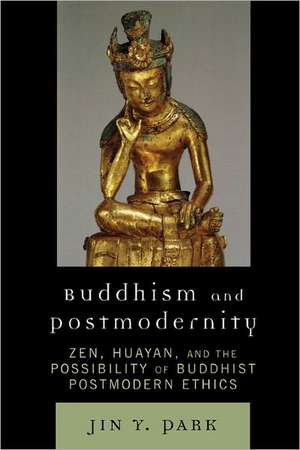
Buddhism and Postmodernity: Zen, Huayan, and the Possibility of Buddhist Postmodern Ethics
Autor Jin Y. Parken Limba Engleză Paperback – 28 oct 2010
Notăm cu interes modul în care Jin Y. Park utilizează conceptul de „Tăcere a lui Buddha” ca punct de plecare pentru a chestiona relevanța budismului în peisajul filosofic contemporan. În Buddhism and Postmodernity, autoarea nu se limitează la o prezentare istorică, ci propune o investigație critică asupra modului în care tradițiile Zen și Huayan pot răspunde provocărilor modernității. Structura volumului urmărește o progresie logică de la metafizică spre dimensiunea socială: prima parte analizează fundamentele ontologice în dialog cu Hegel, a doua parte investighează relația dintre limbaj și violența instituționalizată, iar ultima parte conturează o etică a tensiunii.
Descoperim aici o analiză neînfricată a contradicțiilor interne ale Zen-ului, în special în capitolul dedicat dimensiunii sociale a limbajului, unde Park explorează de ce o filosofie a eliberării menține adesea structuri autoritare. Această abordare este comparabilă cu Critical Buddhism de James Mark Shields în rigurozitate, dar actualizat pentru contextul deconstrucției continentale, punând un accent mai mare pe fenomenologia Huayan. În contextul operei sale anterioare, Buddhism and Postmodernity rafinează temele explorate în New Perspectives in Modern Korean Buddhism, mutând focalizarea de la contextul istoric colonial spre o paradigmă etică universală, dar ancorată în particularități.
Putem afirma că lucrarea reușește să creeze o punte solidă între filozofia est-asiatică și postmodernismul occidental. Spre deosebire de Postmodern Ethics, Emptiness, and Literature de Jae-seong Lee, care se concentrează pe dimensiunea literară, volumul de față rămâne strict în sfera discursului filosofic și al legitimizării politice, oferind o bază teoretică pentru ceea ce Park numește o „etică deconstructivă budistă”. Este o resursă densă, esențială pentru înțelegerea modului în care budismul încetează să fie un obiect de studiu exotic și devine un partener activ în dezbaterile etice globale.
Preț: 329.76 lei
Preț vechi: 469.32 lei
-30%
Carte tipărită la comandă
Livrare economică 28 septembrie-12 octombrie
Specificații
ISBN-10: 0739118242
Pagini: 283
Dimensiuni: 146 x 226 x 20 mm
Greutate: 0.44 kg
Editura: Bloomsbury Publishing
Colecția Lexington Books
Locul publicării:New York, United States
V-ar putea interesa
-
 Bringing Yoga to LifeDonna FarhiPreț: 95.72 lei
 -
 Zhuangzi: Basic WritingsZhuangziPreț: 171.20 lei
 -
 A History of Islamic Philosophy 3eMajid FakhryPreț: 357.80 lei
 -
 Preț: 125.00 lei
 -
 An Introduction to Indian Philosophy: Hindu and Buddhist Ideas from Original SourcesDr Christopher Bartley-24%Preț: 235.65 lei309.57 lei
 -
 -32%Preț: 76.72 lei112.81 lei
 -
 Psychotherapy East & WestAlan Watts-21%Preț: 88.70 lei111.68 lei
 -
 -26%Preț: 569.11 lei765.60 lei
 -
 Deep AwakeTim FrekePreț: 71.03 lei
 -
 -16%Preț: 94.93 lei113.13 lei
 -
 The Buddha in Me, The Buddha in YouDavid Hare-36%Preț: 85.94 lei133.70 lei
 -
 -24%Preț: 185.58 lei245.00 lei
 -
 Inside the NowThich Nhat Hanh-30%Preț: 91.89 lei130.72 lei
De ce să citești această carte
Recomandăm această carte cercetătorilor și studenților la filosofie sau studii religioase care doresc să depășească interpretările simpliste ale budismului. Cititorul va câștiga o înțelegere profundă a modului în care conceptele de „vid” și „non-sine” pot fundamenta o etică modernă, oferind instrumente critice pentru a analiza puterea și autoritatea în instituțiile spirituale. Este o lectură densă, care transformă teoria deconstrucției într-un exercițiu de etică aplicată.
Descriere
Park argues that, as unrelated as these questions may seem, the issues that have generated them are related to perennial philosophical themes of identity, institutional power, and ethics, respectively. Each of these themes constitutes one section of Buddhism and Postmodernity. Park discusses the three issues in the book through the exploration of the Buddhist concepts of self and others, language and thinking, and universality and particularities. Most of this discussion is drawn from the East Asian Buddhist traditions of Zen and Huayan Buddhism in connection with the Continental philosophies of postmodernism, hermeneutics, and deconstruction. Self-critical from both the Buddhist and Western philosophical perspectives, Buddhism and Postmodernity points the reader toward a new understanding of Buddhist philosophy and offers a Buddhist-postmodern ethical paradigm that challenges normative ethics of metaphysical traditions.
Cuprins
Part 2 Part One. Centripetality: Buddhism and Metaphysics
Chapter 3 The Silence of the Buddha
Chapter 4 Hegel and Buddhism
Chapter 5 The Logic of Nothing and A-Metaphysics
Part 6 Part Two. Centrifugality: Language and Violence
Chapter 7 Language and Thinking: Subjectivity and Zen Huatou Meditation
Chapter 8 Thinking and Violence: Zen Hermeneutics
Chapter 9 Violence Institutionalized: The Social Dimension of Zen Language
Part 10 Part Three. The Tension: Buddhism and the Politics of Postmodernity
Chapter 11 Modernity, Postmodernity, and the Question of Legitimation
Chapter 12 Postmodern Small Discourses and the Huayan World of Mutually Non-interfering Phenomena
Chapter 13 Envisioning Zen Ethics through Huayan Phenomenology
Chapter 14 The Ethics of Tension: Toward Buddhist Deconstructive Ethics
Recenzii
Buddhism and Postmodernity is a fascinating journey into the field of Buddhist philosophy. Jin Park skillfully negotiates a variety of discourses including Buddhist studies, feminism, and postmodernism. She masterfully unmasks prejudices about Buddhist traditions and their alleged lack of propensity for systematic thought, and presents a convincing case for a Zen ethics by demonstrating affinities between Zen and deconstruction. Her mastery of the material is impressive, her sketch of Zen philosophy visionary. For everyone with interest in Buddhism and/or postmodernism, Buddhism and Postmodernity is a must-read.
...Admirably concise and yet complex... Professor Park carefully exemplifies her own conclusions regarding the centrifugal potentials of Buddhist thought and practice by offering us clearly presented prospects on a yet-to-come ethics of non-dual interdependence. The wide ambitions of Buddhism and Postmodernity are skillfully threaded together through recurring contrasts of centripetal/centrifugal and hermeneutical/existential dynamics at play both historically and philosophically, in the West and its encounters with Buddhism, and in the global transit from modernity to postmodernity . . . Buddhism and Postmodernity raises important questions, opening promising avenues for further conversation.
The dialogue between Buddhism and postmodernity is one of the most exciting developments in contemporary philosophy, with important implications for ethics. Jin Y. Park's insightful study of their relationship is grounded in a deep understanding and appreciation of both traditions. Her book is a welcome addition to the growing literature.