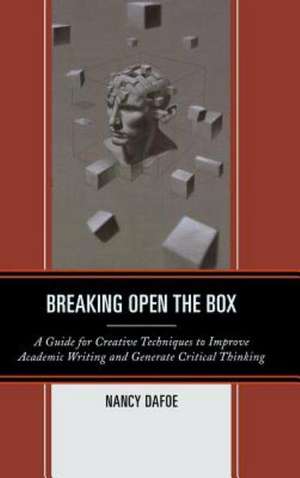
Breaking Open the Box: A Guide for Creative Techniques to Improve Academic Writing and Generate Critical Thinking
Autor Nancy DaFoeen Limba Engleză Hardback – 21 feb 2013
The movement away from children's natural creative impulses in elementary school to a direction in which they literally fit their writing into preconfigured shapes is a gradual one. Although purportedly taught to instill academic structures, these boxes are also designed to facilitate the ease with which student product may be assessed.
We need a more creative approach to teaching writing. A methodology incorporating creativity, as modeled by students in this text, demonstrates the kind of progress we are all seeking, offering an exciting challenge for young writers and educators alike.
Preț: 511.28 lei
Preț vechi: 733.58 lei
-30%
Puncte Express: 767
Carte tipărită la comandă
Livrare economică 07-21 noiembrie
Livrare prin curier în România Termenul estimat este afișat lângă disponibilitate.
Transport gratuit pentru acest produs Plată online sau ramburs, în funcție de opțiunile comenzii.
Retur gratuit în 14 zile Comandă securizată și suport în română.
Specificații
ISBN-13: 9781475802733
ISBN-10: 1475802730
Pagini: 210
Dimensiuni: 160 x 232 x 18 mm
Greutate: 0.48 kg
Editura: Bloomsbury Publishing
Colecția R&L Education
Locul publicării:New York, United States
ISBN-10: 1475802730
Pagini: 210
Dimensiuni: 160 x 232 x 18 mm
Greutate: 0.48 kg
Editura: Bloomsbury Publishing
Colecția R&L Education
Locul publicării:New York, United States
V-ar putea interesa
-
 Chomsky on Mis-EducationNoam Chomsky-21%Preț: 143.76 lei181.16 lei
 -
 -24%Preț: 317.42 lei416.71 lei
 -
 Becoming a Reflective TeacherRobert J MarzanoPreț: 289.80 lei
 -
 Preț: 246.75 lei
 -
 High-Impact InstructionJim KnightPreț: 328.32 lei
 -
 Facilitating Authentic Learning, Grades 6-12Laura L R. ThomasPreț: 247.64 lei
 -
 Opening Minds: Using Language to Change LivesPeter JohnstonPreț: 205.03 lei
 -
 -26%Preț: 1222.54 lei1659.69 lei
 -
 The Book of PlenaryPhil BeadlePreț: 109.12 lei
Cuprins
Foreword
Acknowledgments
Introduction: Writing Well Matters
Chapter 1:Encouraging Creative Frameworks for Critical Thinking and Writing
Chapter 2: The Writer as Critical ThinkerSection 1: Playing with Language
Section 2: Taking Creative Risks to Improve Writing
Chapter 3: Recognizing the Problem
Section 1: A Familiar Scene
Section 2: Why the Essay Genre Presents Such Challenges
Section 3: The Hollow Middle
Section 4: When a Good Student Writes a Bad Essay
Section 5: When a Student Surprises with His/Her Writing
Chapter 4: Outlining Creative Applications to Academic Writing
Section 1: Where to start and how to proceed with instruction in creative techniques and creative choices
Section 2: Applications with Metaphor
Chapter 5: Applications with Prose Poems or Poetic Prose
Chapter 6: Discourse Applications with Poetry
Chapter 7: Applications with Narrative-Story, Dialogue, and the Mini-Script
Chapter 8: Applications with Parody and Satire
Chapter 9: Applications with Musings and Journaling
Chapter 10: Applications with Unusual Vessels and Technology
Section 1: Student Applications with Unusual Vessels
Section 2: Applications with Technology
A: Texting
B: Blogging
Chapter 11: Traditional Looking Essays Incorporating Creative Techniques
Chapter 12: Changing the Landscape of Academic Writing Assignments
and the Classroom Environment
Chapter 13: Making Editing Integral
Chapter 14: Inviting the Common Core Standards into the Classroom and
Recognizing they are First Cousins to Creativity
Chapter 15: Lesson Planning Involving Creative Choice and Techniques
Section 1: Building Creative Techniques into the Writing Lesson
Section 2: Tweaking the Assessment Rubric to Encourage Creativity
Chapter 16: Setting Up Action Research
Section 1: Student Writing Surveys
Section 2: Examining Comparative Data
Section 3: A Procedural Guide-Building Creative Choice
into the Compositional Assignment
Chapter 17: Providing Students with Opportunities for Authentic Audience
Instructional Application and Dedication
Appendix A: A Guide for Parents
Appendix B: A Sampling of Young Writers' Conferences
Appendix C: Helpful, Creative Resources for Writers and Writing Instruction
Bibliography
Notes
Acknowledgments
Introduction: Writing Well Matters
Chapter 1:Encouraging Creative Frameworks for Critical Thinking and Writing
Chapter 2: The Writer as Critical ThinkerSection 1: Playing with Language
Section 2: Taking Creative Risks to Improve Writing
Chapter 3: Recognizing the Problem
Section 1: A Familiar Scene
Section 2: Why the Essay Genre Presents Such Challenges
Section 3: The Hollow Middle
Section 4: When a Good Student Writes a Bad Essay
Section 5: When a Student Surprises with His/Her Writing
Chapter 4: Outlining Creative Applications to Academic Writing
Section 1: Where to start and how to proceed with instruction in creative techniques and creative choices
Section 2: Applications with Metaphor
Chapter 5: Applications with Prose Poems or Poetic Prose
Chapter 6: Discourse Applications with Poetry
Chapter 7: Applications with Narrative-Story, Dialogue, and the Mini-Script
Chapter 8: Applications with Parody and Satire
Chapter 9: Applications with Musings and Journaling
Chapter 10: Applications with Unusual Vessels and Technology
Section 1: Student Applications with Unusual Vessels
Section 2: Applications with Technology
A: Texting
B: Blogging
Chapter 11: Traditional Looking Essays Incorporating Creative Techniques
Chapter 12: Changing the Landscape of Academic Writing Assignments
and the Classroom Environment
Chapter 13: Making Editing Integral
Chapter 14: Inviting the Common Core Standards into the Classroom and
Recognizing they are First Cousins to Creativity
Chapter 15: Lesson Planning Involving Creative Choice and Techniques
Section 1: Building Creative Techniques into the Writing Lesson
Section 2: Tweaking the Assessment Rubric to Encourage Creativity
Chapter 16: Setting Up Action Research
Section 1: Student Writing Surveys
Section 2: Examining Comparative Data
Section 3: A Procedural Guide-Building Creative Choice
into the Compositional Assignment
Chapter 17: Providing Students with Opportunities for Authentic Audience
Instructional Application and Dedication
Appendix A: A Guide for Parents
Appendix B: A Sampling of Young Writers' Conferences
Appendix C: Helpful, Creative Resources for Writers and Writing Instruction
Bibliography
Notes
Recenzii
Dafoe presents as her central thesis the argument that "teaching our students to write expressively and well may be the most valuable lesson we can offer." She concludes that techniques for creative writing may be the best method for doing so. The author offers several chapters' worth of advice on creative-writing pedagogies, brief assignment descriptions, and sample student essays. Where her argument falls apart, however, is due to a methodological confusion. The book, while maintaining a pretense of being action research, largely consists of lore; its claims are supported primarily by anecdote or quotation of others. In particular, she relies heavily upon Peter Elbow, whose expressivist work--while foundational to the field--has been thoroughly problematized by contemporary researchers and thinkers about composition. This confusion is especially frustrating because the strongest part of the book is an intriguing chapter on how to set up action research in writing classrooms. Though the book claims an audience of high school teachers and college composition instructors, most compositionists will likely find the author's ideas problematic or old hat. The book may be somewhat useful, however, for education students looking for ideas for lesson plans. Summing Up: Recommended. Upper-division undergraduates.
In her passionately-argued and critically engaging study of creative writing, Nancy Dafoe calls on her 14 years of experience as a writer and teacher of writing. Dafoe's legacy to her students shines through in her efforts to eliminate what she calls "our collective inarticulateness." Only when student writers feel personally invested in their writing can they become the voices who will leave their own legacy, Dafoe argues, and she clearly pursues the route to such a legacy through lively examples from her own experience and cogent theory. Writing is a means toward discovery; so is this book.
This book is a gift of treasured strategies, experiences and effective practices for educators at all levels in developing the art and skill of writing with 21st century learners. In each chapter, Nancy Dafoe eloquently engages the reader with the voice of an experienced practitioner and the heart of a highly effective teacher by sharing valuable insights in igniting creativity in the teaching and learning of writing. Breaking Open the Box is a timely and much needed resource for our profession.
Students have more to say than they realize, and being able to give them liberating choices with which to express ideas and feelings is cause for celebration. Thanks to Nancy Dafoe, teachers will no longer have to plow through piles of poorly written, unimaginative work by bored students who are not invested in their work. Breaking Open the Box restores a sense of play and discovery to the writing process. What better gift can we give our students and teachers than the means to clear and creative communication as well as the courage and pride that result?
Nancy Dafoe is a brilliant secondary English teacher who motivates even the most reluctant student writers. In her book Breaking Open the Box, she shares her most successful strategy for engaging students in literary analysis and the analytical writing process: providing creative choice. After applying her strategy in my own classroom, I watched as my students threw themselves into their writing and blossomed as critically thinking intellectuals. Nancy's is a must-read book for teachers hoping to help their students meet their full potential as writers and readers of literature.
Mrs. Dafoe has improved my writing and critical analysis abilities immeasurably. Through her guidance, mastering the true power of the English language, I learned that the best writing is inextricably linked to creativity and that stretching the limits of language every now and then is desirable-not just acceptable. Learning how to use word play and complex metaphors effectively does not come naturally, but Mrs. Dafoe makes it extremely accessible. Her methods result in a whole new world of expressive and analytical skills; the creative methods she teaches are exhilaratingly free from illusions of constraint that separate good writing from great writing.
Nancy Dafoe's creative writing class provided an opportunity for existential growth that I have yet to find since. Whether we recalled the days' absurdities, noted a meaningful quotation from another author, or simply mused about a meaningful observation, our journals were about our words, our thoughts, our dreams. We were always encouraged to be creative, and yet, in offering freedom, Mrs. Dafoe brought to her lessons a specificity that required us to hone in on meaning. By the end of each semester, I felt has if I had grown as a person as well as a writer. I was able to embrace my niche to quiet the heart, a moment to decipher the whirlwind of thought, and absorb the instruction to give each heartstring a voice.
In her passionately-argued and critically engaging study of creative writing, Nancy Dafoe calls on her 14 years of experience as a writer and teacher of writing. Dafoe's legacy to her students shines through in her efforts to eliminate what she calls "our collective inarticulateness." Only when student writers feel personally invested in their writing can they become the voices who will leave their own legacy, Dafoe argues, and she clearly pursues the route to such a legacy through lively examples from her own experience and cogent theory. Writing is a means toward discovery; so is this book.
This book is a gift of treasured strategies, experiences and effective practices for educators at all levels in developing the art and skill of writing with 21st century learners. In each chapter, Nancy Dafoe eloquently engages the reader with the voice of an experienced practitioner and the heart of a highly effective teacher by sharing valuable insights in igniting creativity in the teaching and learning of writing. Breaking Open the Box is a timely and much needed resource for our profession.
Students have more to say than they realize, and being able to give them liberating choices with which to express ideas and feelings is cause for celebration. Thanks to Nancy Dafoe, teachers will no longer have to plow through piles of poorly written, unimaginative work by bored students who are not invested in their work. Breaking Open the Box restores a sense of play and discovery to the writing process. What better gift can we give our students and teachers than the means to clear and creative communication as well as the courage and pride that result?
Nancy Dafoe is a brilliant secondary English teacher who motivates even the most reluctant student writers. In her book Breaking Open the Box, she shares her most successful strategy for engaging students in literary analysis and the analytical writing process: providing creative choice. After applying her strategy in my own classroom, I watched as my students threw themselves into their writing and blossomed as critically thinking intellectuals. Nancy's is a must-read book for teachers hoping to help their students meet their full potential as writers and readers of literature.
Mrs. Dafoe has improved my writing and critical analysis abilities immeasurably. Through her guidance, mastering the true power of the English language, I learned that the best writing is inextricably linked to creativity and that stretching the limits of language every now and then is desirable-not just acceptable. Learning how to use word play and complex metaphors effectively does not come naturally, but Mrs. Dafoe makes it extremely accessible. Her methods result in a whole new world of expressive and analytical skills; the creative methods she teaches are exhilaratingly free from illusions of constraint that separate good writing from great writing.
Nancy Dafoe's creative writing class provided an opportunity for existential growth that I have yet to find since. Whether we recalled the days' absurdities, noted a meaningful quotation from another author, or simply mused about a meaningful observation, our journals were about our words, our thoughts, our dreams. We were always encouraged to be creative, and yet, in offering freedom, Mrs. Dafoe brought to her lessons a specificity that required us to hone in on meaning. By the end of each semester, I felt has if I had grown as a person as well as a writer. I was able to embrace my niche to quiet the heart, a moment to decipher the whirlwind of thought, and absorb the instruction to give each heartstring a voice.