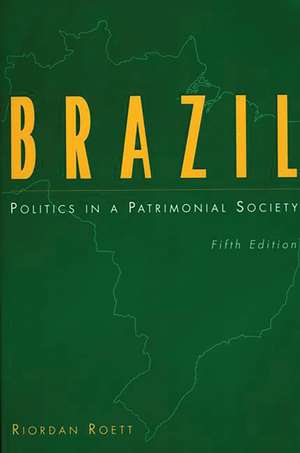
Brazil: Politics in a Patrimonial Society
Autor Riordan Roetten Limba Engleză Hardback – 29 oct 1999 – vârsta până la 17 ani
| Toate formatele și edițiile | Preț | Express |
|---|---|---|
| Paperback (2) | 61.48 lei 43-49 zile | |
| Oxford University Press – 18 aug 2016 | 61.48 lei 43-49 zile | |
| Bloomsbury Publishing – 29 oct 1999 | 237.84 lei 6-8 săpt. | |
| Hardback (2) | 273.47 lei 43-49 zile | |
| Oxford University Press – sep 2016 | 273.47 lei 43-49 zile | |
| Bloomsbury Publishing – 29 oct 1999 | 450.38 lei 6-8 săpt. |
Preț: 450.38 lei
Preț vechi: 653.63 lei
-31% Nou
Puncte Express: 676
Preț estimativ în valută:
79.70€ • 93.45$ • 69.99£
79.70€ • 93.45$ • 69.99£
Carte tipărită la comandă
Livrare economică 04-18 februarie 26
Preluare comenzi: 021 569.72.76
Specificații
ISBN-13: 9780275958992
ISBN-10: 027595899X
Pagini: 264
Dimensiuni: 156 x 235 x 22 mm
Greutate: 0.5 kg
Ediția:Revised
Editura: Bloomsbury Publishing
Colecția Praeger
Locul publicării:New York, United States
ISBN-10: 027595899X
Pagini: 264
Dimensiuni: 156 x 235 x 22 mm
Greutate: 0.5 kg
Ediția:Revised
Editura: Bloomsbury Publishing
Colecția Praeger
Locul publicării:New York, United States
V-ar putea interesa
-
 The Physical Geography of the MediterraneanJamie Woodward-34%Preț: 2094.94 lei3171.84 lei
 -
 -18%Preț: 1010.73 lei1232.60 lei
 -
 Land Law in IndiaAstha Saxena-18%Preț: 1026.64 lei1252.00 lei
 -
 -39%Preț: 619.06 lei1022.78 lei
 -
 Preț: 362.51 lei
 -
 Democracy, Diaspora, Territory: Europe and Cross-Border PoliticsOlga Oleinikova-18%Preț: 1013.01 lei1235.37 lei
 -
 Beyond Macaulay: Education in India, 1780–1860Parimala V. Rao-34%Preț: 788.06 lei1194.33 lei
 -
 Indigeneity and Occupational Change: The Tribes of PunjabBirinder Pal Singh-18%Preț: 1014.51 lei1237.21 lei
 -
 Contours of Relationship: India and the Middle EastKingshuk Chatterjee-18%Preț: 1011.51 lei1233.54 lei
 -
 -18%Preț: 1018.33 lei1241.86 lei
 -
 -19%Preț: 321.26 lei397.31 lei
 -
 In Search of Indian English: History, Politics and IndigenisationRanjan Kumar Auddy-34%Preț: 786.78 lei1193.55 lei
 -
 Preț: 460.52 lei
 -
 Preț: 359.37 lei
 -
 Global Mobility and Higher LearningAnatoly OleksiyenkoPreț: 401.80 lei
 -
 -18%Preț: 1119.90 lei1365.73 lei
 -
 The New BrazilRiordan RoettPreț: 183.35 lei
 -
 Preț: 264.62 lei
 -
 Preț: 226.82 lei
 -
 Preț: 202.60 lei
 -
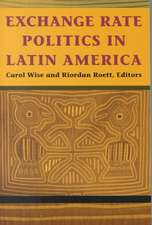 Exchange Rate Politics in Latin AmericaCarol WisePreț: 170.23 lei
 -
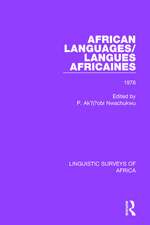 African Languages/Langues Africaines: Volume 2 1976P. Akụjụobi NwachukwuPreț: 347.04 lei
 -
 -18%Preț: 1016.04 lei1239.07 lei
 -
 -18%Preț: 1005.42 lei1226.12 lei
 -
 Social Welfare Policies and Programmes in South AsiaChannaveer R. M.-18%Preț: 1019.82 lei1243.69 lei
Notă biografică
RIORDAN ROETT is the Sarita and Don Johnston Professor and Director of the Western Hemisphere Program at the Paul H. Nitze School of Advanced International Studies at The Johns Hopkins University. He has authored or edited numerous works on Brazil's political development, including The Politics of Foreign Aid in the Brazilian Northeast, Brazil in the Seventies, and four previous editions of Brazil: Politics in a Patrimonial Society (Praeger).
Cuprins
PrefaceIntroductionBrazil: A Framework for AnalysisPolitical Parties and ElectionsThe Patrimonial State and Society in BrazilThe Military in PoliticsThe Brazilian EconomyBrazilian Foreign PolicyChallenges for the Next Century: The Social Agenda in BrazilAppendixSelected BibliographyIndex
Descriere
Descriere de la o altă ediție sau format:
Brazil is one of the most important but puzzling countries in the world. A nation of 200 million people, it has vast natural resource reserves, rich cultural traditions, a middle class undergoing explosive growth, and social welfare policies that are models for much of the world ('la bolsa familia,' which provides a guaranteed income to poor families). And, after decades of authoritarian rule, it is a stable democracy. Yet it is beset by problems that no other advanced economy suffers from: staggeringly high crime rates, sky-high inequality levels, and endemic political corruption. Emblematic of these two sides of Brazil is the selection of Rio as site of both the next Summer Olympics and the next World Cup. While the choice of Rio for these events points to Brazil's expanding presence on the world stage, so far the construction and planning for the events have been disastrous, threatening to deeply embarrass the nation. In Brazil: What Everyone Needs to Know, Riordan Roett, an eminent scholar of Brazil and Latin America, will provide a rich overview of Brazil, covering Brazilian society, politics, culture, and the economy. The book begins with a series of chapters on Brazilian history, beginning with the pre-colonial period and moving on, in succession, to the long era of Portuguese rule, the birth of independent Brazil, the emergence of modern Brazil in the 1930s, the era of the dictators, and - finally - to the democratic regime that came into being in the 1980s. Throughout the book, Roett will focus sharply on the fault lines -- racial, economic, political, and cultural - that have plagued Brazil from its beginnings to this day. As the 2016 World Cup and Summer Olympics approach, interest in Brazil is sure to rise. Roett's synthesis will provide interested readers with an accessible, authoritative overview of this troubled yet fascinating giant.
Brazil is one of the most important but puzzling countries in the world. A nation of 200 million people, it has vast natural resource reserves, rich cultural traditions, a middle class undergoing explosive growth, and social welfare policies that are models for much of the world ('la bolsa familia,' which provides a guaranteed income to poor families). And, after decades of authoritarian rule, it is a stable democracy. Yet it is beset by problems that no other advanced economy suffers from: staggeringly high crime rates, sky-high inequality levels, and endemic political corruption. Emblematic of these two sides of Brazil is the selection of Rio as site of both the next Summer Olympics and the next World Cup. While the choice of Rio for these events points to Brazil's expanding presence on the world stage, so far the construction and planning for the events have been disastrous, threatening to deeply embarrass the nation. In Brazil: What Everyone Needs to Know, Riordan Roett, an eminent scholar of Brazil and Latin America, will provide a rich overview of Brazil, covering Brazilian society, politics, culture, and the economy. The book begins with a series of chapters on Brazilian history, beginning with the pre-colonial period and moving on, in succession, to the long era of Portuguese rule, the birth of independent Brazil, the emergence of modern Brazil in the 1930s, the era of the dictators, and - finally - to the democratic regime that came into being in the 1980s. Throughout the book, Roett will focus sharply on the fault lines -- racial, economic, political, and cultural - that have plagued Brazil from its beginnings to this day. As the 2016 World Cup and Summer Olympics approach, interest in Brazil is sure to rise. Roett's synthesis will provide interested readers with an accessible, authoritative overview of this troubled yet fascinating giant.