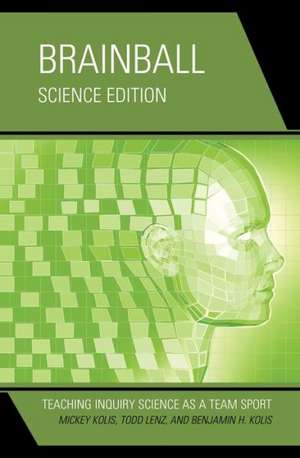
Brainball: Teaching Inquiry Science as a Team Sport
Autor Mickey Kolis, Todd Lenz, Benjamin H. Kolisen Limba Engleză Hardback – 18 mar 2014
Preț: 431.39 lei
Preț vechi: 597.29 lei
-28%
Puncte Express: 647
Carte tipărită la comandă
Livrare economică 14-28 noiembrie
Livrare prin curier în România Termenul estimat este afișat lângă disponibilitate.
Transport gratuit pentru acest produs Plată online sau ramburs, în funcție de opțiunile comenzii.
Retur gratuit în 14 zile Comandă securizată și suport în română.
Specificații
ISBN-13: 9781475808872
ISBN-10: 1475808879
Pagini: 196
Ilustrații: 3 b/w illustrations; 12 tables
Dimensiuni: 152 x 232 x 18 mm
Greutate: 0.41 kg
Ediția:Science
Editura: Bloomsbury Publishing
Colecția Rowman & Littlefield
Locul publicării:New York, United States
ISBN-10: 1475808879
Pagini: 196
Ilustrații: 3 b/w illustrations; 12 tables
Dimensiuni: 152 x 232 x 18 mm
Greutate: 0.41 kg
Ediția:Science
Editura: Bloomsbury Publishing
Colecția Rowman & Littlefield
Locul publicării:New York, United States
V-ar putea interesa
-
 INTUITIVE PRACTITIONERATKINSON-29%Preț: 184.63 lei258.96 lei
 -
 Improving Schools Through Teacher LeadershipAlma Harris-29%Preț: 163.35 lei230.62 lei
 -
 The Ethical TeacherElizabeth Campbell-27%Preț: 199.56 lei273.07 lei
 -
 Learning without LimitsSusan Hart-26%Preț: 195.94 lei265.93 lei
 -
 Raising Boys' Achievement in Secondary SchoolsMike Younger-29%Preț: 170.67 lei240.79 lei
 -
 -27%Preț: 194.18 lei266.00 lei
 -
 -18%Preț: 1260.05 lei1536.64 lei
 -
 Preț: 354.90 lei
 -
 Tools for Dossier Success: A Guide for Promotion and TenureJoy J. BurnhamPreț: 337.05 lei
 -
 Leading for Instructional ImprovementStephen FinkPreț: 240.09 lei
 -
 Managing Online Instructor WorkloadSimone C O ConceiçãoPreț: 212.45 lei
 -
 Three-Minute Classroom Walk-ThroughCarolyn DowneyPreț: 306.30 lei
 -
 Preț: 249.88 lei
 -
 Beyond FoundationsThomas J GritesPreț: 392.76 lei
 -
 Academic Working Lives: Experience, Practice and ChangeDr Lynne Gornall-24%Preț: 904.69 lei1193.68 lei
 -
 A Guided Inquiry Approach to High School ResearchRandell K. Schmidt-20%Preț: 261.88 lei325.54 lei
 -
 Preț: 180.74 lei
 -
 Supporting and Supervising your Teaching AssistantDr Jill Morgan-43%Preț: 104.07 lei182.68 lei
Descriere
What is a game? You might think of cards and dice, computers, or sports. You might even think of music or theater as games. But what about Science? Games have rules, players, and objectives, but, maybe most importantly, games are fun. People play games because they think they are "fun," and sometimes they even learn some important lessons. Classrooms are intended to teach important lessons, and sometimes people think they are fun (not nearly often enough).
Brainball (Science Edition) is designed to combine the best of both worlds! Science Inquiry is the game and learning the intended outcome! Veteran science teachers Kolis and Lenz provide small step-by-step 5E's lessons and an inquiry-based sequence to guide you through that first learning experience so that you too can play the game of Brainball (Science Edition)!
Brainball (Science Edition) is designed to combine the best of both worlds! Science Inquiry is the game and learning the intended outcome! Veteran science teachers Kolis and Lenz provide small step-by-step 5E's lessons and an inquiry-based sequence to guide you through that first learning experience so that you too can play the game of Brainball (Science Edition)!
Cuprins
Foreword
Acknowledgements
Introduction
Section 1: Brainball!
Chapter 1: Brainball (Science Edition) - The Point of the Game is Learning
Chapter 2: The Big Ideas: Product, Process, and Community aligned with Purpose
Chapter 3: Brainball (SE) Beliefs (Dispositions)
Chapter 4: Brainball (SE) Key Concepts (Knowledge)
Chapter 5: Brainball (SE) Skills
Section 2: Five Coaching Tips
Chapter 6: Tip 1: Keep the End-in-Mind
Chapter 7: Tip 2: Play the Game
Chapter 8: Tip 3: Competitions as Evaluations
Chapter 9: Tip 4: Sequences matter
Chapter 10: Tip 5: Explicit Communications
Section 3: Day-to-Day Lesson Plans: Brainball Illuminated
Lesson 1: Perceptions
Lesson 2: Observations
Lesson 3: Patent Description
Lesson 4: Problem Statements
Lesson 5: Picking Problem Statements
Lesson 6: Gathering Information
Lesson 7: Gathering Information
Lesson 8: Hypothesis
Lesson 9: Null Hypothesis
Lesson 10: Experimental Procedure
Lesson 11: Experimental Design
Lesson 12: Presenting Data (Tables)
Lesson 13: Presenting Data (Graphs)
Lesson 14: Analyzing Data
Lesson 15: Writing a Conclusion
Section 4: A More Integrated Example!
Chapter 11: All together now!
Conclusion
Appendix A: Community Roles
Appendix B: S.C.A.M.P.E.R.
Appendix C: Shifting Points of View Story
Appendix D: Circle of Power and Respect
Appendix E: Why Observations Matter / SRP Chart
Appendix F: Recipe for Catalase Solution
Appendix G: Idea Evaluator
Appendix H: Checklist for Science Lab
Appendix I: Bad Directions
Appendix J: Data Table Assignments
Appendix K: Graph Assignments
Appendix L: Choosing the Appropriate Statistical Test
Appendix M: Social Contracts
Appendix N: Dialogue
Appendix O: Team / Community Building Books
Acknowledgements
Introduction
Section 1: Brainball!
Chapter 1: Brainball (Science Edition) - The Point of the Game is Learning
Chapter 2: The Big Ideas: Product, Process, and Community aligned with Purpose
Chapter 3: Brainball (SE) Beliefs (Dispositions)
Chapter 4: Brainball (SE) Key Concepts (Knowledge)
Chapter 5: Brainball (SE) Skills
Section 2: Five Coaching Tips
Chapter 6: Tip 1: Keep the End-in-Mind
Chapter 7: Tip 2: Play the Game
Chapter 8: Tip 3: Competitions as Evaluations
Chapter 9: Tip 4: Sequences matter
Chapter 10: Tip 5: Explicit Communications
Section 3: Day-to-Day Lesson Plans: Brainball Illuminated
Lesson 1: Perceptions
Lesson 2: Observations
Lesson 3: Patent Description
Lesson 4: Problem Statements
Lesson 5: Picking Problem Statements
Lesson 6: Gathering Information
Lesson 7: Gathering Information
Lesson 8: Hypothesis
Lesson 9: Null Hypothesis
Lesson 10: Experimental Procedure
Lesson 11: Experimental Design
Lesson 12: Presenting Data (Tables)
Lesson 13: Presenting Data (Graphs)
Lesson 14: Analyzing Data
Lesson 15: Writing a Conclusion
Section 4: A More Integrated Example!
Chapter 11: All together now!
Conclusion
Appendix A: Community Roles
Appendix B: S.C.A.M.P.E.R.
Appendix C: Shifting Points of View Story
Appendix D: Circle of Power and Respect
Appendix E: Why Observations Matter / SRP Chart
Appendix F: Recipe for Catalase Solution
Appendix G: Idea Evaluator
Appendix H: Checklist for Science Lab
Appendix I: Bad Directions
Appendix J: Data Table Assignments
Appendix K: Graph Assignments
Appendix L: Choosing the Appropriate Statistical Test
Appendix M: Social Contracts
Appendix N: Dialogue
Appendix O: Team / Community Building Books
Recenzii
Combining the best perspectives from two worlds--team sports and science classrooms--Brainball offers a fresh perspective on the learning and teaching of science. The authors contend that not unlike real science, games are the transformation of theory into practice; they require a clear goal, are dynamic, and yet have a clear set of rules. The ultimate aim of the so-called game is science learning, and Brainball is a teaching methodology that embraces the complexity of science education and brings it to life. Sections 2 and 3, along with the numerous appendixes, will appeal to novice teachers, as they offer straightforward guidance, including a chapter on assessment along with series of lesson plans that present a scripted narrative to help instructors immediately bring these ideas to the classroom setting. . . .[T]his one offers easily accessible, down-to-earth strategies for science teachers across the K-12 continuum. Summing Up: Recommended. Graduate, research, and professional collections.
I love all of the different viewpoints: professor, teacher, and student. This made the book practical, rather than so many other theoretical education-related books. I thought the book had a very nice flow to it - professional when needed, yet candid at times to give my mind a break.
This book forces you to think about the fundamentals of teaching and learning and makes science inquiry seem simple and practical, with the added lessons in the final chapter (great idea, keeps the skeptics at bay). Brainball (Science Edition) is an easy read with many "ah ha" moments along the way. I highly recommend this for any high school or middle school science teacher, school administrator, or curriculum leader.
I wholeheartedly agree with the trajectory of the book, which in my view seeks to prepare teachers to teach in ways that foster what is indeed meaningful learning. This project has in mind the betterment of people (and thus society), and I am invigorated as an educator by this emphasis. The writing is also organized to partner philosophical vision with practical descriptions of what such a vision would look like in the classroom. Without such an emphasis, convincing people to change their practice is (understandably) a distant long shot..I found [the writing style] to be accessible and entertaining.
Brainball is a purposeful and process-driven set of teaching strategies that gets kids to take on the role of being a scientist. The book focuses on creating experiences for science students to "problem notice and problem solve" through a specific set of processes. Lessons in Brainball challenge students to be creative, share their ideas, strategize procedures, analyze data, and reflect on their learning. This book is also an excellent resource to help guide teachers in intentionally planning to get students to develop positive dispositions, collaborative teams, and supportive communities where everyone contributes and everyone has a role.
I love all of the different viewpoints: professor, teacher, and student. This made the book practical, rather than so many other theoretical education-related books. I thought the book had a very nice flow to it - professional when needed, yet candid at times to give my mind a break.
This book forces you to think about the fundamentals of teaching and learning and makes science inquiry seem simple and practical, with the added lessons in the final chapter (great idea, keeps the skeptics at bay). Brainball (Science Edition) is an easy read with many "ah ha" moments along the way. I highly recommend this for any high school or middle school science teacher, school administrator, or curriculum leader.
I wholeheartedly agree with the trajectory of the book, which in my view seeks to prepare teachers to teach in ways that foster what is indeed meaningful learning. This project has in mind the betterment of people (and thus society), and I am invigorated as an educator by this emphasis. The writing is also organized to partner philosophical vision with practical descriptions of what such a vision would look like in the classroom. Without such an emphasis, convincing people to change their practice is (understandably) a distant long shot..I found [the writing style] to be accessible and entertaining.
Brainball is a purposeful and process-driven set of teaching strategies that gets kids to take on the role of being a scientist. The book focuses on creating experiences for science students to "problem notice and problem solve" through a specific set of processes. Lessons in Brainball challenge students to be creative, share their ideas, strategize procedures, analyze data, and reflect on their learning. This book is also an excellent resource to help guide teachers in intentionally planning to get students to develop positive dispositions, collaborative teams, and supportive communities where everyone contributes and everyone has a role.
Notă biografică
Mickey Kolis is the author of eight books and a veteran public school teacher; he is currently a university professor. Making learning relevant is his highest professional aspiration.