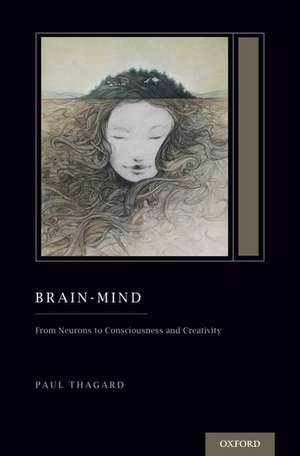
Brain-Mind: From Neurons to Consciousness and Creativity: Oxford Series on Cognitive Models and Architectures
Autor Paul Thagarden Limba Engleză Hardback – 21 mar 2019


Preț: 397.20 lei
Preț vechi: 438.55 lei
-9%
Puncte Express: 596
Carte disponibilă
Livrare economică 06-11 noiembrie
Livrare prin curier în România Termenul estimat este afișat lângă disponibilitate.
Transport gratuit de la 400.00 lei Plată online sau ramburs, în funcție de opțiunile comenzii.
Retur gratuit în 14 zile Comandă securizată și suport în română.
Specificații
ISBN-13: 9780190678715
ISBN-10: 0190678712
Pagini: 336
Dimensiuni: 239 x 157 x 28 mm
Greutate: 0.66 kg
Editura: Oxford University Press
Colecția OUP USA
Seria Oxford Series on Cognitive Models and Architectures
Locul publicării:New York, United States
ISBN-10: 0190678712
Pagini: 336
Dimensiuni: 239 x 157 x 28 mm
Greutate: 0.66 kg
Editura: Oxford University Press
Colecția OUP USA
Seria Oxford Series on Cognitive Models and Architectures
Locul publicării:New York, United States
Recenzii
A readable overview of the philosophy of cognitive science and its goal of establishing mechanistic or computational models of cognition and emotion
With his deep background in cognitive science and philosophy of mind, Thagard is able to sketch a bird's eye view of the mindencompassing cognition, emotion, and consciousnesswhile staying grounded in a computational theory of neural organization.
Paul Thagard's Brain-Mind is an extremely ambitious attempt (largely successful, I believe), to provide a unified, neurally-based, account of how the Brain creates the Mind. Using Chris Eliasmith's Semantic Pointer Architecture and related ideas, Thagard shows how all the various aspects of the mind from lower level phenomena, such as Perception, to the highest levels of cognition, such as Language and the Self, can be realized in terms of a set of unifying principles based on the Semantic Pointer Architecture and its grounding in neural mechanisms. It provides a strong intellectual foundation for the even more ambitious other volumes (Mind-Society and Natural Philosophy) of his three-volume Treatise on Mind and Society.Thagard takes us on a mind-expanding journey.
With his deep background in cognitive science and philosophy of mind, Thagard is able to sketch a bird's eye view of the mindencompassing cognition, emotion, and consciousnesswhile staying grounded in a computational theory of neural organization.
Paul Thagard's Brain-Mind is an extremely ambitious attempt (largely successful, I believe), to provide a unified, neurally-based, account of how the Brain creates the Mind. Using Chris Eliasmith's Semantic Pointer Architecture and related ideas, Thagard shows how all the various aspects of the mind from lower level phenomena, such as Perception, to the highest levels of cognition, such as Language and the Self, can be realized in terms of a set of unifying principles based on the Semantic Pointer Architecture and its grounding in neural mechanisms. It provides a strong intellectual foundation for the even more ambitious other volumes (Mind-Society and Natural Philosophy) of his three-volume Treatise on Mind and Society.Thagard takes us on a mind-expanding journey.
Notă biografică
Paul Thagard is a distinguished philosopher and cognitive scientist who has written many books, including The Brain and the Meaning of Life (Princeton University Press, 2010) and The Cognitive Science of Science (MIT Press, 2012). He is a Fellow of the Royal Society of Canada, the Cognitive Science Society, and the Association for Psychological Science.
Cuprins
- Preface
- Acknowledgments
- 1. What are Minds?
- Why Minds Matter
- What are Minds?
- Cognitive Science
- Representations and Processes
- Mechanisms
- Looking Ahead
- Summary
- Notes to Chapter 1: Minds
- 2. How Brains Make Minds
- Why Brains Matter to Mind and Society
- Thinking with Cells
- Neurons
- Neural Groups
- Combining Neural Representations
- Semantic Pointers
- The Semantic Pointer Architecture
- Innateness versus Learning
- Summary and Discussion
- Appendix: Details and Comparisons
- Notes to Chapter 2: Brains
- 3. Perception and Imagery
- Why Perception and Imagery Matter to Mind and Society
- From Sensation to Perception to Imagery
- External Senses
- Internal Senses
- Imagery
- Mental Mechanisms for Imagery
- Neural Mechanisms for Imagery
- Uses of Imagery
- Summary and Discussion
- Notes to Chapter 3: Perception
- 4. Concepts
- Why Concepts Matter to Mind and Society
- Theories of Concepts
- Neural Mechanisms for Concepts
- Uses of Concepts
- Summary and Discussion
- Notes to Chapter 4: Concepts
- 5. Rules
- Why Rules Matter to Mind and Society
- Mental Mechanisms for Rules
- Neural Mechanisms for Rules
- Uses of Rules
- Summary and Discussion
- Notes to Chapter 5: Rules
- 6. Analogies
- Why Analogies Matter to Mind and Society
- Mental Mechanisms for Analogy
- Neural Mechanisms for Analogy
- Uses of Analogies
- Summary and Discussion
- Notes to Chapter 6: Analogies
- 7. Emotions
- Why Emotions Matter to Mind and Society
- Psychological Theories of Emotion
- Neural Mechanisms for Emotions
- Uses of Emotions
- How Emotions Change
- Summary and Discussion
- Notes to Chapter 7: Emotions
- 8. Consciousness
- Why Consciousness Matters to Mind and Society
- Psychological Theories of Consciousness
- Neural Mechanisms for Consciousness
- Uses of Consciousness
- Summary and Discussion
- Notes to Chapter 8: Consciousness
- 9. Action and Intention
- Why Actions Matter to Mind and Society
- Psychological Theories of Action, Intention, and Will
- Neural Mechanisms for Action and Intention
- Uses of Action and Intention
- The Will
- Summary and Discussion
- Notes to Chapter 9: Action
- 10. Language
- Why Language Matters to Mind and Society
- Syntax First: Chomsky
- Integrating Syntax, Semantics, and Phonology
- Meaning
- Conceptual Blending
- Metaphor
- Innateness and Language Learning
- Summary and Discussion
- Notes to Chapter 10: Language
- 11. Creativity
- Why Creativity Matters to Mind and Society
- What is Creativity?
- Images
- Concepts
- Rules
- Procedural Creativity
- Analogies and Metaphors
- Emotions
- Case Study: CRISPR/Cas9
- Summary and Discussion
- Notes to Chapter 11: Creativity
- 12. The Self
- Why the Self Matters to Mind and Society
- What is the Self?
- Semantic Pointers for Self-Representation
- Semantic Pointer Mechanisms for Self-Effecting and Self-Changing
- Multilevel Systems
- Molecular Mechanisms
- Social Mechanisms
- Summary and Discussion
- Notes to Chapter 12: Self
- References
- Index