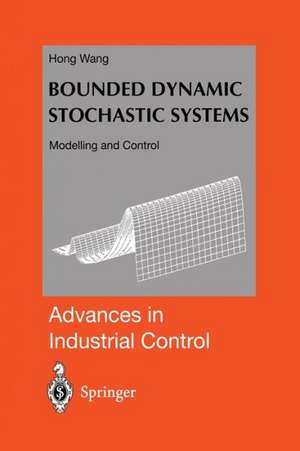
Bounded Dynamic Stochastic Systems: Advances in Industrial Control
Autor Hong Wangen Limba Engleză Paperback – 4 oct 2012
A new representation of dynamic stochastic systems is produced by using B-spline functions to descripe the output p.d.f. Advances in Industrial Control aims to report and encourage the transfer of technology in control engineering. The rapid development of control technology has an impact on all areas of the control discipline. The series offers an opportunity for researchers to present an extended exposition of new work in all aspects of industrial control.
Din seria Advances in Industrial Control
- 15%
 Preț: 650.40 lei
 - 18%
 Preț: 959.01 lei
 - 18%
 Preț: 757.72 lei
 - 18%
 Preț: 1147.97 lei
 - 18%
 Preț: 976.39 lei
 - 18%
 Preț: 905.80 lei
 - 18%
 Preț: 864.31 lei
 - 18%
 Preț: 790.01 lei
 - 18%
 Preț: 752.66 lei
 - 18%
 Preț: 1411.69 lei
 - 18%
 Preț: 735.52 lei
 - 15%
 Preț: 645.35 lei
 - 15%
 Preț: 661.36 lei
 - 15%
 Preț: 647.27 lei
 - 18%
 Preț: 896.57 lei
 - 18%
 Preț: 775.66 lei
 - 18%
 Preț: 951.24 lei
 - 18%
 Preț: 947.30 lei
 - 15%
 Preț: 620.38 lei
 - 15%
 Preț: 644.70 lei
 - 18%
 Preț: 983.57 lei
 - 15%
 Preț: 663.58 lei
 - 18%
 Preț: 1436.95 lei
 - 18%
 Preț: 980.03 lei
 - 18%
 Preț: 913.01 lei
 - 18%
 Preț: 982.24 lei
 - 18%
 Preț: 985.21 lei
 - 18%
 Preț: 1148.21 lei
 - 15%
 Preț: 669.91 lei
 - 15%
 Preț: 663.58 lei
 - 18%
 Preț: 979.63 lei
 - 18%
 Preț: 982.74 lei
 - 18%
 Preț: 1153.23 lei
 - 15%
 Preț: 664.01 lei
 - 18%
 Preț: 982.58 lei
 - 18%
 Preț: 980.78 lei
 - 15%
 Preț: 660.75 lei
 - 15%
 Preț: 663.58 lei
 - 20%
 Preț: 669.73 lei
 - 18%
 Preț: 1148.59 lei
 - 20%
 Preț: 1029.39 lei
 - 15%
 Preț: 667.27 lei
 - 24%
 Preț: 1082.44 lei
 - 18%
 Preț: 978.15 lei
 - 18%
 Preț: 1342.56 lei
 - 15%
 Preț: 676.08 lei
 - 15%
 Preț: 666.52 lei
 - 20%
 Preț: 620.99 lei
 - 18%
 Preț: 1080.75 lei
Preț: 638.36 lei
Preț vechi: 751.01 lei
-15%
Puncte Express: 958
Carte tipărită la comandă
Livrare economică 21 noiembrie-05 decembrie
Livrare prin curier în România Termenul estimat este afișat lângă disponibilitate.
Transport gratuit pentru acest produs Plată online sau ramburs, în funcție de opțiunile comenzii.
Retur gratuit în 14 zile Comandă securizată și suport în română.
Specificații
ISBN-13: 9781447111511
ISBN-10: 1447111516
Pagini: 196
Ilustrații: XVI, 176 p.
Dimensiuni: 155 x 235 x 11 mm
Greutate: 0.31 kg
Ediția:Softcover reprint of the original 1st ed. 2000
Editura: Springer
Colecția Advances in Industrial Control
Seria Advances in Industrial Control
Locul publicării:London, United Kingdom
ISBN-10: 1447111516
Pagini: 196
Ilustrații: XVI, 176 p.
Dimensiuni: 155 x 235 x 11 mm
Greutate: 0.31 kg
Ediția:Softcover reprint of the original 1st ed. 2000
Editura: Springer
Colecția Advances in Industrial Control
Seria Advances in Industrial Control
Locul publicării:London, United Kingdom
V-ar putea interesa
-
 Industrial Automation: Hands OnFrank Lamb-32%Preț: 372.33 lei547.27 lei
 -
 Arduino Projects for Amateur RadioJack Purdum-40%Preț: 189.12 lei314.42 lei
 -
 The Technological SingularityMurray Shanahan-21%Preț: 95.19 lei121.21 lei
 -
 Health Insurance HandbookHong Wang-5%Preț: 169.52 lei178.44 lei
 -
 AtherosclerosisWang-9%Preț: 1229.31 lei1350.89 lei
 -
 Integrated Vehicle Dynamics and ControlWuwei Chen-23%Preț: 750.29 lei974.40 lei
 -
 Arduino SketchesJames A Langbridge-20%Preț: 211.27 lei264.08 lei
 -
 Practical Field RoboticsSturges-8%Preț: 636.53 lei691.87 lei
 -
 Adventures in ArduinoBecky StewartPreț: 111.83 lei
 -
 -15%Preț: 639.42 lei752.25 lei
 -
 Preț: 372.05 lei
 -
 Control System Design based on Exact Model Matching TechniquesKunihiko IchikawaPreț: 368.50 lei
 -
 Stochastic ProgrammingFrancesco ArchettiPreț: 385.30 lei
 -
 Stochastic Processes in Underwater AcousticsCharles R. BakerPreț: 380.05 lei
 -
 Non-Identifier-Based High-Gain Adaptive ControlAchim IlchmannPreț: 369.16 lei
 -
 Preț: 374.51 lei
 -
 Mechanics and ControlJ. M. SkowronskiPreț: 399.96 lei
 -
 Applied Stochastic AnalysisIoannis KaratzasPreț: 387.51 lei
 -
 Preț: 316.32 lei
 -
 Preț: 365.94 lei
 -
 Development of Circular Economy in ChinaJianguo Qi-15%Preț: 650.25 lei765.00 lei
Public țintă
ResearchCuprins
1 Preliminaries.- 1.1 Introduction.- 1.2 An example: flocculation model.- 1.3 The aim of the new development.- 1.4 The structure of the book.- 1.5 Random variables and stochastic processes.- 1.6 Stochastic processes.- 1.7 Some typical distributions.- 1.8 Conclusions.- 2 Control of SISO Stochastic Systems: A Fundamental Control Law.- 2.1 Introduction.- 2.2 Preliminaries on B-splines artificial neural networks.- 2.3 Model representation.- 2.4 System modelling and parameter estimation.- 2.5 Control algorithm design.- 2.6 Discussions.- 2.7 Examples.- 2.8 Conclusions.- 3 Control of MIMO Stochastic Systems: Robustness and Stability.- 3.1 Introductionx.- 3.2 Model representation.- 3.3 The controller using V(k).- 3.4 The controller using f(y, U(k)).- 3.5 An illustrative example.- 3.6 Conclusions and discussions.- 4 Realization of Perfect Tracking.- 4.1 Introduction.- 4.2 Preliminaries and model representation.- 4.3 Main result.- 4.4 Simulation results.- 4.5 An LQR based algorithm.- 4.6 Conclusions.- 5 Stable Adaptive Control of Stochastic Distributions.- 5.1 Introduction.- 5.2 Model representation.- 5.3 On-line estimation and its convergence.- 5.4 Adaptive control algorithm design.- 5.5 Stability analysis.- 5.6 A simulated example.- 5.7 Conclusions.- 6 Model Reference Adaptive Control.- 6.1 Introduction.- 6.2 Model representation.- 6.3 An adaptive controller design.- 6.4 Adaptive tuning rules for K(t) and Q(t).- 6.5 Robust adaptive control scheme.- 6.6 A case study.- 6.7 Conclusions and discussions.- 7 Control of Nonlinear Stochastic Systems.- 7.1 Introduction.- 7.2 Model representation.- 7.3 Control algorithm design.- 7.4 Stability issues.- 7.5 A neural network approach.- 7.6 Two examples.- 7.7 Calculation of ?.- 7.8 Conclusions.- 8 Application to Fault Detection.- 8.1Introduction.- 8.2 Model representation.- 8.3 Fault detection.- 8.4 An adaptive diagnostic observer.- 8.5 Discussions.- 8.6 An identification based FDD.- 8.7 Fault diagnosis.- 8.8 Discussions and conclusions.- 9 Advanced Topics.- 9.1 Introduction.- 9.2 Square root models.- 9.3 Control algorithm design.- 9.4 Simulations.- 9.5 Continuous-time models.- 9.6 The control algorithm.- 9.7 Control of the mean and variance.- 9.8 Singular stochastic systems.- 9.9 Pseudo ARMAX systems.- 9.10 Filtering issues.- 9.11 Conclusions.- References.
Textul de pe ultima copertă
Over the past decades, although stochastic system control has been studied intensively within the field of control engineering, all the modelling and control strategies developed so far have concentrated on the performance of one or two output properties of the system, such as minimum-variance control or mean-value control. The general assumption used in the formulation of modelling and control strategies is that the distribution of the random signals involved is Gaussian. In this book, a set of new approaches for the control of the output probability density function of stochastic dynamic systems (those subjected to any bounded random inputs), has been developed. In this context, the purpose of control system design becomes the selection of a control signal that makes the shape of the system output's p.d.f. as close as possible to a given distribution. The book contains material on the subjects of:
• Control of single-input single-output and multiple-input multiple-output stochastic systems.
• Stable adaptive control of stochastic distributions.
• Model reference adaptive control.
• Control of nonlinear dynamic stochastic systems.
• Condition monitoring of bounded stochastic distributions.
• Control algorithm design.
• Singular stochastic systems.
A new representation of dynamic stochastic systems is produced by using B-spline functions to describe the output p.d.f.
• Control of single-input single-output and multiple-input multiple-output stochastic systems.
• Stable adaptive control of stochastic distributions.
• Model reference adaptive control.
• Control of nonlinear dynamic stochastic systems.
• Condition monitoring of bounded stochastic distributions.
• Control algorithm design.
• Singular stochastic systems.
A new representation of dynamic stochastic systems is produced by using B-spline functions to describe the output p.d.f.
Caracteristici
Broaches new ground in considering a wide range of system output distributions Fault detection methods applicable in diverse control situations..
Notă biografică
Mr. Jianguo Qi, Vice Director and senior Research Fellow ¿Institute of Quantitative & Technical Economics¿Chinese Academy of Social Sciences. He is Chief Expert in the research field of circular economy theory and Methodology. Since 2003, He has been committed to promoting the development of circular economy in China, in order to alleviate the problems of the resources shortage and heavy pollution emission caused by economic growth in China. His research interests focus on policy issues, but also relates to the technology and industrial organization.
He served in the following non entities, Director of research centre for circular economy and environment¿Chinese Academy of Social Sciences, Executive Vice President of Chinese Association of Quantitative Economics, Syndic of Chinese Association of Soft Sciences Research, Syndic of Chinese Association of Sciences and Policy, Members of the national strategic emerging industry expert committee.
Mr.Jingxing Zhao, Senior Research Fellow ¿Institute of Quantitative & Technical Economics¿Chinese Academy of Social Sciences. He is the Chief Expert in the research field of Growth theory and Chinese economy.
Mr. Wenjun Li, Senior research fellow ¿director of the division of Industrial Technical Economics, Institute of Quantitative & Technical Economics¿vice director of research centre for circular economy and environment¿Chinese Academy of Social Sciences. His research interests focus on circular economy theory, methodology, policy issues, regional plan, as well as something related to the technology and industrial organization. He has broadly studied the projects on quantitative and technical economics. The main projects are as follows:
Some regional plans on the development of circular economy, 2010-2014; Transformation of China's economy development pattern, 2008-2009; The socio-economic effects of the West Route in the South North Diversion Project, 2005-2007; Investigation on the Socio-economic Development of Villages and towns, 2006-2007; National Maglev Transportation Engineering R&D Center, 2005-2006; Sustainable Water Integrated Management of the East Route in the South North Diversion Project in China ¿SWIMER¿, 2004-2006; The Efficiency and Competitive ability of Commercial Banks, 2004-2006; Regional Industry Innovation on the Background of Knowledge-based Economy, 2001-2003.
Mr. Xushu Peng, Associate research fellow and an associate professor in Institute of Quantitative & Technical Economics, Chinese Academy of Social Sciences, and titled as an Assistant Director in Center for Studies on China's Circular Economy and Environment.
Dr. Peng graduated from Peking University, Graduate School of Chinese Academy of Social Sciences, by BA, master's and PhD in Management. His favorite research fields are technical innovation, circular economy and China's economic growth. he has taken part in several research subjects entrusted by the National Social Science Foundation, the Ministry of Science and Technology and Chinese Academy of Social Sciences, fulfilled several consultation task commissioned by local government and business, and published more than 10 articles and 10 working papers.
Mr. Bin Wu, Associate Professor¿Institute of Quantitative & Technical Economics¿Chinese Academy of Social Sciences. In 2008¿he graduated from Graduate School, Chinese Academy of Social Sciences and received his Ph.D.in industrial economics. Since Dr. Wu jointed the institute, he has been carrying research in the fields of industrial and technical economics, energy and technical economics, circular economics. He has participated in tens of key projects supported by national social sciences foundations, national sciences foundations, Chinese Academic of Social Sciences, many ministries of the central government, and large and mediu